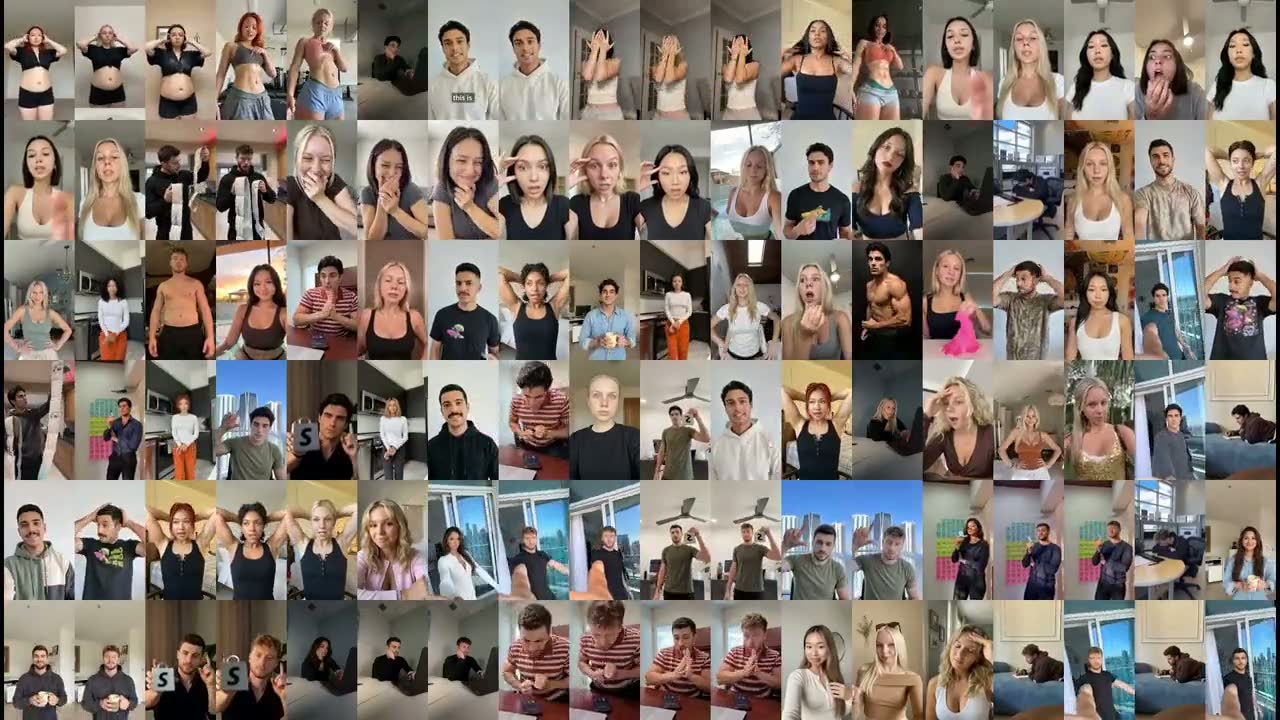
Monclers is a workspace for creating AI-generated user-generated content at scale. The site calls it the operating system for AI UGC at scale — a single place where you can clone viral reactions onto AI avatars, spin up TikTok slideshows, edit the results in a timeline editor and schedule hundreds of posts. The stated promise is that all of this happens with no filming, no editing and no prompt engineering, which positions the product for creators and teams who need a high volume of short-form video across multiple TikTok accounts.
Monclers describes a specific problem it was built to solve: reposting the same clip gets flagged as duplicate. Its answer is the remix engine, which re-performs one viral reaction on different avatars, rooms and outfits, so every account posts something original and you can A/B test hooks at scale. The founders' note on the site explains the origin: they were running dozens of TikTok accounts by hand, posting the same hooks with different faces every single day, so they automated the whole pipeline and turned it into the tool they wished they had. The site also frames the broader problem as tool sprawl, arguing that most stacks staple together a dozen half-built tools while claiming that every capability in Monclers is built in-house and wired together.
The remix engine starts from the inspiration library, described as 10,000+ viral reactions that have already been analyzed. Every clip is tagged by AI for niche, emotion, hook and on-screen text. Niches listed on the site include Fitness, Beauty, SaaS, Finance, Education, Food, Gaming, Wellness, Fashion, Productivity, Pets and Travel, while the emotion tags include Shocked, Mind blown, Laughing, Disbelief, Excited, Cringe, Proud and Relieved. Users can favorite and filter clips, turn any of them into a template in one click, or paste any TikTok link to import it as a template. The site also notes that you can import your own content from TikTok, Instagram and YouTube.
From there, the UGC Reactions tool clones any viral reaction onto your avatars using motion-control video models. The interface shown on the site offers 720p and 1080p output, a batch of four so you can generate several versions and pick the best, and free retries on failures. AI Avatars let you either upload a selfie or design a character with AI, with the promise of consistent faces and endless scenes. In the three-step workflow, casting an avatar means uploading one photo or designing a character, after which the avatar re-performs the reaction with the same timing and energy but a new face and a new room.
The slideshow engine targets what the site calls TikTok's easiest format to scale. You can paste any viral carousel or simply type a topic, and an AI director writes the slides, picks the images and then hands you an editor for the final five percent. In the example workflow shown on the site, the system reads seven slides with vision OCR, rewrites hooks for your brand, finds on-aesthetic backgrounds and produces seven ready slides that you can export or post. The shorter feature description notes that pasting a viral carousel gives you a remix with hooks, fonts and on-aesthetic images.
Once assets exist, the timeline editor handles trimming, splitting, adding text, music and voice changes, and a one-click make more action renders variations in a batch. Scheduling connects multiple TikTok accounts so you can fill a week of posts in under an hour, and the site shows a Monday-through-Sunday calendar view for that workflow. A brand reader lets you drop in your URL so the system learns your product, audience and voice, which is what allows slideshow hooks to be rewritten for your brand rather than a generic template.
Muse is the product's AI producer, described as your content team in one chat. You tell Muse what you want and it searches the library, reads your brand, creates avatars, writes slideshows and queues renders, asking before it spends a credit or running on autopilot within your limit. The site lists 20+ tools across every engine, approval cards or an auto mode with a spend cap, and the same agent available in Claude through MCP. The MCP integration means you can ask in a chat and have Claude drive your real workspace, announced on the site as NewMCP is live — create straight from Claude.
Monclers frames itself as two engines, eight tools and one pipeline, emphasizing that a hook you find becomes a posted video without a single export. The workspace provides access to multiple frontier models under the line that every frontier model is ready to go; the site names Veo 3.1, Kling 3 Motion Control, Seedance 2.0, Nano Banana, GPT Image, MiniMax Hailuo, Wan Animate, PixVerse, Grok Imagine, Whisper and Kling 2.6. Motion-control models render in minutes, and the site states that failures are refunded.
Stated benefits center on volume, originality and cost. The remix engine means every account can post something original while you A/B test hooks at scale. The site cites 20+ posts per month per workspace, 10,000+ analyzed viral reactions to start from, and millions of lifetime views generated. On output quality, the FAQ says outputs are tuned for short-form with real-room lighting, natural motion and native-feeling captions, so they read as creator content rather than AI slop — the site's own phrase for the alternative. On cost, a comparison table puts a typical patchwork stack at $250+ per month plus a lot of glue against Monclers from $49.
Concrete scenarios the site describes include running dozens of TikTok accounts with the same hooks and different faces, filling a week of posts across multiple TikTok accounts in under an hour, generating a four-variant batch of a reaction and choosing the best take, turning a viral carousel into a branded slideshow with rewritten hooks, testing hooks by re-performing one reaction on different avatars, rooms and outfits, and creating content directly from a Claude chat via MCP. Teams that run separate niches can divide them across multiple workspaces.
Pricing has three tiers. Starter is $49 per month with 300 credits, one workspace, unlimited slideshows and variants, reaction library access, posting and scheduling and the Muse agent, with extra credits at $0.16. Pro is $79 for the first month at 20% off, then $99 per month, with 700 credits, five workspaces to separate niches and extra credits at $0.14. Agency is $159 for the first month at 20% off, then $199 per month, with 1,700 credits, ten workspaces and extra credits at $0.12. Teams and credits capabilities include shared workspaces, invite links and one credit pool. Credit use varies by model and settings, purchased credits never expire, prices are in USD excluding taxes, and you can cancel anytime with no contracts or fees. The site notes the product was built by two senior engineers.
In summary, Monclers bundles reaction cloning, AI avatars, slideshow generation, a timeline editor, TikTok scheduling, a brand reader and an agent into one pipeline, aiming to replace a patchwork of apps, freelancers and spreadsheets with a single workspace for running AI UGC at scale.
Publisher
A
admin
Launch Date2026-11-11
Platformweb
Pricingpaid
Tech Stack
#MCP#Claude#Veo 3.1#Kling 3 Motion Control#Seedance 2.0#Nano Banana