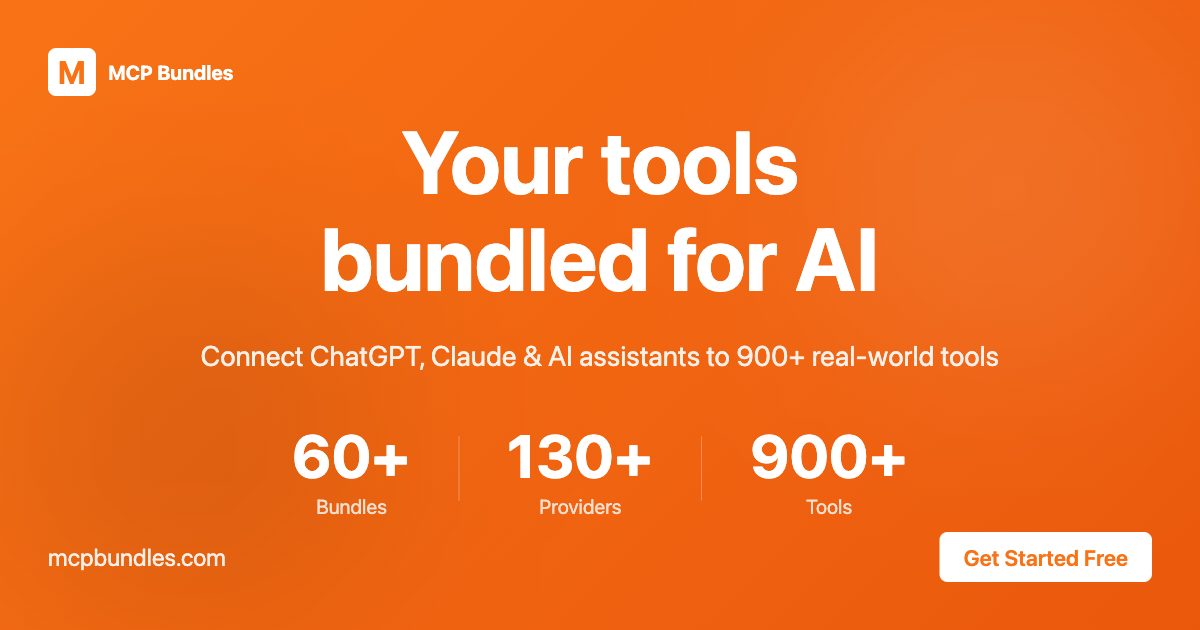
MCP Bundles provides cloud-hosted tool bundles that solve the "many tool" problem for AI workflows. It offers centralized OAuth/API key management, permissions control, and full observability with tool-call history across 500+ integrations.
MCP Bundles is a cloud-hosted platform that provides pre-configured bundles of tools specifically designed to streamline and enhance AI workflows. It targets developers, AI engineers, and teams building AI applications who are overwhelmed by the complexity of managing numerous individual tools and API integrations. The core value proposition of MCP Bundles is solving the 'many tool' problem by offering a centralized, managed service that aggregates over 500 integrations into cohesive, easy-to-use bundles. This approach allows users to focus on building their AI applications rather than on the tedious setup, security, and maintenance of disparate tooling. By bundling tools for AI, the platform significantly reduces integration overhead and operational complexity.
The primary problem MCP Bundles addresses is the fragmented and inefficient nature of modern AI development, where engineers must manually connect, secure, and monitor a vast array of APIs and services. This 'many tool' problem leads to significant time spent on configuration, increased security risks from scattered API keys, and a lack of visibility into how tools are being used across workflows. For teams, this fragmentation hampers collaboration, complicates permission management, and makes it difficult to maintain consistency and observability. MCP Bundles matters because it directly reduces this friction, enabling faster development cycles, stronger security postures, and better operational control. It turns a chaotic collection of point solutions into a unified, manageable resource.
A first major feature group is centralized OAuth and API key management. The platform acts as a secure vault where all credentials for the integrated tools are stored and managed in one place. This eliminates the need for developers to handle API keys within their application code or environment variables, drastically reducing the risk of key exposure or leakage. The system manages the authentication flows, including OAuth handshakes, and provides a single point of control for credential rotation and access revocation. This centralized approach is crucial for security and compliance, as it ensures that sensitive keys are not scattered across different services or developer machines. It simplifies onboarding for new team members and standardizes how the entire organization connects to external services.
The second major feature group is granular permissions control and access management. MCP Bundles allows administrators to define precisely which tools and capabilities within a bundle each user or role can access. This fine-grained control ensures that developers only have the permissions necessary for their work, adhering to the principle of least privilege. Teams can manage access at the level of individual tools or entire bundles, streamlining the process of granting and revoking access as projects evolve or team members change. This feature is essential for larger organizations or projects with multiple stakeholders, as it provides governance and security oversight without hindering developer productivity. It centralizes what would otherwise be a disparate set of access controls across dozens of separate services.
Publisher
A
admin
Launch Date2025-12-19
Platformweb
Pricingfreemium
Tech Stack
#MCP#OAuth#API