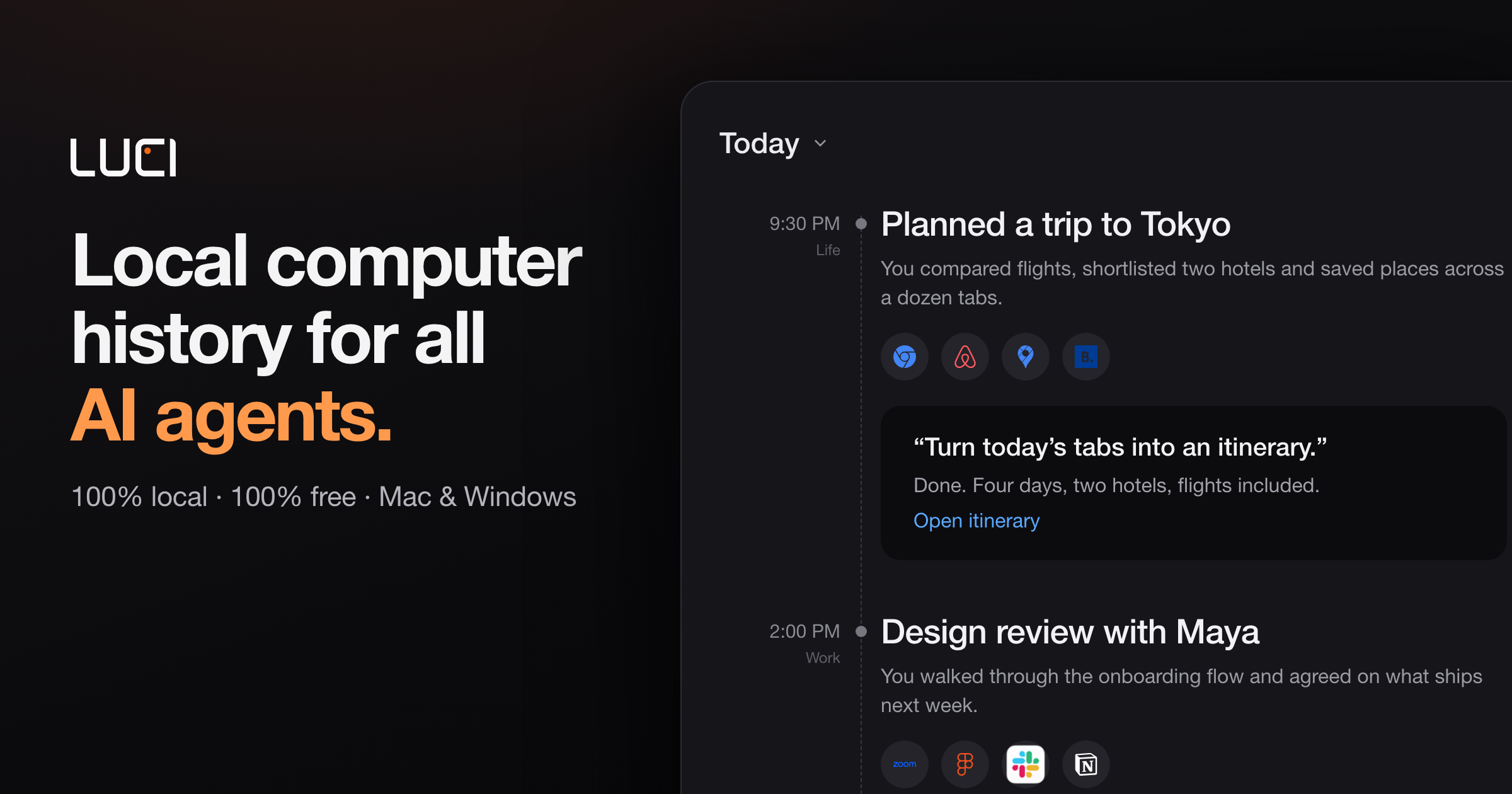
LUCI is a desktop memory layer for your computer. It remembers your whole day — meetings, code, email, and everything in between — and makes that memory available to the AI agents you already run, including Claude Code, Cursor, Codex, and Gemini. Instead of re-explaining what you were doing every time you ask an agent for help, you get one memory across everything you touch. LUCI is free, runs on Mac and Windows, and is built for anyone whose day does not fit in a chat window: developers, founders, researchers, consultants, designers, and support and operations teams. Everything it remembers is processed and stored on your own machine.
The problem LUCI exists to solve is context loss. AI agents are powerful inside a single session, but they start each new conversation without any idea of what you were looking at five minutes ago, what was decided on a call this morning, or which file you were reading last week. The usual workaround is to copy, paste, and explain — dropping error traces and design specs into an editor, or reconstructing decisions from scattered calls and threads. Connector-based tools only deepen the problem: they require OAuth, API keys, and per-app configuration, and they still miss internal tools and private documents. Context windows reset between sessions, so the knowledge you build up evaporates. LUCI's answer is to remember on your behalf, locally, and then hand that memory to whichever agent you ask.
LUCI's first capability group is capture and chronology. LUCI reads directly from your screen and your calls, which means there are no OAuth flows, no API keys, and nothing to configure: every app you open is already supported, including internal tools and private documents that connectors cannot reach. Chrome, Gmail, Slack, Notion, Linear, Figma, Zoom, Google Meet, Microsoft Teams, YouTube, Discord, and coding agents such as Codex, Cline, Amp, and opencode all fall inside the same record. Because capture is continuous, chronology emerges naturally: your day is laid out end to end, so you can walk back to any moment instead of trying to remember it. Day reports show the shape of that day — active capture hours, sample counts, and the time blocks where work actually happened — alongside the meetings, people, projects, organizations, and rules attached to it.
Visual memory is the second piece. LUCI reads and understands what is on your screen on your device, and keeps it findable afterwards. You do not have to have bookmarked a page or saved a file: if you saw it, LUCI can bring it back. Search and insights sit on top of that record. You can ask in plain English across both screen content and meetings — describing something the way you would to a colleague — and answer questions not only about what you saw but about where the day actually went. That combination turns scattered fragments of a working day into something queryable.
The third group covers meetings and written output. Voice and transcripts capture every word — yours and theirs — in meetings and calls, with on-device transcription, attached to the day it happened. That means you never take manual notes, and the record of a call sits alongside the screens you were looking at while it happened. From there, distillation takes over: your agent turns the raw day into a short written record and files it in your Life folder. Daily summaries are produced with Microsoft Foundry Local. The Life folder is plain files in a folder rather than a proprietary silo — a record that outlives any single app, including LUCI itself.
The fourth group is the local model and privacy layer. Local models — Phi, Qwen, Llama, and DeepSeek — power the understanding of your day; you pick one, switch whenever you like, and your memory stays exactly where it is. Zero-leak redaction runs before anything is saved: cards, keys, and passwords are blacked out so secrets never enter the record. Everything LUCI remembers lives on your machine encrypted at rest, with no cloud copy, and retention is yours to set — keep a week, keep a year, and deleting a day removes it entirely. Agent Bridge ties this to the agents: LUCI connects itself to Claude Code, Cursor, Codex, Gemini, Copilot, Windsurf, Zed, opencode, Amp, Cline, Kilo Code, Warp, VS Code, and Grok, with nothing to set up and no per-agent configuration to keep in sync.
Overall, LUCI works by moving memory out of the session and into your machine. Rather than building a connector for every tool, it reads from the screen and the microphone, so coverage is universal by construction. On-device understanding converts that raw material into something structured: days, transcripts, and distilled reports. Then Agent Bridge exposes it to your agents, which query LUCI instead of asking you to re-explain. Add a new agent tomorrow and your memory is already there. The result is a single, persistent, private record that any assistant can draw on.
The benefits show up in the small frictions that disappear. A staff engineer stops copy-pasting error traces and Figma specs into Cursor, because the agent queries LUCI for what was on screen five minutes ago and gets straight to work. A head of product no longer spends Friday afternoons reconstructing decisions from scattered calls and threads, because the week is distilled into the project log in seconds. A founder ends each evening with an honest summary of where the time actually went. A principal AI engineer can recall why a specific architecture pattern was chosen three weeks ago, even though context windows reset between sessions. A solutions director gets every client call captured and organized without manual notes, so a proposal draft can pull the exact constraints the client mentioned. And for security teams, redaction plus local indexing makes sign-off frictionless — LUCI is GDPR compliant and SOC 2 Type 2 certified.
The use cases LUCI highlights are the things you would ask on day one. Ask about your screen: whatever is in front of you becomes answerable, so you can resolve 'this' and 'that' across sessions and jump straight to the right source. Catch up on a call: every word, yours and theirs, is captured without you taking notes. Recap your week: your agent distills the day into plain files in your Life folder, giving an honest picture of where the week went. Search what you saw: describe a reference you scrolled past on Tuesday and find it again on Friday — a page you forgot to bookmark, a decision from a call, a half-remembered document still findable weeks later.
LUCI is built for developers, founders, researchers, consultants, designers, and support and operations teams — anyone who would rather not copy, paste, and explain what they were doing every time they ask an agent for help. It runs on Mac and Windows, and it is free and fully local. Supported agents include Claude Code, Cursor, Codex, Gemini, Copilot, Windsurf, Zed, opencode, Amp, Cline, Kilo Code, Warp, VS Code, and Grok, with any agent you install next expected to connect through the same bridge. Data lives encrypted on your disk, on-device understanding keeps processing local, and your Life folder is plain files you control.
LUCI's core promise is simple: your whole day on the computer, remembered on your machine, and handed to whichever agent you ask. It removes the work of carrying context between sessions while keeping the memory yours — local, redacted, encrypted, and portable as plain files.
Publisher
A
admin
Launch Date2026-09-30
Platformdesktop
Pricingfree
Tech Stack
#Microsoft Foundry Local#Phi#Qwen#Llama#DeepSeek