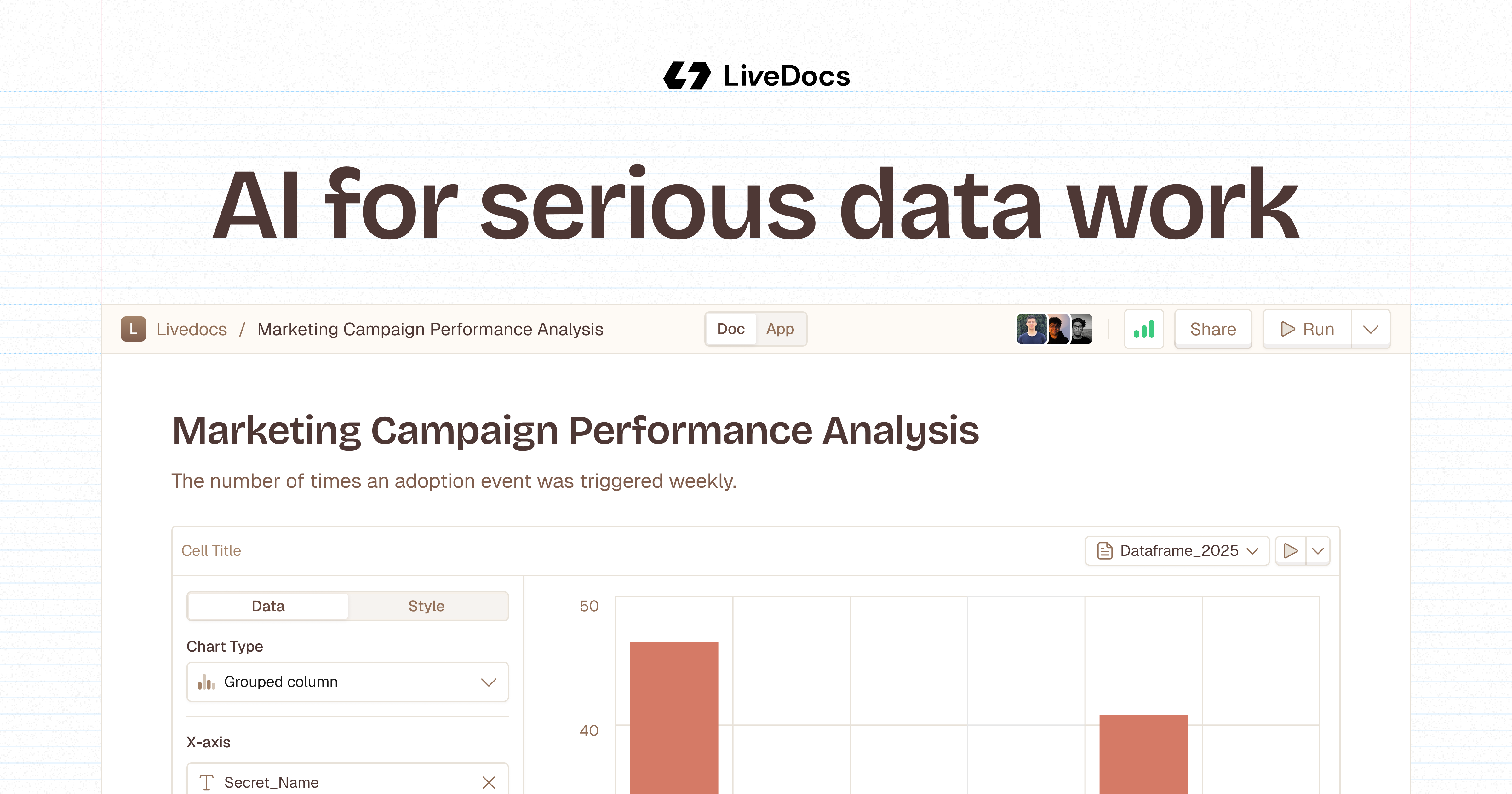
Livedocs is an advanced AI agent for data analysis designed to transform raw data into actionable insights within seconds. This powerful tool operates within the category of collaborative data workspaces, specifically targeting modern teams that need to move from data questions to results rapidly. Its core value lies in eliminating the traditional barriers of complex data analysis by providing an intuitive interface where users can simply ask questions and receive comprehensive answers, charts, and metrics. By functioning as an AI-driven analyst, Livedocs democratizes data access, allowing team members across various functions to engage with data without requiring deep technical expertise in programming or statistical software. The platform's integration of notebooks and app builders creates a unified environment where analysis and application development converge, fostering a more iterative and productive workflow for data-driven projects.
A primary pain point Livedocs addresses is the time-consuming and technically demanding nature of conventional data analysis. Many professionals and teams struggle with lengthy processes involving data cleaning, query writing, statistical computation, and visualization, which often require specialized skills in tools like SQL, Python, or Excel. This bottleneck delays decision-making and prevents organizations from leveraging their data assets effectively. Livedocs directly tackles this by automating these complex steps, enabling users to go from a raw data file or connected database to clear insights and visualizations in moments. The significance of this solution is profound for business agility, as it allows teams to test hypotheses, monitor performance, and uncover opportunities at the speed of thought, rather than being hindered by technical debt or resource constraints associated with traditional data workflows.
One of the platform's major feature groups is its instant AI-powered analysis and insight generation. When a user uploads a CSV, spreadsheet, or connects a live database, they can pose questions in plain English, and Livedocs processes the request to produce relevant charts, key metrics, and narrative explanations. This feature works by interpreting the user's intent, understanding the structure and content of the provided data, and then executing the necessary analytical operations—such as trend identification, segmentation, or forecasting—in the background. The utility is immense because it translates complex data patterns into digestible, plain-English summaries and visual representations, making the findings accessible to stakeholders regardless of their analytical background. This capability effectively replaces the need for manual coding or formula writing, accelerating the insight discovery cycle dramatically.
admin
A second critical feature group is the collaborative workspace that integrates notebooks with app builders. This environment allows teams to not only conduct analyses but also build interactive applications, dashboards, and data pipelines based on those analyses. The workspace supports real-time collaboration, where multiple users can work on the same data project, comment on findings, and iterate on models or visualizations. The terminology 'notebooks' refers to dynamic documents that combine code, visualizations, and narrative text, similar to Jupyter notebooks but more accessible, while 'app builders' enable the creation of custom interfaces and automated workflows without extensive development. This integration is useful because it closes the loop between analysis and action; insights derived in a notebook can be immediately operationalized into a dashboard for ongoing monitoring or an internal tool for other teams, ensuring that data work translates directly into business value.
Additional capabilities prominently featured include a wide array of specific analytical functions showcased as inspiration use cases. These encompass sales trend analysis, customer segmentation, revenue forecasting, data cleaning pipelines, SQL query generation, interactive dashboard building, churn prediction, A/B test analysis, cohort analysis, data merging, anomaly detection, time series analysis, marketing ROI measurement, inventory optimization, customer lifetime value calculation, price elasticity studies, financial ratio analysis, supply chain analytics, social media analytics, and website traffic analysis. The platform also supports connecting to various data sources, implying integration with common databases and file formats. This extensive suite of pre-built analytical templates and functions means users can tackle diverse business questions without starting from scratch, applying proven methodologies to their specific datasets with minimal configuration.
The overall workflow of Livedocs follows a streamlined, user-centric methodology. It begins with data ingestion, where users add their files—such as CSVs and spreadsheets—or connect directly to external data sources like databases. Once data is loaded, the user interacts primarily through a conversational interface or by selecting from predefined analysis templates. The AI agent then takes over, handling the technical execution which may involve data cleaning, statistical computation, and visualization generation. The results are presented in an interactive format within the collaborative workspace, where they can be refined, shared, or used as the foundation for building applications. This approach abstracts away the underlying complexity of data engineering and statistical programming, presenting a cohesive experience where the focus remains on the question and the answer, not the intermediary steps of query syntax or chart configuration.
Concrete use cases illustrate the practical application and outcomes. For sales trend analysis, a user can upload quarterly sales data to instantly identify growth patterns and opportunities, leading to targeted strategic adjustments. In customer segmentation, behavioral and transactional data can be analyzed to segment customers by lifetime value and engagement, enabling personalized marketing campaigns. Revenue forecasting allows finance teams to predict next quarter's performance using historical trends, supporting more accurate budgeting. A data cleaning pipeline use case involves standardizing messy datasets, saving analysts hours of manual work and ensuring data quality for downstream analysis. Building an interactive dashboard enables managers to create a comprehensive view of KPIs and charts for real-time performance monitoring. Each scenario demonstrates how Livedocs delivers specific, valuable outcomes—from uncovering insights to creating operational tools—directly from raw data inputs.
The target audience includes modern teams across functions such as sales, marketing, customer analytics, product, and finance, as indicated by the category filters on the website. Specific roles likely to benefit are business analysts, data analysts, marketing managers, product managers, sales operations specialists, and finance professionals who need to conduct data analysis but may lack extensive coding skills. The platform is a web-based application, accessible through a browser, emphasizing ease of start-up with no credit card required for the free tier. While explicit tech stack details are not provided, its ability to analyze CSVs, spreadsheets, and databases suggests compatibility with common data formats and potential integrations. The core takeaway is that Livedocs empowers these teams with data superpowers, transforming complex data work into a fast, collaborative, and actionable process that drives informed decision-making and operational efficiency.
Livedocs is designed for modern teams and professionals who need to conduct data analysis but seek to avoid complex, code-heavy tools. This includes business analysts, data analysts, marketing managers, product managers, sales operations specialists, and finance professionals in small to medium-sized teams. It specifically targets users in functions like sales, marketing, customer analytics, and product, as indicated by the platform's category filters, who require fast, collaborative, and actionable insights from their data without deep programming expertise.