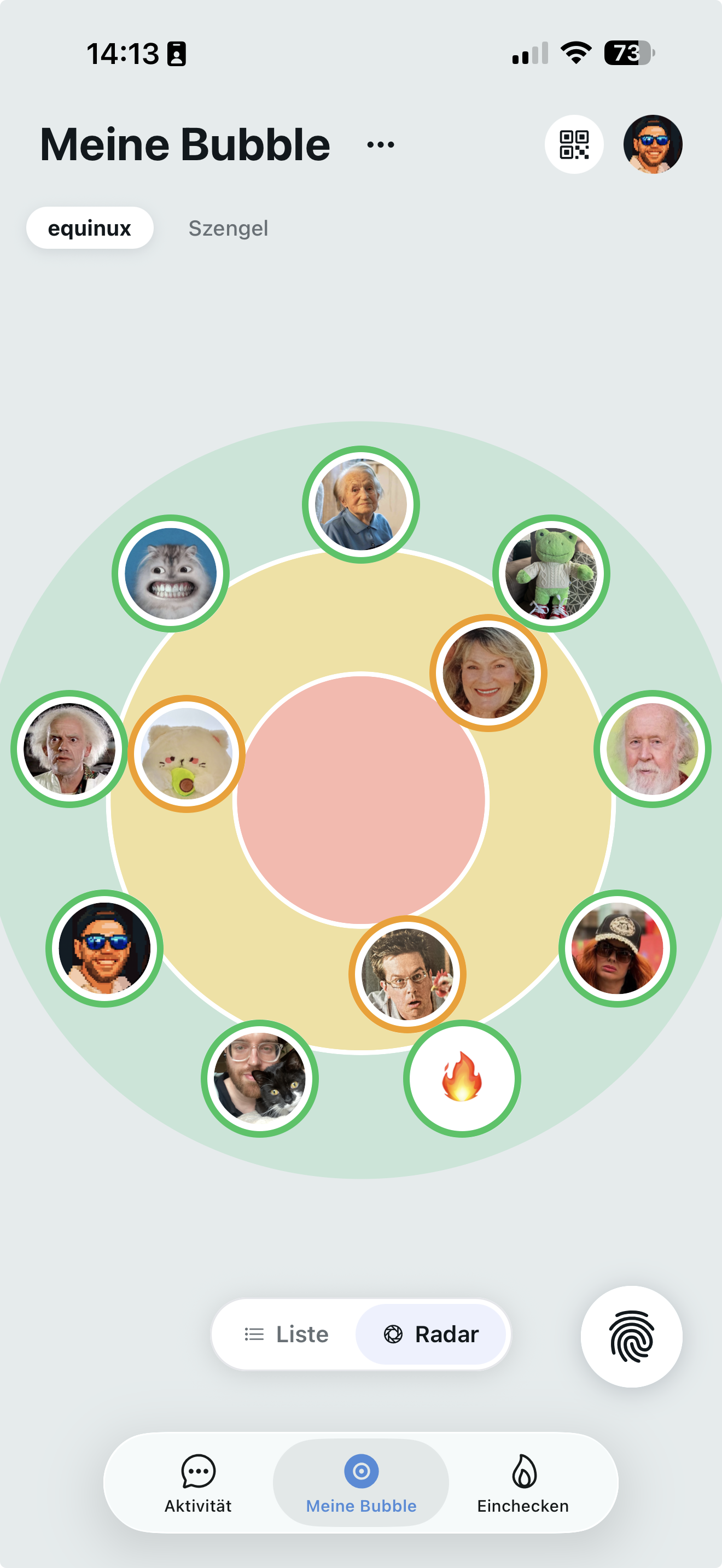
Knuff is a family check-in app built to make it easy to see how the people around you are doing, even when life gets busy. It is available for iPhone and iPad with iOS 16 or later as well as Android smartphones, and the website says it is for families and friend groups of all ages. Inside the app you create a bubble with your most important people — family, close friends, or neighbors — and share quick check-ins so everyone stays connected wherever life takes you. Knuff was developed to bring people closer together and give them a good feeling in everyday life, whether between grandparents, children, parents, partners, or friends.
The problem Knuff addresses is the everyday uncertainty of not knowing whether the people you care about are okay. Traditionally, that means sending messages, making calls, or starting conversations just to confirm that everything is fine — small interactions that add up and sometimes feel like an obligation. Knuff frames its check-in as an answer to exactly that: no more messages, no more calls, just choose a Knuffling, check in, and you are done. The app turns reassurance into a single tap, so everyone in the group stays up to date and can react if someone does not check in as usual. Knuff is not positioned as a replacement for messengers; its FAQ states that it complements existing messengers such as WhatsApp or iMessage. The focus is on knowing how people in your bubble are doing and being informed when someone has been inactive for a long time.
Bubbles are the organising principle of Knuff. You can create separate bubbles for family, close friends, or neighbors, and within each bubble every member can see each other's check-in status. The website describes this as private, simple, and reassuring. Privacy is scoped by bubble: your check-ins are always limited to the bubble where they were created, and only members of that bubble can see them, while other bubbles have no access. You do not choose individual recipients for each check-in — instead, a check-in is shared with all members of the bubble it was posted in. To control who receives which check-ins, you create additional bubbles, so each one acts as its own separate group. A bubble is automatically deleted when the last member leaves it.
Checking in is deliberately minimal. You tap the hand button in the Knuff bubble or in the Knuff chat, select a Knuffling — one of the little figures that make the process more personal — indicate how you feel, and check in. From there you can optionally expand the check-in with whether you feel good or bad, a personal message, an uploaded photo or video, a picture taken directly through the camera, a voice message, a poll for your group, or your current location. How much you share is up to you. The bubble map then shows at a glance how current each member's check-in is: whoever has just checked in stays outside in the green area, while a member whose last check-in was a long time ago moves further toward the center and the red area. Bubble themes, such as the Sardegna theme shown on the website, let you customise the look of your bubble, and the app also shows member details and reactions.
Alongside check-ins, Knuff includes a chat where you can discuss, share pictures, upload videos, and simply stay in good contact with your loved ones. Inviting people happens from inside a bubble: you tap the plus symbol, and people who are with you can scan the avocado to join, or you can invite others by email, WhatsApp, and other channels. Because every bubble is a closed group, the check-ins and shared content stay with the people you chose. The website also highlights that Knuff is international, with an interface available in a long list of languages including English, German, Spanish, French, Italian, Japanese, Korean, Portuguese, Russian, Turkish, Chinese, Arabic, Hindi, and many more, plus a random-language option for trying something new.
Knuff's commercial approach is unusual for a mobile app: there are no subscriptions. Core features are free for you and everyone in your bubble. Extras are bought from the Knuff Shop — additional Knufflings, bubble designs, or features that everyone in the bubble can then use — as simple one-time purchases. Features are also made available through Passes with a fixed validity period: a Pass expires automatically, nothing renews without your explicit confirmation, and you are only charged for another Pass when you confirm the purchase yourself. You can extend a Pass at any time, even before it expires, and the additional time is added in full to the current Pass. The Bubble Store lets you expand a bubble with surveys, appointment scheduling, location sharing, or longer video clips; these packs are activated for the entire bubble so all members can use them, they apply only to the bubble where they were purchased or unlocked, and any member of a bubble can sponsor a pack or contribute to unlocking one. Knufflings can be purchased individually and given as gifts, and after purchase they are available in all bubbles without a time limit. Knuff is built in Munich, Germany, by a small independent team, and the website states that data stays entirely in Germany in the team's own German data center — not with US providers like AWS, Google, or Microsoft.
The benefit Knuff promises is reassurance without friction. Instead of chasing updates through messages and calls, families and friends get a continuous, low-effort signal that everyone is okay, and they are alerted when someone has been inactive for a long time, so they can react if needed. Because check-ins can carry a feeling, a message, a photo, a video, a voice note, a poll, or a location, they can be as light or as personal as the situation requires. The bubble map makes the state of the group readable at a glance, and the privacy model means that openness inside a group of trusted people does not spill over into other groups. For people who want to stay close without constant conversation, that combination — visible status, simple check-ins, and a private-by-bubble design — is the core value.
Knuff's website illustrates its use through a network of example people. A 68-year-old grandmother who lives alone and is recovering from hip surgery values her independence and likes staying connected to family life through small updates. Grandparents living abroad keep in touch with their grandchildren from afar through photos and video clips. A busy mother of three who works from home uses Knuff to know her children are okay and to stay connected with colleagues during the day. A pilot who is often far from home shows his partner where he is and gives her a glimpse of his day without sending a message or starting a conversation, and uses a dedicated bubble to let his football friends know when he is ready for a match. A 19-year-old who has just moved to a new city for university keeps in touch with family and roommates. A 15-year-old checks in quickly when out with friends in the evening, with or without sharing his location. And a child who has started going to school alone reassures her parents by checking in as soon as she arrives.
Knuff is aimed at families and friend groups of all ages — grandparents, parents, partners, children, roommates, and hobby groups such as a football team or school friends — and the app is explicitly built for people who care. It is available on the App Store and Google Play, requires iPhone or iPad with iOS 16 or later, and runs on Android smartphones. All core functionality is free; optional extras are bought in the Knuff Shop, and features can be unlocked for a whole bubble through the Bubble Store, either by purchase or by sponsorship. Accounts and bubbles can be managed in the app, where deleting an account is done from the head icon in the top right, then your name, then delete account.
Overall, Knuff's value proposition is simple and warm: a private bubble, one tap to check in, and a clear view of how your people are doing — with free core features, no subscriptions, and data kept in Germany.
Publisher
A
admin
Launch Date2026-10-08
Platformmobile
Pricingfreemium