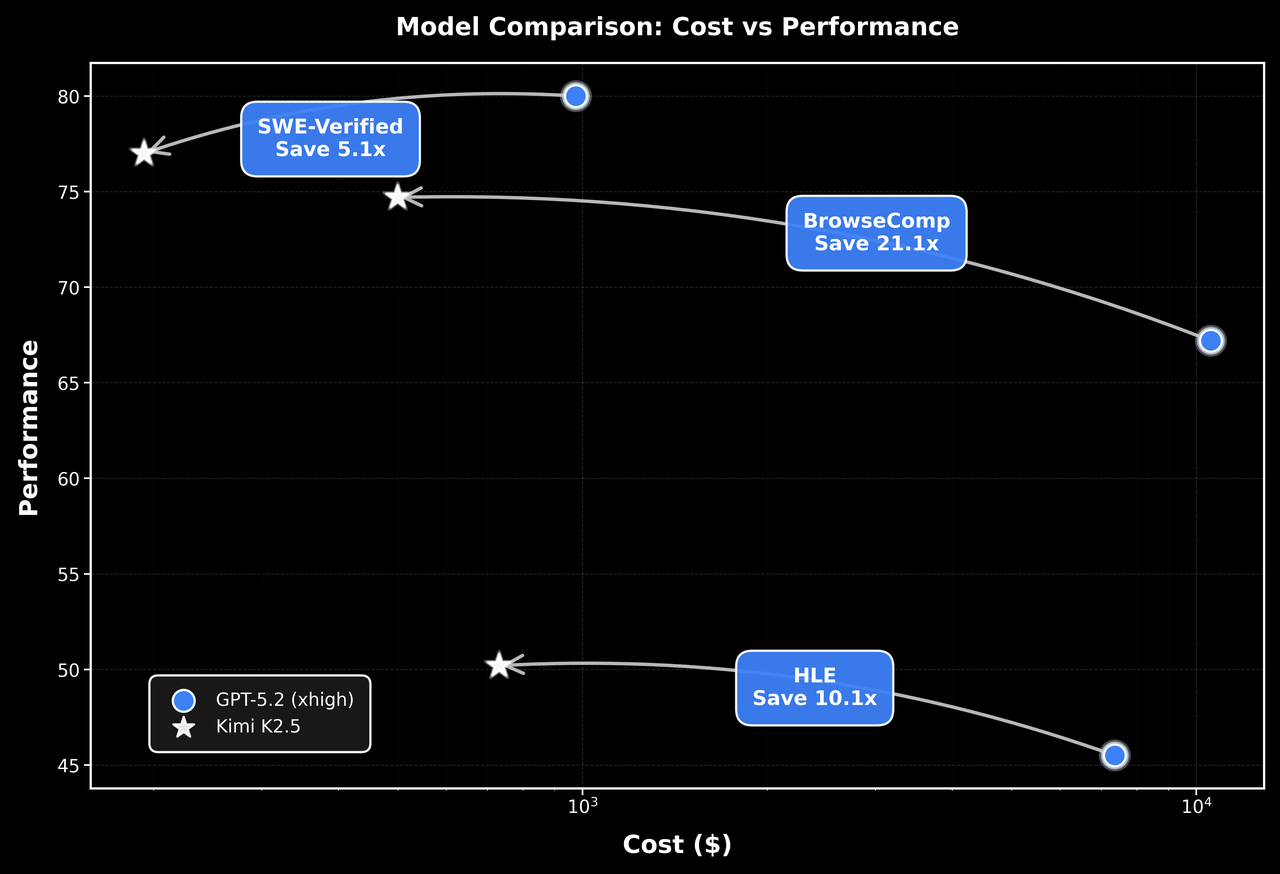
Kimi K2.5 is a groundbreaking open-source multimodal AI model that embodies visual agentic intelligence, setting new benchmarks in both coding and vision domains. Built upon continued pretraining on approximately 15 trillion mixed visual and text tokens, it delivers state-of-the-art performance across agentic, coding, and image understanding benchmarks. Designed for developers, researchers, and knowledge workers, its core value lies in self-directing an agent swarm of up to 100 sub-agents capable of executing up to 1,500 parallel tool calls, slashing execution time by up to 4.5× compared to single-agent approaches. Available via Kimi.com, the Kimi App, API, and Kimi Code, it introduces four interaction modes including K2.5 Instant, Thinking, Agent, and the beta Agent Swarm, making powerful agentic intelligence accessible for real-world tasks.
Kimi K2.5 directly tackles the pain point of executing complex, multi-step tasks that traditionally require tedious sequential processing and manual orchestration. In fields like software engineering, data analysis, and document production, users often spend hours coordinating multiple tools and data sources, leading to high latency and reduced throughput. The model's agent swarm architecture overcomes this by decomposing tasks into parallelizable subtasks, automatically assigning them to dynamically created sub-agents. This approach mitigates the common failure mode of serial collapse, where agents default to sequential execution. By emphasizing critical path reduction through a staged reward shaping mechanism, K2.5 ensures that parallelism genuinely shortens completion time, enabling users to achieve results up to 4.5 times faster on intricate tasks such as wide search, code debugging, and comprehensive report generation.
Kimi K2.5's first major feature group, Coding with Vision, revolutionizes how users translate visual ideas into functional code. By leveraging massive-scale vision-text joint pre-training, the model can parse a single image or video prompt and generate complete front-end interfaces with interactive layouts and rich animations, such as scroll-triggered effects. This capability directly addresses the difficulty of articulating design intent through text alone, allowing users to simply show a reference or describe a visual concept to produce production-ready code. Additionally, K2.5 excels at visual debugging by inspecting its own output through visual inputs and documentation lookup, enabling autonomous iteration until the desired result is achieved. The model's coding prowess is validated by the Kimi Code Bench, an internal benchmark spanning building, debugging, refactoring, testing, and scripting across multiple languages, where K2.5 shows consistent improvements over its predecessor K2. For software engineering teams, pairing K2.5 with Kimi Code, an open-source terminal and IDE-integrated coding agent that also accepts image and video inputs, unlocks a seamless workflow from concept to deployment.
admin
The Agent Swarm feature embodies a paradigm shift from scaling up to scaling out, enabling self-directed orchestration of up to 100 specialized sub-agents. Built on Parallel-Agent Reinforcement Learning (PARL), K2.5 learns to act as a trainable orchestrator that decomposes complex tasks into parallelizable subtasks, dynamically instantiating frozen sub-agents for each subtask. This approach eliminates the need for predefined roles or hand-crafted workflows, adapting in real time to task demands. To combat common training challenges like serial collapse and spurious parallelism, PARL employs staged reward shaping that initially encourages parallel exploration and later focuses on task success. Performance is measured using Critical Steps, a latency-oriented metric inspired by critical path analysis, ensuring that parallelism genuinely reduces wall-clock time. In internal evaluations, the Agent Swarm achieves up to an 80% reduction in end-to-end runtime compared to single-agent execution on tasks like wide search and complex research, setting a new standard for agentic efficiency.
Kimi K2.5 significantly boosts office productivity by serving as an end-to-end agent for high-density knowledge work. It can process large, complex inputs and coordinate multi-step tool use to produce expert-level outputs including documents, spreadsheets, PDFs, and slide decks directly through conversation. Advanced capabilities include adding annotations in Word, constructing financial models with Pivot Tables, and writing LaTeX equations in PDFs, scaling to outputs as large as 10,000-word papers or 100-page documents. The model is evaluated on two internal expert productivity benchmarks: the AI Office Benchmark, which assesses end-to-end Office output quality, and the General Agent Benchmark, which measures production-grade workflows against human expert performance. On these benchmarks, K2.5 achieves 59.3% and 24.3% improvements over the previous K2 Thinking model, demonstrating its superior ability to handle real-world professional tasks. This feature transforms hours-long manual processes into minutes-long automated workflows, making it invaluable for analysts, researchers, and business professionals.
Kimi K2.5 operates as a native multimodal foundation model, integrating vision and text processing from the ground up through continued pretraining on an unprecedented scale of 15 trillion tokens. Its workflows are driven by agentic intelligence: users can engage via four distinct modes—Instant for quick tasks, Thinking for deep reasoning, Agent for multi-step tool use, and Agent Swarm for highly parallel execution. The model's methodology centers on a reinforcement learning framework that trains an orchestrator to dynamically decompose tasks, parallelize subtasks, and coordinate up to 100 sub-agents without predefined scripts. Each sub-agent is a frozen execution unit focused on a specific subtask, allowing the orchestrator to adapt strategies based on real-time feedback. This approach is complemented by visual capabilities that enable the model to inspect visual outputs and iterate autonomously, as demonstrated in the autonomous visual debugging example where K2.5 created an art-inspired webpage by refining its own code.
Real-world use cases demonstrate Kimi K2.5's transformative impact across diverse domains. In one example, the Agent Swarm autonomously researched 100 niche domains to identify the top three YouTube creators per niche, creating 100 parallel sub-agents that conducted searches and aggregated results into a structured spreadsheet, a task that would be prohibitively time-consuming sequentially. In coding, the model solved a complex maze pathfinding problem by analyzing the image, implementing BFS and A* algorithms, and visualizing the shortest path, all through conversational interaction. For creative development, it translated a video of a website design into functional code, showcasing its ability to reconstruct interfaces from visual references. On the productivity front, users can generate 10,000-word research papers or construct financial models with pivot tables in minutes, dramatically reducing the time from idea to polished output. These scenarios highlight how K2.5 turns high-effort, multi-step projects into efficient, automated workflows delivering expert-quality results.
Kimi K2.5 is designed for developers, researchers, and knowledge workers who demand cutting-edge AI performance in real-world applications. It is accessible through multiple platforms: the web-based Kimi.com, the Kimi mobile App, a REST API for custom integrations, and Kimi Code, an open-source terminal agent that integrates with popular IDEs like VSCode, Cursor, and Zed. The model is available under open-source license, promoting transparency and community adoption. In terms of pricing, Kimi offers free credits for high-tier paid users on the Agent Swarm beta, lowering the barrier to advanced parallel execution. Technologically, K2.5 builds on a transformer architecture optimized for vision-language tasks, using reinforcement learning with parallel agent training to achieve its capabilities. In summary, Kimi K2.5 redefines the frontier of open-source AI by delivering visual agentic intelligence that combines state-of-the-art coding, vision, and scalable swarm execution, making it an indispensable tool for anyone seeking to accelerate complex knowledge work.
Target audience includes software engineers and front-end developers who need to generate and debug code using visual inputs, researchers requiring deep analysis and long-form document creation, data analysts building financial models, and knowledge workers such as business professionals automating repetitive office tasks. Early adopters include open-source AI enthusiasts and high-tier paid users on the Kimi platform, who receive free credits for the beta Agent Swarm feature. The model is also ideal for technical teams seeking scalable agentic AI to integrate into their workflows via the API or Kimi Code.