KidSense is a parenting companion built for the hard days of ADHD parenting. It does two things. First, it lets a parent ask Sage — an AI-powered parenting companion — for practical parenting guidance about one situation right now. Second, it lets that parent save Moments and feelings across seven days and beyond, so the individual moments build into a clearer picture and clearer next steps. KidSense is aimed at parents and families raising neurodivergent children, and it was built by an Australian dad. Its stated purpose is to help parents understand their child's behaviour, recognise patterns and feel more confident navigating everyday challenges.
The problem KidSense addresses is understanding. ADHD parenting involves everyday challenges that are difficult to make sense of in the moment, and a parent who is managing those challenges is often also trying to work out what is behind them. KidSense's approach is to serve both needs at once: practical guidance about a single situation now, and a saved record of Moments and feelings that accumulates over seven days and beyond so the parent can see a clearer picture instead of relying on memory or on how a single day felt. That combination — immediate help plus a longer view — is the core of what the product claims to do.
The first half of KidSense is Sage, described as an AI-powered parenting companion. Sage is designed to be asked for practical parenting guidance about one situation now — meaning the parent brings a specific, current situation rather than a general question about parenting theory, and the guidance offered is practical rather than abstract. Because it is positioned as a companion, it sits alongside the parent in the moment rather than replacing a clinician or a diagnosis. The stated benefit is that the parent does not have to wait for an appointment or sift through generic advice to get an answer to the situation directly in front of them. Sage is the part of KidSense that addresses the "now" in the product's own framing of parenting help now.
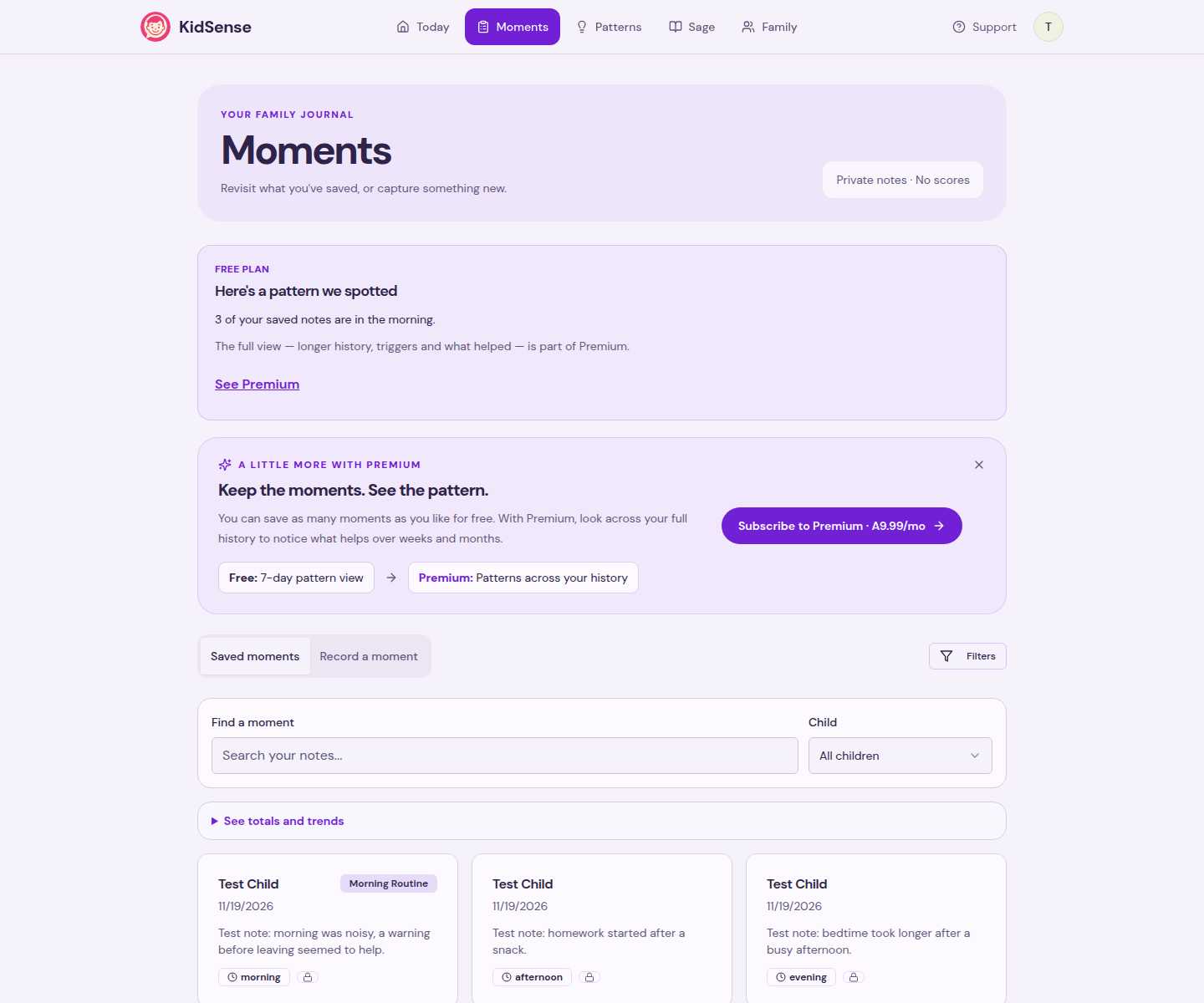
The second half of KidSense is the record. Parents can save Moments and feelings as they happen. A Moment is the event itself; the feelings saved alongside it are part of the same record. Saving both means the parent is not only noting what happened but also capturing how it felt at the time, which is exactly the kind of detail that is usually lost by the end of a difficult day. These saved Moments and feelings are kept across seven days and beyond, so the record becomes a reference the parent can return to rather than a one-off note that disappears. That saved history is what the product uses to move from a single incident to something closer to a picture.
Once Moments and feelings have been saved, KidSense is described as helping parents recognise patterns. The seven-day and beyond framing is what makes this possible: looking across a stretch of saved Moments gives a clearer picture than looking at a single incident, and that clearer picture is what the product points to as the basis for next steps. KidSense also lets parents build routines. Routines are listed alongside recording moments and getting guidance from Sage as one of the things the app supports, giving parents a way to put structure in place rather than only responding to what has already happened. Patterns and routines work together — the pattern shows what is recurring, and the routine is one way to respond to it.
Taken together, the two halves form a loop. A parent asks Sage about a situation now and gets practical guidance. The parent saves the Moment and the feelings around it. Over seven days and beyond, those saved entries accumulate into a clearer picture, and recognising patterns in that picture feeds into the next steps the parent takes and the routines they build. KidSense is therefore not only a chat interface and not only a journal: its unique approach is to pair instant guidance with a saved, ongoing record so that each side informs the other. The product is explicitly framed around neurodivergent children, with ADHD parenting named as the focus — it is not a general-purpose journal repurposed for families.
The outcomes KidSense states are understanding, recognition and confidence. Understanding your child's behaviour is the first: the product is framed around helping parents understand why behaviour happens, not just how to stop it. Recognising patterns is the second: saved Moments and feelings across seven days and beyond are what make that recognition possible. Feeling more confident navigating everyday challenges is the third, and it follows from the other two — a parent who understands the behaviour and can see the pattern is in a better position to decide next steps. The overall promise, in the product's own words, is that the challenging days of ADHD parenting become a little easier.
The concrete workflows described are straightforward. A parent facing one situation — a difficult moment happening now — asks Sage for practical guidance about that situation. They then save the Moment and the feelings attached to it. Over the following seven days and beyond, they add further Moments and feelings, and the accumulated record gives them a clearer picture and a sense of next steps. Alongside that, they build routines. For a parent raising a neurodivergent child who wants to understand their child's behaviour rather than only react to it, the combination of saved Moments and pattern recognition is the mechanism the product offers. Each of these workflows starts from something small and immediate, which is how the product is positioned.
KidSense is explicitly for parents and families raising neurodivergent children, with ADHD parenting named as the focus, and it was built by an Australian dad. That origin is stated as part of the product's positioning: it is made by a parent for parents in similar circumstances. On pricing, the stated offer is to start free; no further plan details are described in the available material. The product is available through the web and is set up to work as a mobile web app.
KidSense's value proposition is narrow and clear: parenting help now, and a clearer picture over time. By pairing Sage's practical guidance about a single situation with saved Moments and feelings that stretch across seven days and beyond, it gives parents raising neurodivergent children a way to understand behaviour, recognise patterns and build routines — and to feel more confident on the challenging days of ADHD parenting.
Publisher
A
admin
Launch Date2026-11-27
Platformweb
Pricingfree