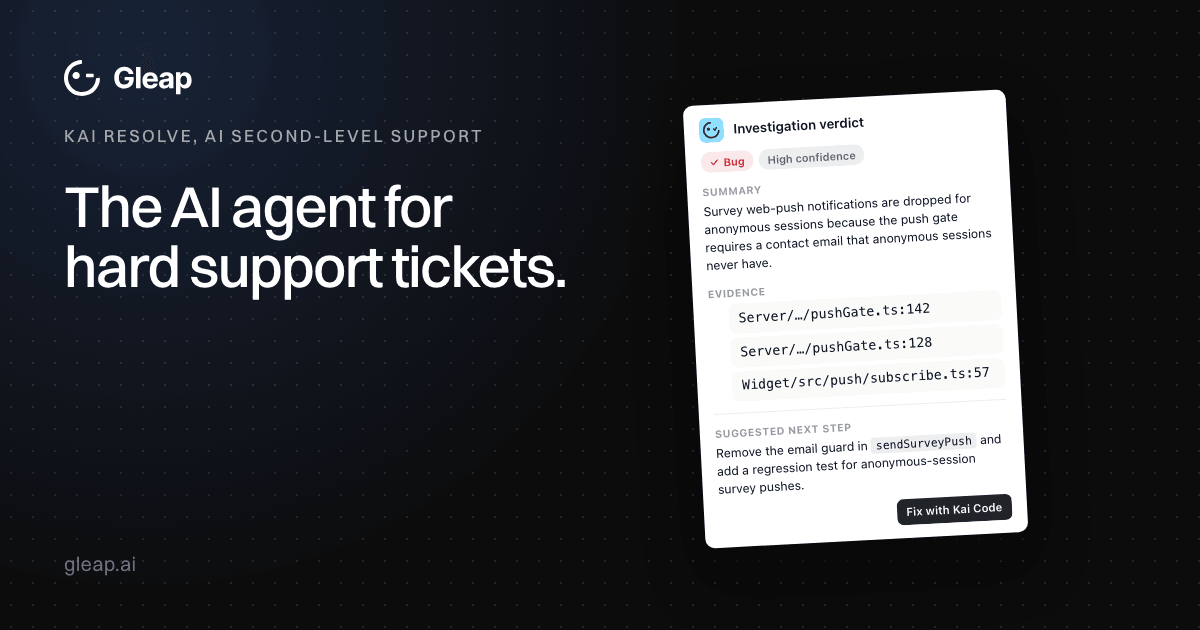
Kai Resolve is an AI support engineer from Gleap built for second-level, or tier 2, support. It handles the hard support tickets that Kai Support, Gleap's first-level AI agent, cannot answer. Rather than replying from documentation alone, Kai Resolve investigates: it reads the screen recording, console and network logs, the click trail, device and SDK versions, screenshots, account data from connected sources and read-only code access, then answers the customer or escalates with a diagnosis. It is built for SaaS and software support teams whose difficult tickets otherwise end up in an engineering queue, and it runs inside Gleap, the support platform that states it is trusted by more than 4,500 teams worldwide.
The problem Kai Resolve targets is the ticket that an answer cannot settle. First-level support answers known questions around the clock, but a report like a checkout failing for some EU customers, or exported invoice PDFs coming back empty, needs someone to read logs, check configuration, trace a bug through source code and involve engineering. That investigation work is what tier 2 support does, and it is slow because the evidence is scattered and the context is rarely handed over cleanly. Kai Resolve is positioned as the second level that investigates those tickets, answers what the evidence settles and escalates the rest with a diagnosis, so engineers see the tickets that need them with the evidence already attached instead of as a bare handover.
Every investigation starts from the evidence. Kai Resolve works from the ticket and thread, the device and SDK versions, console and network logs, the click trail, the screen recording and screenshots, plus repositories and data sources when the team allows them. On the website this is presented as an investigation brief with a set of sources, for example a ticket with three messages, two console errors and one failed request, a two-minute recording, read-only repositories and a read-only Postgres data source reached through MCP. Tickets that originate from the Gleap SDK carry the most evidence because console and network logs are captured automatically alongside the screenshot and any screen recording.
Code investigation is explicitly read-only. Repositories are cloned into a sandbox and the report is traced through the source, and findings cite the files it read. Kai Resolve never commits or pushes. Access is listed per investigation, for example a read-only API repository and a read-only web repository, a data source queried through MCP, and any write, delete or billing tool blocked. A code change is a separate step performed by a coding task the team picks up, so the investigator itself does not modify the source code.
The investigation produces three outcomes. If a setting or expected behavior explains the report, Kai Resolve sends a proposed customer reply with the cause, and the ticket can be answered without a teammate. If the report is a confirmed bug, it becomes a coding task in the ticket with the evidence attached. If a human decision is needed, the question arrives as a card with options, and the team's answer resumes the investigation. Tickets are classified as answerable, confirmed bug, suspected bug, feature request, needs more info or inconclusive, and a bug is marked confirmed or suspected with a confidence level and evidence citing the files it read. Feature requests are matched to the existing request on the public roadmap and the customer is subscribed to updates. When the customer's report is missing details, Kai Resolve asks the customer one focused question. When it is not sure, it says so: inconclusive means unknown, never no issue, and it re-investigates once when a new angle exists before asking a teammate.
There are three ways an investigation starts. With "Analyze bug reports first" turned on, Kai Resolve investigates new bug reports from the Gleap widget before they reach the inbox, so they arrive classified with the evidence attached. In the chat widget, Kai Resolve takes over when Kai Support cannot answer or a customer asks for a person. And a teammate can start an investigation from any ticket, any channel, including email, Slack and integrations. The team sets the policy per project, from full second level to safety net only.
Confirmed bugs become coding tasks that land in the ticket with the evidence attached. From there the team can fix the issue with Kai Code, open it in Claude Code, Codex or Cursor, or send it back with notes. Kai Code plans the change, edits the code, runs the tests and opens a pull request linked to the ticket, and engineers review and merge. With the default follow-up setting, a teammate confirms the fix is live before Gleap sends the customer reply. The company describes this chain as closing the loop from report to shipped fix, with Kai Support on first level, Kai Resolve on investigation and Kai Code on the code change.
For users, the stated benefit is that hard tickets get a clear next step without the team sorting every report by hand. Customers can be answered directly when the evidence settles the ticket, engineers receive investigated escalations with a diagnosis instead of an unqualified handover, and the context travels with the work through to the pull request. The control claims are explicit: read-only code access, findings with evidence, and decisions made by the team. Inconclusive results are never silently turned into a no-issue verdict, and destructive database and billing operations are blocked.
Concrete scenarios in the content include an EU checkout failing with a 500 from the tax endpoint after a deploy, where Kai Resolve reports a likely bug citing the deploy, surface survey notifications never arriving for visitors who are not logged in while chat notifications work, where the investigation finds that survey alerts skip visitors without an email, and empty exported invoice PDFs where the preview still shows every line. Others include a roadmap request for working hours per teammate that gets matched to the existing feature request and subscribes the customer, and technical questions in the chat widget that Kai Support hands over to Kai Resolve with session logs carried over.
On plans, Kai Resolve is included in Gleap Team at $149 per month billed annually ($179 billed monthly), and in Pro and Enterprise. Each investigation is billed by the work it does, about $0.49 on average, a code investigation bills as Kai Code usage, and a run that fails to start is not charged. A 7-day free trial is offered with cancellation anytime. Gleap advertises a 4.6/5 rating on G2, and named customers in the content include Squarespace, Papa Johns, UNICEF, Microsoft, Universal Music, Tridonic, Commonplace, Partfox and Salesforge.
In summary, Kai Resolve's value proposition is that it turns the hardest support tickets into investigated outcomes: an evidence-grounded answer, a coding task with the evidence attached, or an escalation with a diagnosis, all with read-only access and the team in control.
Publisher
A
admin
Launch Date2026-10-20
Platformweb
Pricingpaid
Tech Stack
#Gleap SDK#Model Context Protocol (MCP)