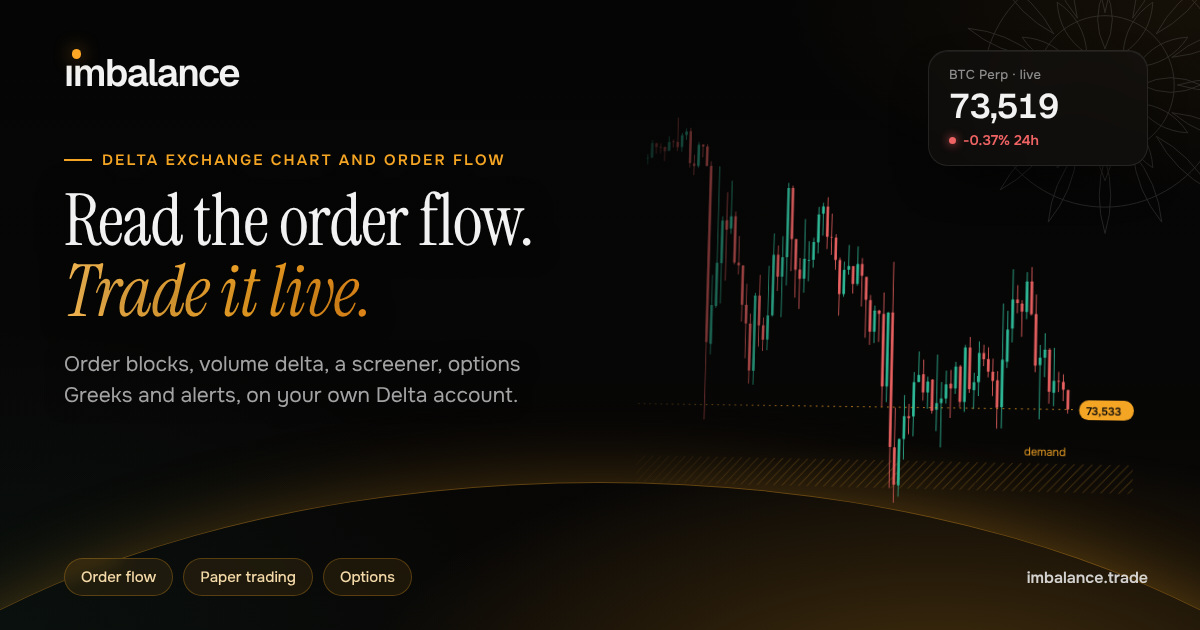
imbalance is an advanced trading terminal built for Delta Exchange India accounts. It takes the perpetuals, options and tokenised markets available on that exchange and wraps them in four core pages — Verdict, Gravity, Strike and Greeks — with a screener, a multi-chart Mosaic, alerts, an AI copilot and a journal sitting around them. The site's own framing is short: read the market, strike when it turns. The terminal covers every Delta Exchange India perpetual, including crypto, gold, silver and US stock tokens, plus BTC, ETH and XAUT options, with prices shown in rupees and times in IST. It is aimed at traders who already hold a Delta Exchange India account and want a sharper read of order flow, positioning and options data than a plain price chart gives them.
The product is positioned explicitly as an addition to Delta Exchange India's own app rather than a replacement for the exchange. The site lists what it contributes on top: a verdict per market with its invalidation, a pressure map of where price is pulled and held, order-flow analytics such as the Imbalance Map, volume delta and CVD, a depth heatmap and absorption markers, 26 indicators, a screener across every perpetual, options GEX, IV rank, the smile and a payoff builder with 15 strategy templates, alerts by push, Telegram and email, server-held loss limits and a journal. The organising idea is that a market read should be falsifiable: Verdict does not simply say a market leans one way, it names the specific price that would prove the read wrong, so a trader knows in advance where the thesis breaks. Gravity supplies the counterpart question of where price is likely to be pulled and held, and Strike supplies the execution surface where the read becomes an order.
Verdict is the first page. It reads each market and returns a structured verdict; the site's BTC example reads "BTC leans bearish. 4h and 1h structure both bearish: the trend and the timing agree." The read is broken into structure, order flow, positioning, options & IV, and liquidity, each of which is labelled — in that example structure is bearish, order flow, positioning and options & IV lean bear, and liquidity is neutral. Each verdict carries its invalidation: "Proved wrong above 74,770: A 1h close above 74,770, the last lower high, breaks the structure this rests on." The home page summarises the coverage as 250 perpetuals read live, with 80 of 170 up and down today and the tape's risk mode described as neutral. Verdict also ranks markets in the site's leaderboard pieces, where a Verdict link sits beside each listed perpetual.
Gravity takes gamma, option walls, liquidation clusters and the order book and places them on one price ladder. A sample BTC ladder lists an open gap, a call wall, an ask wall, a bid wall, a put wall, OI support and long liquidations stacked around the current price. Bar length encodes the strength of each level, and the colour logic is stated plainly: red levels above the price push back, green levels below hold. The FAQ describes this as a pressure map of where price is pulled and held, which is useful in practice because it turns several separate data sources — options open interest, gamma, liquidations and book depth — into a single vertical axis that can be read against the chart in one glance.
Strike is the terminal where the trading actually happens. It is built on charts that show order flow rather than price alone. The tool list on the page names the Imbalance Map, volume delta plus CVD, a depth heatmap, absorption, options open interest on price, bar replay, chart trading, and brackets with trailing stops. The Imbalance Map draws the live order blocks and gaps nearest the price directly on the chart; the site's BTC example shades supply order blocks and bear fair value gaps above the market. Volume delta is shown bar by bar with the cumulative line drawn over it across the last 48 hours, estimated from where each bar closed. Strike also carries 26 indicators, and orders can be placed from the chart with brackets and trailing stops attached.
Greeks is the options desk. It displays calls on the left and puts on the right for the nearest expiry, live from Delta, with delta, bid, ask and the change in delta for each strike — the sample BTC 13 Nov chain runs from 68,200 up to 69,000 with spot at 68,696.8. Strategies can be built from 15 templates or leg by leg, and hedged with futures. The broader options toolset includes GEX, IV rank, the smile and a payoff builder with those 15 strategy templates. Around the four pages sit the Screener, which ranks every perpetual by the Imbalance score using move, funding, open-interest flow and structure, with screens that save as alerts; Mosaic, which shows up to six live charts side by side, each with its own market and timeframe; Alerts on price, indicator, order-block zone, funding and open interest, checked on every tick and sent by push, Telegram or email; Copilot, an AI second reader for the chart you are on and the order you are about to place, working from the live data on screen; and a Journal that rebuilds trades from fills, with a P&L calendar in IST, expectancy, fees including GST and funding, and a tax estimate to check with a CA.
Live trading works through an API key created on Delta Exchange India. The key carries trading rights and no withdrawal permission, and is locked to the relay's IP address that imbalance shows you. It is encrypted on arrival and never shown again, and two-factor sign-in guards the account. Each order can be confirmed with size, price, margin and fees before it goes, or sent one-click when speed matters. Daily loss and losing-streak locks are worked out from Delta's own fills and held on the server rather than in the browser. imbalance never holds customer money: funds stay in the Delta Exchange India account, and the key it asks for cannot withdraw, so it can place and cancel orders and nothing else. A separate paper mode is an add-on for rehearsing, giving ₹10,00,000 of virtual capital on an engine that follows Delta's rules, with fills from the live order book, fees including 18% GST, funding and liquidation; paper results have no cash value. A leaderboard season ranks traders on a skill score built from Sharpe, return, drawdown and positive weeks rather than raw profit, with paper accounts ranking isolated trades up to 25× and live traders able to opt in in percentages only.
The benefits follow from those pieces. A trader gets a stated read with an explicit invalidation level instead of an open-ended opinion, a single ladder showing where price may be pushed back or held, order-flow visibility on the execution chart, an options desk with Greeks and a payoff builder, alerts that watch every market so the trader does not have to, and a journal that turns fills into expectancy, fee and funding accounting. Risk controls live on the server and are derived from real fills, which matters because the API key can trade. Because Copilot reads the same live data on screen, it acts as a second reader before an order is placed rather than a generic chatbot.
Concrete workflows described on the site include opening Verdict to get a market read and its invalidation price, then moving to Gravity to see the nearest strong levels; trading from Strike with the Imbalance Map, volume delta and CVD visible on the chart and brackets plus trailing stops attached; building an options position in Greeks from one of 15 templates and hedging it with futures; screening every perpetual by move, funding, open-interest flow and structure and saving a screen as an alert; watching up to six markets at once in Mosaic; rehearsing a setup in paper mode with virtual capital and live book fills; and reviewing the month in the journal with a P&L calendar in IST, expectancy, fees with GST and funding, and a tax estimate. The site's idea library shows an example BTC Bear Put Spread around 74.8k Max Pain marked +1.60R and settled, which illustrates how ideas and results are recorded.
Pricing runs on three tiers. Free is ₹0 always and covers the whole terminal on your own Delta account, with a watchlist of up to 3 markets, a 15-minute delay in the app only, a scorecard showing hit rate and a ticket from each setup sized by you. Pro is ₹299 a month and adds every market, instant alerts by bell, push and Telegram, a full scorecard with average R, auto-fire into Practice sized by risk, and a one-tap Practice ticket marked as coming soon. Elite is ₹999 a month. Prices include GST, live trading, charts, Verdict, Gravity, Greeks, alerts and the journal are on every plan, and payments are not open yet, so every account has Elite free until they are. imbalance is independent, run by QNTMHRZN Analytics and Technologies in Dehradun, uses Delta Exchange India's public market data and your own API key, and states clearly that it is not investment advice and that derivatives can lose more than your margin.
The takeaway is straightforward: imbalance turns a Delta Exchange India account into a terminal organised around reading the market before striking it. Verdict states the read and the price that would disprove it, Gravity shows where price is pulled and held, Strike executes from order-flow charts, and Greeks handles options — all while funds stay on Delta and the API key can trade but never withdraw.
Publisher
A
admin
Launch Date2026-11-13
Platformweb
Pricingfreemium