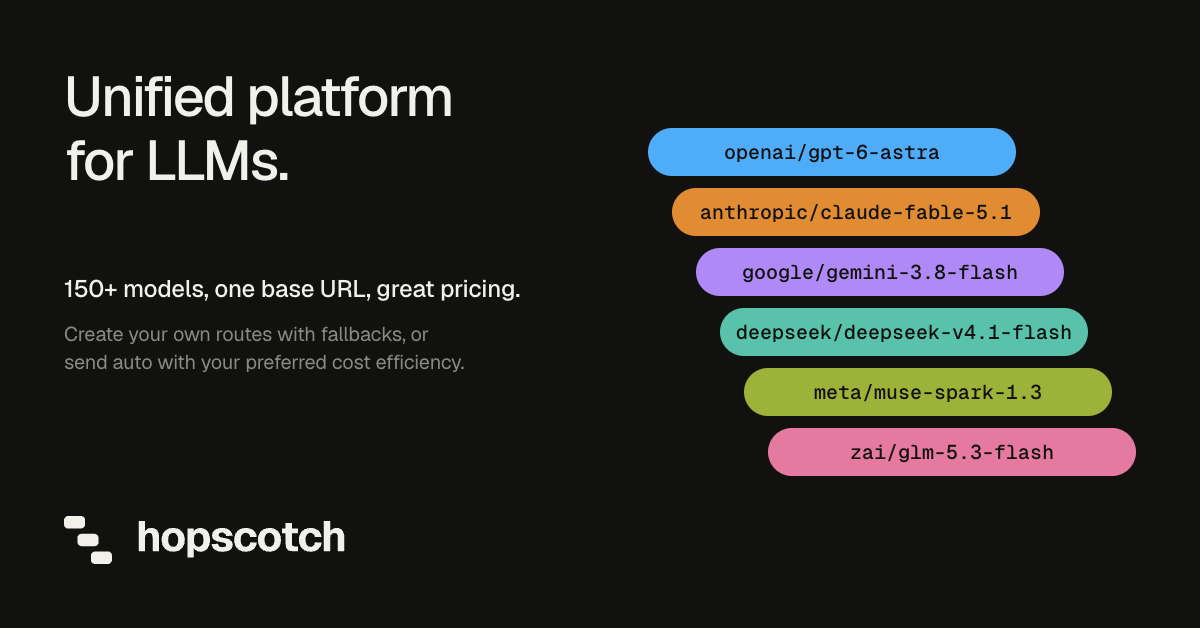
Hopscotch is a single API that gives developers access to more than 500 AI models from Anthropic, OpenAI, Google, DeepSeek, Moonshot AI, Qwen, Meta, and other providers. Instead of creating a separate integration, account, and bill for each provider, a team points the OpenAI SDK it already uses at Hopscotch's base URL, adds a Hopscotch key, and names any model in the catalog. The product is aimed at developers, engineering teams, and AI builders who need access to top models while controlling what those models cost, with spend limits available for every key, teammate, and workspace.
The problem Hopscotch addresses is the fragmentation that comes with building on top of multiple AI providers. Each provider normally has its own integration to maintain, its own account, its own payment method, and its own console for usage. A team that wants to run on Anthropic, OpenAI, and Google typically wires up several SDKs and credentials, reconciles several bills, and has no single place to see which model served which request or what the account spent overall. Hopscotch was built as an intelligence layer for AI to remove that overhead; the company states it raised $7.5m to build it. The result is one base URL, one key, and one balance for a catalog of 500+ models, so moving between providers becomes a configuration change rather than a re-integration project.
The first capability area is unified access. One key covers models from Anthropic, OpenAI, Google, and others on one base URL, billed to one balance. A request names the model in provider-slash-model format, for example anthropic/claude-sonnet-5, and the endpoints include chat completions and the Responses API, plus a models endpoint that lists every model you can call. Because the interface follows the OpenAI SDK shape, the quickstart shows creating a client with the base URL https://api.hopscotchlabs.ai/v1 and an API key, then calling client.chat.completions.create with any model name from the catalog. A curl example posts to the chat completions endpoint with a bearer token, a model, and messages, which means teams can test the service before touching application code.
The second area is model switching. Hopscotch states that once the base URL and key are set, moving to another model means changing the model name only, with no new SDK to install, and the key, balance, and limits stay the same. The model you name is the model that runs: Hopscotch will not swap your model for a different one. If you want another model to take over when your chosen one cannot answer, you list your backups in a routing profile, in the order you choose. The Activity log shows which provider actually served each request, so the model named in code and the provider that answered are both visible, which matters when you are debugging latency, cost, or output quality.
The third area is routing and reliability. If a provider has an outage, Hopscotch retries your request first; if you use a routing profile, it then moves to the next model on your list; for chat requests, a final attempt runs your model through a backup provider; if every attempt fails, you get an error. A routing profile can be arranged in the order you choose, such as Sonnet first and GPT, then Gemini, if it fails. When a provider returns a 429, Hopscotch moves the request to another of its keys for that provider, then to the next model in your routing profile, so your code sends one request and gets one response. You can also bring your own provider key: add your own key for a provider such as OpenAI and Hopscotch sends that provider's requests on your key, the provider bills you directly, Hopscotch charges nothing for those requests, and if your key fails Hopscotch does not switch to its own key. Hopscotch also states that it does not change your prompts or the answers, and that by default it never stores your prompts or the model's responses. Some features that providers run on their own servers, such as web search, audio, and hosted tools, are not supported through Hopscotch's provider accounts.
The fourth area is spend control and visibility. Each key can be given a credit limit that resets daily, weekly, or monthly; monthly limits can be set for teammates and for the workspace; and the account can be capped by how fast it can spend, $50 by default. A request that would cross a limit is refused before it reaches the provider, which means an agent stuck in a loop cannot drain the balance, and an owner can pause all spending at once. The Activity log lists every request and exports to CSV, showing details such as model, provider, attempts, total tokens, cost, and duration, and a rejected request shows no upstream attempt because it was refused before fetch. Usage breaks spend down by model, provider, key, and teammate, and your code can look up any request's tokens and cost through the API.
The fifth area is comparison and catalog transparency. The playground runs one prompt on up to three models side by side, billed through your key like any other request, so you can compare the answers and what each one cost before you change your code. The catalog lists each model with its context window and its price per million tokens; examples shown include anthropic/claude-sonnet-5 at 2.00 in and 10.00 out per 1M, openai/gpt-5.6 at 4.00 in and 20.00 out per 1M, google/gemini-3.6-flash at 1.50 in and 7.50 out per 1M, along with models such as deepseek/deepseek-v4-flash, moonshot/kimi-k3, and qwen/qwen3.8-max. Where several providers serve the same open-weight model, the catalog shows each provider and its price.
Overall, Hopscotch works as a routing and billing layer in front of model providers. You change three settings in your existing code: the base URL, your API key, and the model name, which starts with the provider, such as anthropic/claude-sonnet-5. The rest of your OpenAI SDK code stays the same. Requests arrive at https://api.hopscotchlabs.ai/v1, Hopscotch checks them against your limits, sends them to the named model, follows your routing profile if something fails, and records the outcome. You pay each provider's list price per token, with no markup and no added fees. This combination of a stable interface, explicit routing, and enforced limits is what the product presents as its approach: the model layer becomes something you configure and meter rather than a set of connections you maintain.
The benefits follow directly from those capabilities. Teams get access to 500+ models without managing a separate integration, account, or bill for each provider. Costs become controllable because limits are enforced before a request reaches a provider, and visibility is central because spend can be broken down by model, provider, key, and teammate. Reliability improves through retries, fallbacks, and backup providers. Switching models becomes a one-line change, which reduces lock-in and makes experimentation cheaper and faster. And because prompts and responses are not stored by default, teams keep their existing data posture. For anyone running AI features in production, these outcomes mean fewer surprises in the bill and fewer integration projects when the model landscape changes.
Concrete scenarios from the content include production applications that need per-key budgets so a runaway agent loop cannot drain the balance, and workspaces where an owner can pause all spending at once. Another is comparison: running one prompt on up to three models in the playground, checking the answers and the cost of each, and only then changing the model name in code. Another is reliability engineering, where a routing profile such as Sonnet first, then GPT, then Gemini keeps a service answering when a provider has an outage or returns a 429. Teams can also separate staging and production traffic with different keys and different limits, and developers who already have a provider key can route some traffic through it while other traffic runs on Hopscotch credit.
Hopscotch is aimed at developers and engineering teams building AI features, plus the people who own the AI budget inside those teams, since limits can be assigned per key, per teammate, and per workspace. The technical surface is an OpenAI-SDK-compatible REST API at https://api.hopscotchlabs.ai/v1 with chat completions and Responses endpoints and a models endpoint; the examples in the content use Python and curl. Payment is prepaid credit added by card, starting at $5, with optional auto top-up that refills the balance when it drops below an amount you choose. There are no plans or subscriptions, and no token markup. A Product Hunt promotion offered the first 250 Product Hunt users who signed up $50 in free model credits, redeemed with the code HOPSCOTCH50OFF in the Billing tab.
In short, Hopscotch positions itself as the intelligence layer for AI: one API, one key, and one balance for 500+ models, with named models, routing profiles, per-key and per-workspace spend limits, and a complete record of what every request cost. For teams that want the best available models without a separate integration, account, and bill for each provider, that combination of access and control is the core value.
Publisher
A
admin
Launch Date2026-09-30
Platformweb
Pricingpaid
Tech Stack
#OpenAI SDK#REST API#Python#cURL