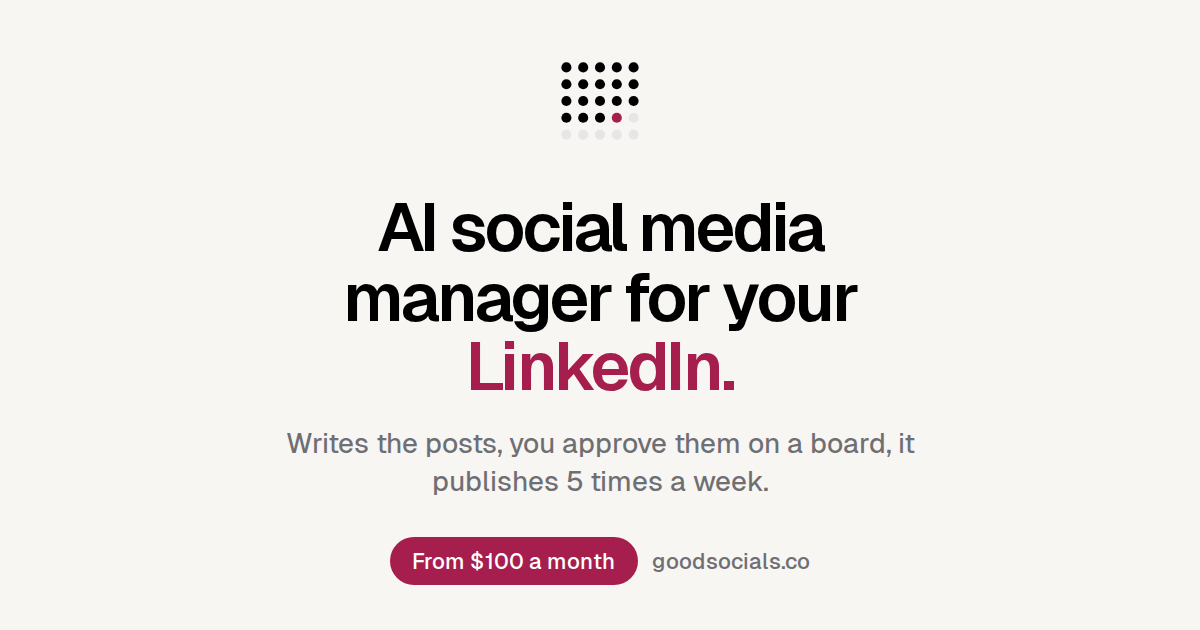
GoodSocials is an AI social media manager built specifically for LinkedIn. It writes posts that draw only on deep research or on your own data, and it publishes five times a week — but only after you approve each post. Onboarding is deliberately fast: you sign in with LinkedIn, paste your website, and according to the site your board is full in 90 seconds with seven posts. The product is made for the person whose name is on the profile, and the site names four groups it is built for: founders, consultants, operators and agencies. The example board shown belongs to TimeTuna.com, a scheduling service, and its stated goal is inbound leads — a useful clue to what the product is ultimately for: a steady, credible professional presence that brings in demand.
The problem it addresses is framed bluntly on the site: a social media manager costs $3,000 a month. A comparison table spells out the trade-offs. A $3,000 manager posts in most weeks; GoodSocials posts every weekday. A $3,000 manager delivers first drafts after a week of onboarding; GoodSocials delivers them in 90 seconds. When you are on holiday the manager stops, while GoodSocials posts what you queued. And the price is $100 a month instead of $3,000. The site also frames the starting point many users are in: three posts in your last three months. That gap — between intending to post regularly and actually doing it — is what the product is built to close. A second, equally explicit concern is quality. GoodSocials positions itself against "AI slop" and lists the writing habits it refuses to produce: cringe openings like "Nobody talks about this, but scheduling is broken", posts built around "I spent 10 years in SaaS", and the "it's not X, it's Y" construction.
Every post is one of three kinds, according to the site: market research, deep dives, and your numbers. This is the core editorial model. Market research posts come from looking at the wider landscape — one example card reports that of 12 scheduling tools compared that month, nine put round-robin scheduling behind a paid tier and two moved it there in the previous quarter. Deep dives go into a source or an idea in more depth — one example draws on 1,200 support threads from new TimeTuna users to identify the most frequent week-one question, and another weighs a famous jam study from Iyengar and Lepper (2000) against a meta-analysis of 50 experiments by Scheibehenne et al. (2010) to explain why TimeTuna shows three slots. Your numbers posts come from your own tools, such as the finding that TimeTuna reschedules fell from 18% in May to 7% in August, one change in between being that the invite now shows the guest's timezone first, based on 9,412 meetings. The site states plainly that the content is research, deep dives and your numbers, nothing else.
To produce those posts, GoodSocials connects to the tools you already use. The example board lists five read-only connections: PostHog, Stripe, GitHub, Plausible and Notion. Because the connections are read-only, the product can quote your data without being able to change anything in those systems, and because they are your own tools, the resulting posts contain figures only you could publish. The output lands on a board — a kanban-style view where posts are drafted and moved through approval. You approve the posts you want, and the pipeline moves them on. Cards are scheduled to specific times, such as Tuesday at 09:00 or Wednesday at 09:00, so the cadence is planned rather than improvised. The board is shown populated with seven posts within 90 seconds of signing in with LinkedIn and pasting your website.
Corrections stick: the site promises that if you correct it once, every post after follows. The mechanism is explicit. When you leave a note on a card, that note rewrites the card and becomes a rule in your voice. In the example, a reviewer's note — "Open on the number, not a question" — becomes a voice rule, joining other rules such as "Reports, does not sell". From then on, every next post follows those rules. The rules accumulate week by week: the site shows one rule in week one, two rules by week four, and five rules by week 12, every one of them originating from a note of yours. For Pro users, those rules are described as three brand principles that learn from every revision. The practical effect is that the system moves toward your voice instead of you rewriting the same feedback into every prompt.
The overall flow is presented as five steps: it reads your tools, it writes the post, it draws the image, you approve, and it publishes — with "Publishes Tue 09:00" shown against the example card. Image generation is part of the pipeline rather than a separate tool, and the Pro plan includes up to 200 generated images a month. Approval sits between generation and publishing, which is what keeps a human in the loop on every piece of content that goes out under your name. The site also flags what is coming: integrations with Codex, Claude Code and a Grok bot are listed as coming soon, suggesting the generation and review loop will extend to more of the tools people already work in.
Cadence is treated as the point of the product. Under the heading "Show up every weekday. The rest follows.", the site contrasts three posts in your last three months with 20 posts next month once the system is running. The claim attached to that cadence is that profile views, followers and inbound leads follow a steady month — that is, the results are framed as a consequence of showing up consistently rather than of any single viral post. For agencies, the same idea is applied across clients, with one board per client. And for the times you are away, queued posts keep publishing, which is exactly the failure mode the site attributes to a human manager who stops when you are on holiday.
The site answers "who is it for" with four groups, each illustrated by an example post. Founders get posts built from business data, such as a Stripe-derived observation that 31% of August signups chose annual, up from 19% in July, with two candidate causes and neither confirmed. Consultants get posts from client work, such as the finding that across 38 client engagements most retainers end in month four and one meeting shows up in 29 of the exits. Operators get engineering-flavoured posts, such as failed deploys per release falling about 62% after one CI rule across a small sample of 11 releases. Agencies manage each client's own profile from one board per client, up to 10 clients. In every case the content is tied to the person whose profile it appears on.
Pricing is published in three tiers, each starting with a seven-day free trial. Pro costs $100 a month for one LinkedIn profile and includes three brand principles that learn from every revision and up to 200 generated images a month. Agency costs $1,000 a month for up to 10 profiles, with one board per client; each client authorises their own profile so the agency never holds a password, and GoodSocials emails the agency before a client's access runs out. Consultancy costs $2,000 a month and is hands-on: Pasha, the founder, sets up your themes, principles and sources with you and has a call with you every week. There is no setup fee, and you can change plan or cancel from the pricing page or in settings. Signing in uses LinkedIn, and the board is delivered in the browser.
The takeaway is a narrow, opinionated promise. GoodSocials is not a general-purpose content generator or a multi-network scheduler; it is an AI social media manager for one network, LinkedIn, that writes only from research and from your own tool data, puts every draft in front of you on a board before it publishes, learns your corrections as lasting voice rules, and keeps posting five times a week for $100 a month against a $3,000-a-month human alternative. If your presence on LinkedIn matters to how you win work and you cannot keep a cadence yourself, that is the trade it offers.
Publisher
A
admin
Launch Date2026-09-27
Platformweb
Pricingpaid