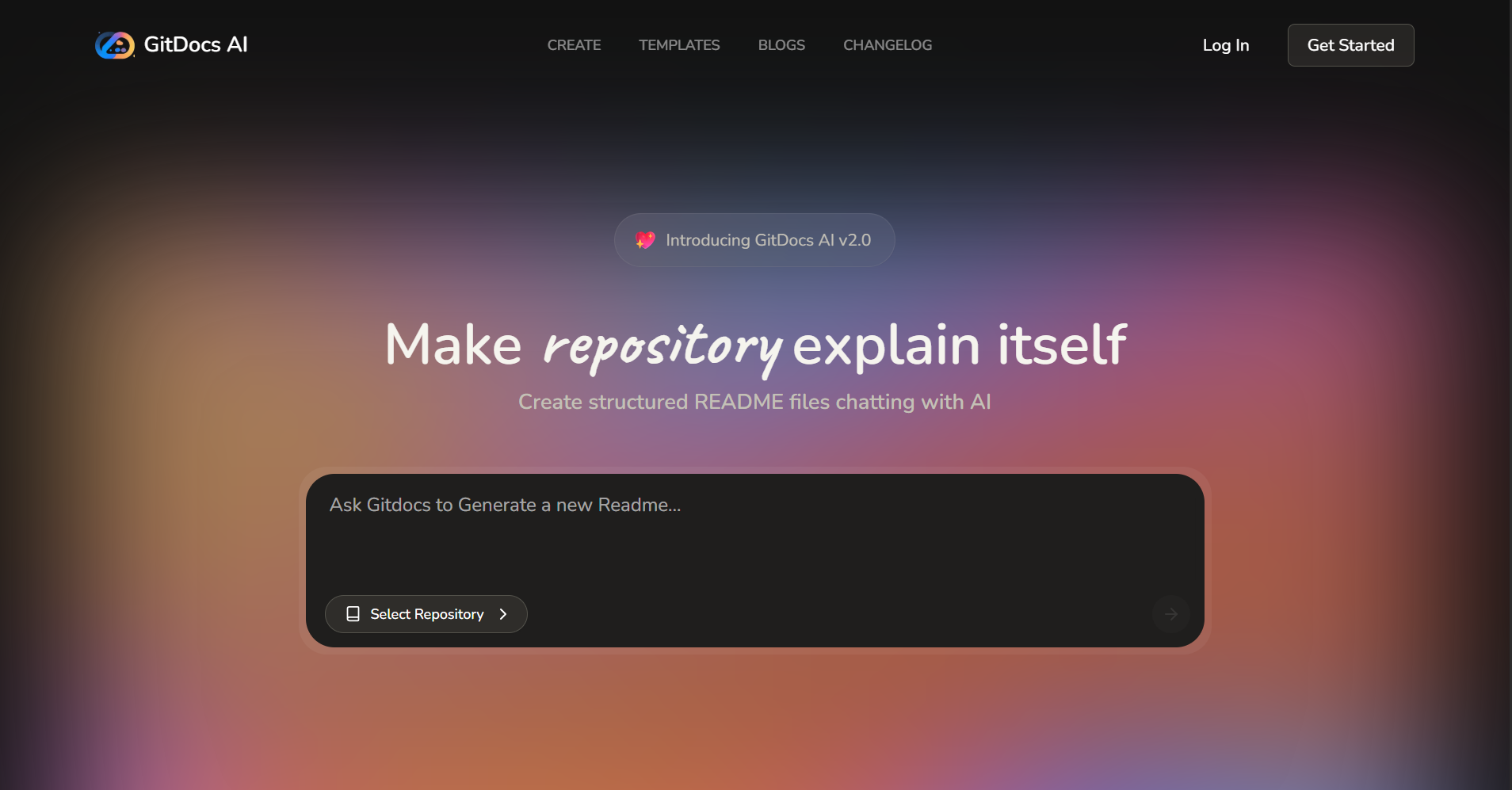
Gitdocs AI is an AI-powered GitHub README generator that revolutionizes documentation for developers. It belongs to the developer productivity category and specifically targets open-source maintainers, software engineers, and tech startups who need professional README files quickly. The core value is automating the tedious documentation writing process while ensuring completeness and quality. By connecting a GitHub repository, the AI automatically analyzes the codebase—scanning file structure, dependencies, and metadata—to generate a comprehensive README tailored to the project. This saves hours of manual effort and guarantees that no critical section is missed. Loved by early builders, the tool is built on a modern stack and integrates seamlessly into existing workflows, making documentation an effortless part of development.
The primary pain point Gitdocs AI addresses is the widespread lack of thorough, up-to-date documentation in software projects. Developers often postpone writing README files because it is time-consuming and unexciting, resulting in incomplete or outdated docs that confuse users and deter contributors. For open-source projects, this can severely limit community growth and project adoption. Gitdocs AI eliminates this friction by automating the initial generation process, providing a solid foundation that users can then refine. This means projects get the documentation they need from day one, without developers having to sacrifice coding time. The tool ensures that every repository explains itself clearly, improving user experience and fostering community engagement.
The first major feature group is AI-Powered README Generation. This feature automatically analyzes the connected GitHub repository to understand its structure, language, dependencies, and purpose. It then selects the best AI model—thanks to Smart AI Model Selection—to generate a README that is contextually appropriate. The generation includes multiple sections like installation instructions, usage examples, and contribution guidelines. Users benefit from a complete, professional starting point that would normally take hours to write. The automatic analysis ensures no critical information is omitted, and the AI adapts the content to the project's specific domain. This feature eliminates the blank page syndrome and accelerates documentation creation significantly.
The second major feature group is Interactive Chat Enhancement. After the initial README is generated, users can engage in a real-time chat with the AI to refine the content. They can request additional sections, clarify wording, adjust the tone to be more formal or casual, or even ask for alternative phrasing. The chat interface provides immediate feedback, allowing iterative improvements without switching context. This interactive capability makes the tool highly flexible, as users can tailor the documentation to their exact preferences. It also serves as a collaborative assistant, helping developers think about what should be included in the README. The result is a polished, user-specific document that perfectly represents the project.
admin
The third feature group includes Multiple Professional Templates and Real-time Preview. Gitdocs AI offers a variety of templates designed for different project types, from open-source libraries to enterprise applications. These templates follow industry best practices for README structure, ensuring consistency and professionalism. Users can preview changes instantly as they edit or chat with the AI, seeing exactly how the final markdown will look. The real-time preview eliminates guesswork and speeds up the review process. Additionally, the Smart AI Integration connects with GitHub and other tools, making it easy to commit the generated file directly. This combination of templates and preview ensures that documentation is not only accurate but also visually appealing and ready for production.
Overall, Gitdocs AI works through a straightforward workflow. Users start by linking their GitHub repository. The tool then performs an automatic repository analysis, scanning files, dependencies, and configuration to gather context. This analysis feeds into the Smart AI model, which selects the best model for the project's language and complexity. The AI generates a first draft of the README, which users can view in real-time. From there, they can use the Interactive Chat to make adjustments—adding sections, improving clarity, or changing the tone. Once satisfied, the final README can be downloaded or pushed directly to the repository. This end-to-end process is designed to be completed in minutes, with near-zero downtime, thanks to a robust backend using Next.js, Clerk, Neon DB, Inngest, and Azure.
Concrete use cases demonstrate the tool's versatility. A solo developer working on a new open-source library can generate a comprehensive README in under a minute, leading to more downloads and contributions. A startup team managing multiple repositories can apply consistent templates across all projects, ensuring a uniform documentation standard that strengthens brand identity. For legacy projects with outdated documentation, re-running the analysis updates the README to reflect the current codebase, reducing confusion among users. In enterprise settings, teams can collaborate via the chat feature to collectively refine documentation during code reviews. The outcome in every scenario is clearer, more professional documentation that enhances project visibility, user satisfaction, and developer efficiency.
Gitdocs AI targets individual developers, open-source maintainers, engineering teams, and tech startups seeking to streamline their documentation process. The platform is built on a modern tech stack including Next.js for frontend, Clerk for authentication, Neon DB for database, Inngest for background job processing, and Azure for cloud hosting—ensuring reliability and near-zero downtime. Pricing is not explicitly stated, but it is loved by early builders and likely offers free tiers for initial use. The primary takeaway is that Gitdocs AI transforms the often neglected task of README creation into a quick, AI-driven experience that keeps documentation synchronized with the codebase. By automating repository analysis and providing interactive refinement, it empowers developers to produce high-quality documentation effortlessly.
Software developers, open-source maintainers, engineering teams, and tech startups who need to create or update README files for GitHub repositories. The tool is particularly beneficial for those managing multiple projects who want consistent, professional documentation without manual effort. It appeals to developers familiar with modern stacks like Next.js, Clerk, and GitHub, and who value AI-assisted workflows. Additionally, technical writers and DevOps engineers can integrate it into CI/CD pipelines for automated documentation. The platform is designed for early adopters and productivity-focused individuals seeking to streamline their documentation process.