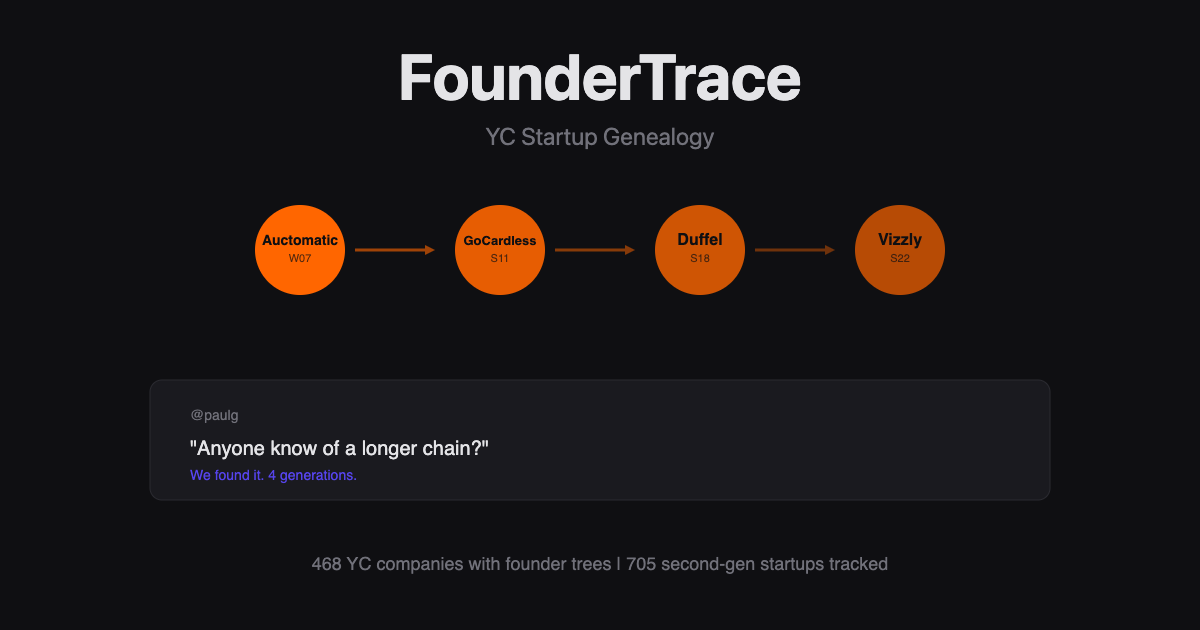
FounderTrace maps the YC founder genealogy showing chains of startups founded by employees of previous YC companies. It tracks over 6,000 YC companies and reveals founder family trees.
FounderTrace is a specialized data platform that maps the founder genealogy of Y Combinator (YC) startups, creating visual chains and family trees of companies founded by employees of previous YC-backed ventures. This tool serves investors, researchers, and startup enthusiasts who want to analyze the interconnected network of YC alumni and understand how talent and entrepreneurial culture propagate through generations of companies. The core value lies in revealing hidden connections and patterns within the YC ecosystem, providing unique insights into how successful companies spawn new ventures and create entrepreneurial lineages that shape the broader tech landscape.
The platform addresses the concrete problem of fragmented and opaque founder career paths within the YC network. Without FounderTrace, tracking which YC company alumni go on to found their own YC-backed startups requires manual research across disparate sources, making it difficult to identify patterns, measure a company's influence as a 'founder factory,' or discover promising investment opportunities based on pedigree. This matters because understanding these genealogical chains helps investors spot teams with proven entrepreneurial training, allows researchers to study innovation diffusion, and helps founders identify potential mentors or competitors with shared lineage, turning anecdotal observations about chains into structured, searchable data.
One major feature group is the comprehensive company database and search functionality, which allows users to explore 5,983 YC companies. The system specifically tags 277 companies that have identifiable founder trees, meaning they have spawned at least one subsequent YC startup founded by a former employee. This filtering capability enables targeted exploration of the most generative nodes in the network. The search interface provides immediate access to this curated dataset, allowing users to move from a general curiosity about YC companies to focused investigation of those with documented genealogical significance, which is fundamental for any analysis of founder spawning patterns.
A second major feature group is the detailed founder genealogy visualization, which displays chains of YC startups. The platform shows specific multi-generational chains, such as the four-startup sequence of Auctomatic (w07), GoCardless (s11), Duffel (s18), and Vizzly (s22). These visual trees map the employee-to-founder transitions, illustrating how talent and experience flow from one venture to the next. The interface likely presents these relationships through interactive diagrams or lineage charts, making complex networks understandable at a glance and allowing users to trace entrepreneurial heritage across multiple generations within the YC portfolio.
Publisher
A
admin
Launch Date2025-12-29
Platformweb
Pricingfree
Tech Stack
#Crustdata APIs