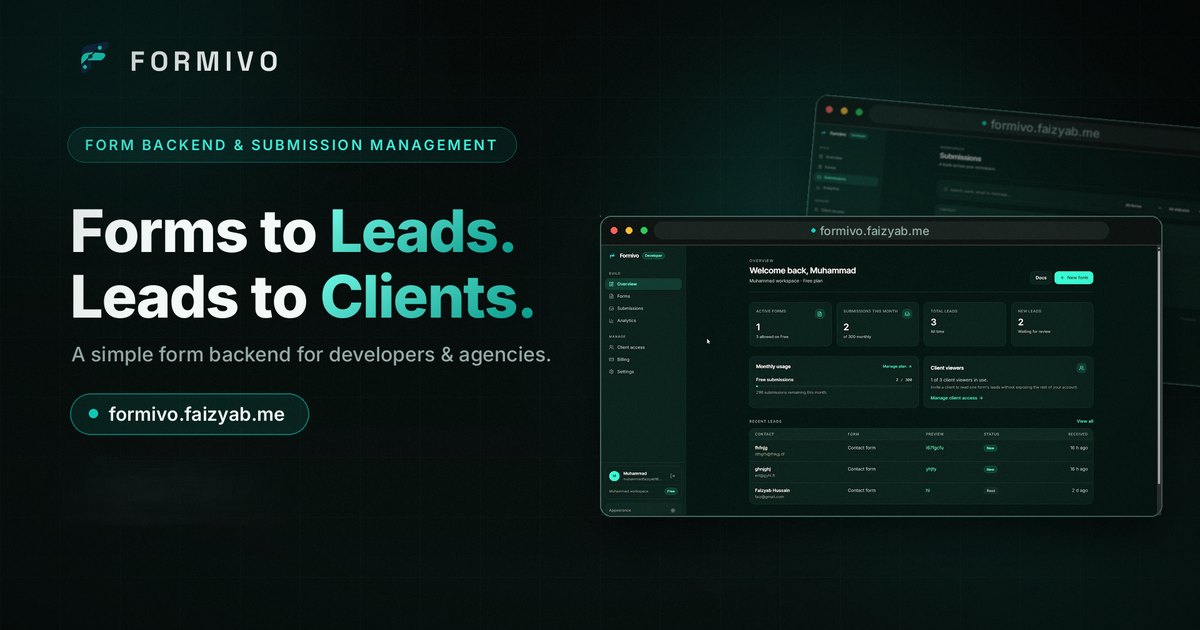
Formivo is a form backend and lead workspace for people who build websites for clients: freelance web and full-stack developers, web developers, web design and development agencies, and small teams who manage forms across several client websites. It connects the forms you have already built to one public HTTPS endpoint, collects every submission as a stored record in a single workspace, and lets you invite each client to a secure, read-only view of their own leads. Formivo is deliberately not a form builder, a CRM or an enterprise sales platform. You keep your own markup, styling and validation, and Formivo handles what happens after the submit button: validation, rate limiting, quota checks, storage and the authenticated read side. Its purpose is to close the gap between a form submission and the client relationship that follows it.
Formivo was built around a simple observation quoted in its launch discussion: a form is a moment, but the lead is the relationship. Collecting an enquiry is the easy part; keeping it, organizing it, following up and getting it to the right client is where the workflow usually falls apart. Without a dedicated backend, storage, validation and retries have to be rebuilt for every project, a notification email is read once and then archived, follow-up lives in a spreadsheet or a note or whoever remembers the thread, client updates mean forwarding enquiries and answering "what came in?" by email, and each project drags in a different form service and a different login. Developers in the launch thread described the same pattern: email-only delivery is where leads quietly die, inboxes get missed and nobody owns the follow-up; teams juggle form tools, email notifications and spreadsheets while giving clients access to their leads is always messy; and agencies can build a form in an afternoon and then spend weeks wiring up storage, search and follow-up. Formivo targets exactly that stretch of work and leaves the rest of the stack alone.
Connecting a form takes one attribute. You create a form in Formivo, copy its public endpoint, and set that URL as the action of the form you already built, with method POST. Field names carry over unchanged, there is no SDK to install, no server to deploy and no secret sitting in client-side markup. The endpoint accepts form-encoded, multipart and JSON submissions, answers OPTIONS requests for CORS preflight, caps request bodies at 256 KB, and returns 201 with a lead id. A plain HTML form gets a built-in confirmation page instead of raw JSON, and an optional hidden _redirect field sends the visitor back to your own thank-you page. A hidden _gotcha honeypot field provides basic bot protection. Integration guides with working examples exist for HTML, React, Next.js, Vue, Nuxt, JavaScript, PHP, Laravel, Node.js, Express, Python, Django, Flask and static sites, and the API reference documents body formats, reserved fields and status codes. A Formivo skill can also be installed into a coding agent with a single command so the agent can read the endpoint contract and wire a form itself.
Every submission lands in one inbox as a complete record: the full payload, the source, a timestamp and a lead status. You can search across contact fields, filter by form or status, and open the full detail of any submission, so follow-up stays visible instead of depending on someone remembering an email thread. Leads move through statuses from New to Contacted, Qualified and Converted, which gives each enquiry a visible state rather than a read-once notification. CSV export is included on Lite, Pro and Agency and is enforced on the server; the Free plan cannot export, and the restriction is not merely a hidden button. Each plan also sets how long analytics history is kept: 90 days on Lite, up to one year on Pro and up to two years on Agency. When a submission allowance is reached, new submissions are rejected with a quota error until the allowance resets or the workspace upgrades, while existing submissions and history are retained and never deleted.
Sharing is where Formivo differs from a generic form endpoint. You invite a client to one form by email; they receive a single-use link that expires, accept it, and get a read-only client account scoped to that form only. Inside the portal a client can view the shared form and read and search its submissions. They cannot change a lead status, edit form settings, open another form, see billing or workspace members, or invite another viewer. Revoking access ends the view on the next request, and permissions are checked on every request rather than hidden in the interface. One form per invitation means one client can never see another client's submissions, which the developer discussions singled out as the requirement that matters most for agencies. The portal runs on your Formivo link today; white-label domains are not available.
The product follows a three-step model: connect, manage, share. The endpoint is public by design, but the read side is genuinely closed. A GET request to a form endpoint returns 405, and stored data is never readable through the public URL. Authorization on every read comes from the signed-in session, never from a form or submission id supplied in a query string. Postgres Row Level Security policies scope forms to their workspace and submissions to forms the caller is allowed to view, and cross-account access is rejected and covered by an authorization test suite. Abuse controls include per-form and per-IP rate limits, honeypot fields, a 256 KB body cap and an immediate pause switch. Database and provider keys are read through server-only modules and never serialized into the browser bundle. Signing up emails a six-digit code sent through Resend, and the dashboard stays closed until that code is entered; sign-in is email and password only, with no social login. The site states plainly that there are no certifications, audits or guarantees that have not been earned.
The outcome Formivo promises is a workflow that stops leaking: submissions stored reliably instead of rebuilt per project, leads organized and searchable instead of scattered across inboxes and spreadsheets, and clients given their own clean view so you stop forwarding enquiries and they stop asking which email had the last one. Because there is no SDK and no vendor lock-in, the form you already built stays yours, and because the endpoint is public by design there is no credential to leak in client markup. You keep the workspace, the leads and the control; the client gets visibility without edit rights. One workspace covers every client website you manage, replacing a different form service and login for each project.
The concrete workflows are the ones the site shows. A freelance developer ships a six-page site with a contact form that asks for a quote; the enquiry arrives as a New lead in the workspace, gets marked Contacted after a reply, Qualified when a budget is approved and Converted when the proposal is signed. An agency running forms across many client websites keeps submissions separated per form and invites each client to just their own form. A studio hands a client a read-only portal so the client can search their own enquiries without emailing the developer. A developer whose stack is Vue, Laravel or Django follows the tested guide for that framework and points the existing form at the same endpoint contract. A coding agent such as Claude Code, Codex / ChatGPT, Gemini CLI or Cursor can be given the Formivo skill and asked to update a form's action, add fields and handle responses.
Formivo's solutions pages name four audiences: freelance developers, who get a reliable backend for every client site without maintaining a submission stack, with the Free plan covering one form and one client view; web developers, who get one endpoint contract across every framework with complete payloads and searchable history; web agencies, who need separated submissions and per-form access that never leaks between accounts, up to 100 active forms on the Agency plan; and client projects, where the deliverable is a read-only view of the client's own form, revocable at any time. Pricing runs from a Free plan with one active form, 100 submissions a month and one client view with no card required, through Lite at $9 per month (5 active forms, 1,000 submissions, 3 client views, 90 days of analytics history, CSV export), Pro at $19 per month (25 active forms, 5,000 submissions, 10 client views, analytics up to one year, client access management, email support) and Agency at $49 per month (100 active forms, 20,000 submissions, 50 client views, analytics up to two years, workspace-wide client access management, priority email support). Yearly billing includes two months free — $90, $190 and $490 respectively. Payments are handled in USD by Polar as merchant of record, which also handles tax; cancellation happens in the Polar customer portal and access continues to the end of the paid period. Support is by email; there is no live chat or phone support. Native CRM sync, webhooks and automation tools are not implemented, and advanced spam filtering, duplicate detection, lead routing and CRM integrations are described as areas worth exploring rather than shipped features.
Formivo is narrow on purpose. It does not replace your form builder, your CRM or your sales stack; it adds the missing piece after the submit button — reliable storage, searchable leads with statuses, and a scoped read-only view for the client who owns each form — so developers and agencies can run many client websites from one workspace without rebuilding a submission backend each time.
Publisher
A
admin
Launch Date2026-11-29
Platformweb
Pricingfreemium
Tech Stack
#Postgres#Row Level Security#Polar#Resend