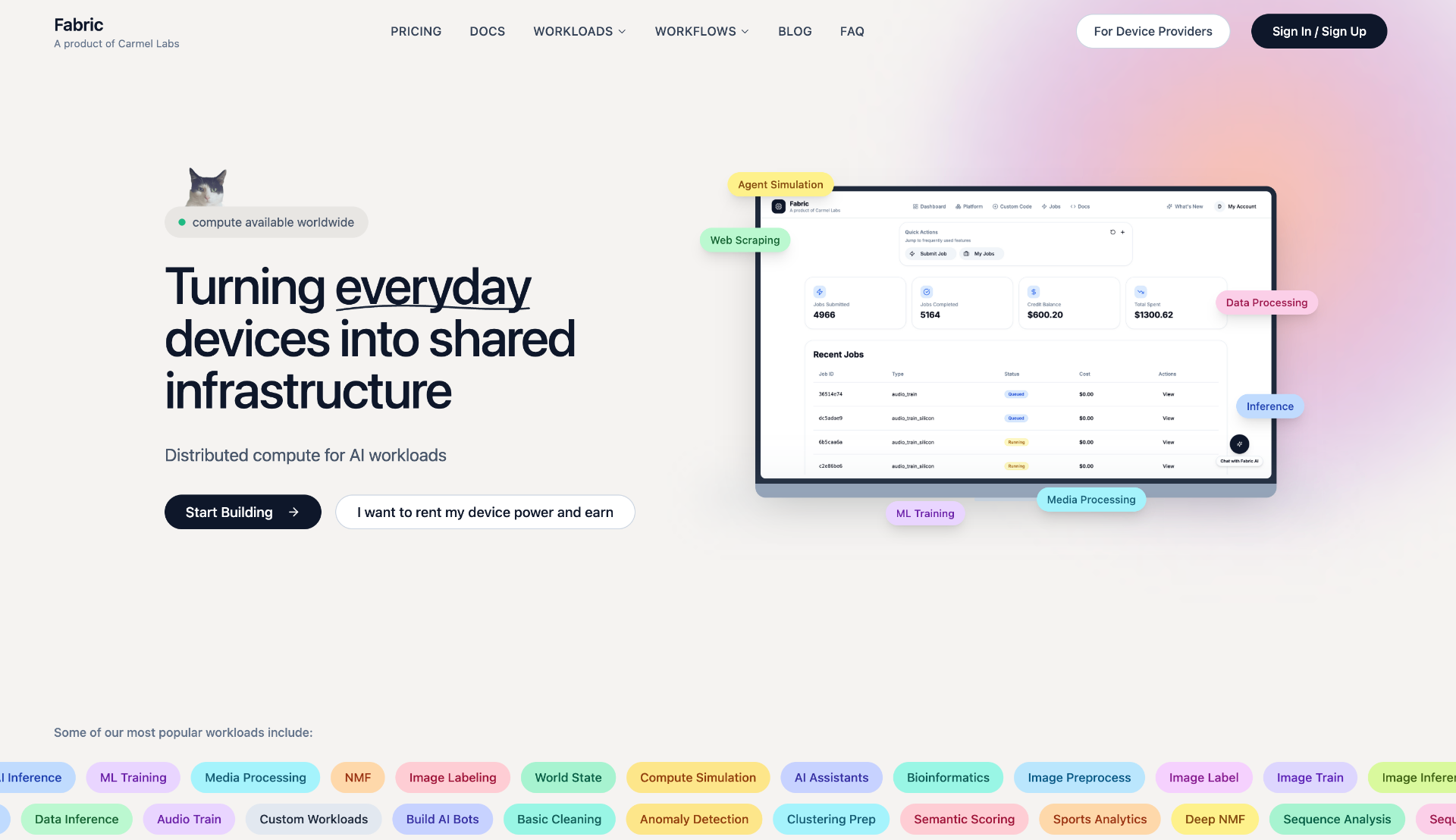
Fabric by Carmel Labs is a distributed AI compute platform that converts idle computing power from devices worldwide into a passive income opportunity. It caters to two distinct user groups: device owners who want to monetize their unused CPU and GPU cycles, and AI practitioners who need cost-effective inference compute. The platform's core value proposition is eliminating wasted compute while enabling earnings for individuals anywhere. With over 800 devices already joined and $10,500+ paid out, Fabric demonstrates real traction in the distributed compute marketplace. The process begins with a lightweight agent that runs in the background, requiring minimal intervention from the user.
Traditional cloud-based AI inference can be prohibitively expensive, especially for researchers, startups, or hobbyists needing sporadic compute. At the same time, millions of personal computers sit idle for hours each day, their processing power unused. Fabric solves this inefficiency by creating a secure bridge between compute supply and demand. Device owners earn passive income from resources that would otherwise remain idle, while AI job runners gain access to distributed computing at a fraction of typical cloud pricing. This peer-to-peer model reduces costs and democratizes access to AI compute. The platform addresses common user concerns about safety through sandboxed execution, zero data collection, and end-to-end encryption, ensuring device owners can participate without worry.
The first major feature group focuses on safety and control. All jobs run inside locked sandboxes with no access to personal files, browsing history, or any private data. The physical separation ensures that even if a job is malicious, it cannot reach the user's documents or photos. Additionally, Fabric implements end-to-end encryption for all network traffic, preventing interception of job data or communications. Device owners retain complete control over resource allocation through adjustable CPU and memory limits. The platform never collects personal data, and users can pause participation at any time with a single click. These safety measures are non-negotiable, as emphasized on the Fabric website: "Your safety is not negotiable."
A second feature set revolves around earnings transparency and ease of use. The dashboard displays every completed job, its exact payout, and a cumulative earnings statement without hidden fees. Users can see "Today's Earnings" and "This month" summaries in real time. Payouts occur weekly with no minimum threshold, meaning even small earnings are accessible immediately. The lightweight agent automatically pauses when the device needs full computing power for user tasks, ensuring that sharing resources never impacts performance. Users set their own schedule and can stop earning at any moment. The simplicity of the interface is captured in the tagline: "It's almost too simple." This transparency builds trust and encourages continued participation.
admin
The platform supports multiple operating systems including Windows, macOS, and Linux, and allows unlimited devices per account. Setting up takes under five minutes via three straightforward steps: create a free account, download and install the lightweight agent, and then relax while earnings accumulate. The agent runs efficiently in the background, using minimal system resources when idle. A dedicated dashboard provides real-time tracking of earnings, recent activity, and device status. The Fabric agent is designed to automatically pause high-intensity tasks like gaming or video rendering when the user needs full performance. This multi-platform compatibility makes the earning opportunity accessible to almost anyone with a modern computer.
Fabric operates as a two-sided marketplace: device owners contribute compute resources, and AI job runners submit inference tasks. When a device is idle, the Fabric agent signals availability to the network, and the platform assigns suitable jobs based on the device's capabilities and current load. Each job executes within a sandboxed container, completely isolated from the host system. Upon completion, the job runner pays a small fee, part of which goes to the device owner as earnings. The entire process is automatic, requiring no manual intervention from either party. The marketplace ensures that jobs are distributed globally, leveraging over 1,000,000 jobs already completed across 32 countries. This approach scales compute without requiring new data centers.
Concrete use cases include a digital nomad who earns passive income from their laptop while traveling, covering travel expenses from otherwise idle compute. A university researcher can run machine learning inference tests at a fraction of cloud costs, accelerating experiments without budget constraints. Gamers with powerful GPUs can earn money during non-gaming hours, turning their expensive hardware into an asset. Small businesses lacking dedicated servers can leverage Fabric for sporadic AI workloads without committing to cloud contracts. In each scenario, the outcome is either direct earnings for device owners or cost savings for compute consumers. The platform's transparent earnings dashboard reinforces trust by showing exactly how much each job contributes.
Fabric targets device owners ranging from remote workers and students to gamers and tech enthusiasts who keep their computers on for extended periods. On the compute consumer side, AI developers, researchers, and startups looking for affordable inference compute are ideal users. The platform runs on Windows, macOS, and Linux, with a lightweight agent that does not interfere with normal usage. Pricing is free for device owners to join; earnings are derived from job completions. For compute consumers, Fabric offers competitive rates compared to traditional cloud providers. The overall takeaway is that Fabric transforms wasted computing power into a valuable resource, creating a win-win ecosystem for both earners and users of AI compute.
Fabric serves device owners who want to monetize idle computing power, including digital nomads, remote workers, students, gamers, and tech enthusiasts. On the compute consumer side, it targets AI developers, researchers, engineers, and small businesses that need cost-effective inference compute without committing to traditional cloud providers. The platform is ideal for anyone with a Windows, macOS, or Linux computer who is comfortable installing a lightweight background agent. With over 800 devices already joined and 32 countries represented, Fabric appeals to a global audience seeking to participate in the decentralized compute economy. Whether you want to earn passive income or access affordable AI compute, Fabric provides a secure, transparent, and easy-to-use solution.