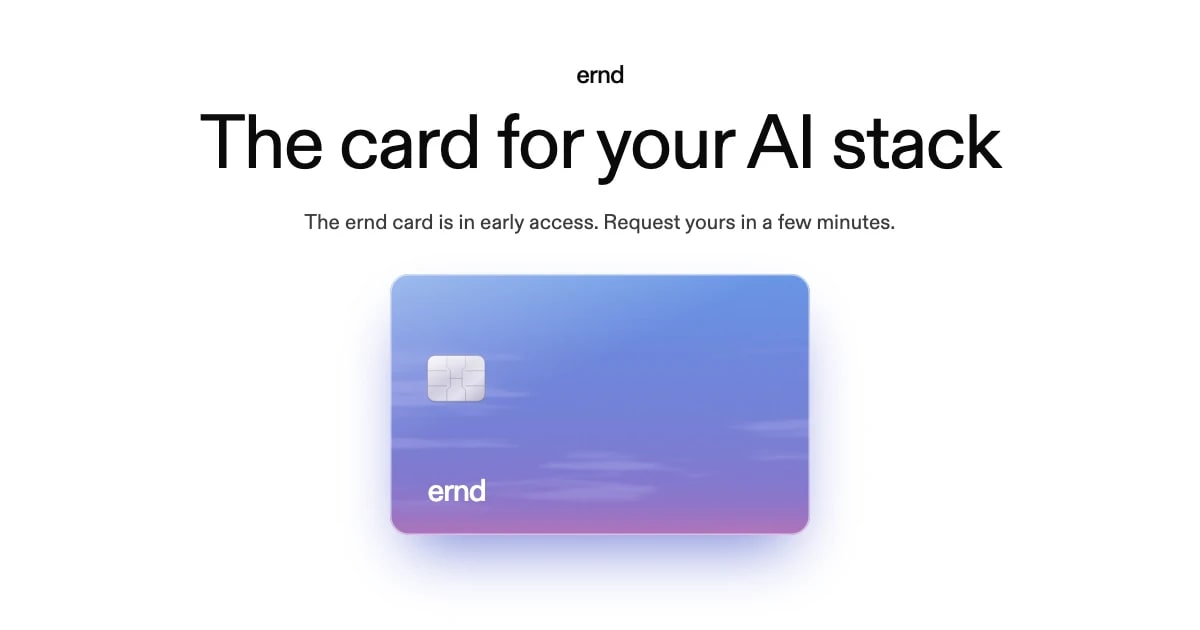
ernd calls itself the credit card for the AI stack, and it is built for US companies that pay for AI. The product is a business credit card whose rewards are weighted toward AI vendor spend: card spend at AI vendors earns 4% back, while everything else earns 1.5%, and the balance is paid off once a month. On top of rewards, ernd negotiates partnerships with AI providers so that cardholders get better pricing and capacity. The company is backed by Y Combinator and is issuing cards to US companies that request them, with requests handled on a first-come, first-served basis.
The context ernd sets out is simple: companies now carry a monthly AI bill, and that spend is spread across vendors. ernd's stated model is that it negotiates the contracts once, and every cardholder gets them. Instead of each company negotiating on its own with each AI provider, ernd negotiates with each provider for all the companies on the card and adds more perks as deals get signed. The card is positioned as a way to get something back from spend a company is already making, while also pooling the terms ernd negotiates with each provider.
The rewards structure is stated directly on the site. Card spend at every AI vendor earns 4% back, and the FAQ confirms this includes OpenAI and Anthropic. Payments to Superserve, Conifer and AgentPhone each earn 5% back. Everything else earns 1.5%. The FAQ adds that the balance is paid off once a month. ernd repeats that final terms come with the card, so the published rates should be read as the current description of the offer rather than a locked contract. For a company routing its AI bills through the card, the gap between a general-purpose business card and a 4% rate at AI vendors is the core of the proposition.
Beyond the earn rates, ernd lists negotiated perks from specific providers, and these are presented as part of the card rather than as separate purchases. Firecrawl offers 2x usage limits. Superserve, Conifer and AgentPhone each offer 5% back. EigenPal offers 5% back on OpenParser and DOCX Editor. Experiential Labs offers 5.5% back. Osto offers a free security stack for the first 100 cardholders. According to the FAQ, these perks come from ernd negotiating with each provider for all the companies on the card, and more are added as deals get signed. The perk list doubles as a signal of which AI vendors ernd is currently working with.
Rewards are issued as points, and the site describes two ways to use them. The first is cheaper work travel: ernd says that because it buys airline points in bulk, it can pass the savings on to cardholders for customer visits, offsites and more. The second is cash back, which the site calls the simple option. ernd notes that a point is worth more at partners like Superserve, so redeeming there is described as the better deal for companies that already use those providers. The FAQ summarises the same position: points are redeemable as cash back and go further on travel ernd books and with recommended providers. Final terms come with the card.
What makes the model distinctive is where the value comes from. The rewards are described as coming from ernd, not from the AI providers: the FAQ states that OpenAI and Anthropic do not sponsor or endorse ernd, that ernd is an independent company, and that companies pay OpenAI and Anthropic with the ernd card the same way they would with any business card. The second source of value is negotiation: ernd signs partnerships with AI providers and extends the resulting pricing and capacity to every cardholder. The site also lists priority GPU and inference capacity as coming soon, presented as another negotiated benefit rather than a shipped feature.
ernd puts a number on the payoff with an on-site estimate. At a monthly AI bill of $10,000, the page estimates the card pays back roughly $4,800 a year. The FAQ adds that requesting a card is free and there is no annual fee, with final terms coming with the card. Taken together, the stated benefits are 4% back on AI spend at every AI vendor, 5% back at named partners, 1.5% back on everything else, access to negotiated provider perks, and a choice between travel savings and cash back when redeeming. The estimate is presented as an illustration tied to the monthly bill entered on the page.
The concrete scenarios the site describes are paying AI vendors, redeeming points on work travel such as customer visits and offsites, and claiming partner perks. A company paying OpenAI and Anthropic monthly would route those payments through the card, as it would with any business card, and the 4% rate applies at every AI vendor. If it also uses Superserve, Conifer, AgentPhone, Firecrawl, EigenPal, Experiential Labs or Osto, the listed perks — extra usage limits, additional cash back, or a free security stack for the first 100 cardholders — attach to that spend. Travel booked through ernd is the alternative redemption path for teams that would rather convert points into cheaper flights.
The card is for US companies. A company admin signs in with a work email or a Google work account and sends the request from the ernd app, which the site says takes a few minutes. The request asks for the company's legal name, type, state, address, phone, EIN, revenue and cash estimates, expected card spend, and the name, title and email of each owner of 25% or more. Submitting a request does not guarantee a card; ernd issues on a first-come, first-served basis and emails the admin about next steps, and a request can be withdrawn from the app at any time. The site also offers a 15-minute booking with Connor.
In short, ernd is a credit card aimed at companies whose AI bills have become a real budget line. It combines 4% back at every AI vendor, 5% back at named partners, 1.5% on everything else, negotiated provider perks, and points that can be taken as cash back or stretched further on work travel, with no annual fee and a request process open to any US company.
Publisher
A
admin
Launch Date2026-11-02
Platformweb
Pricingfree