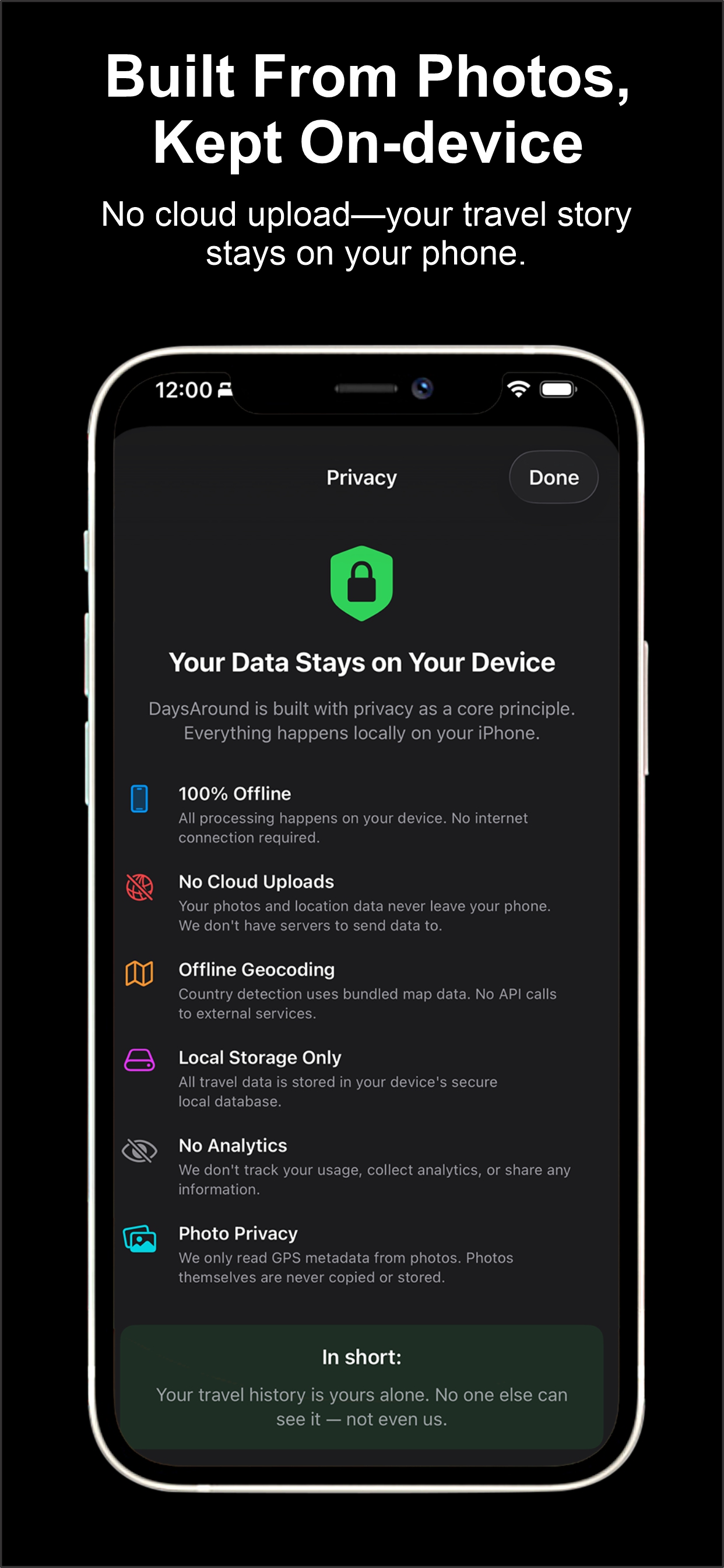
DaysAround is a privacy-first travel tracker consisting of three dedicated iOS apps designed for travelers who need to monitor their days across countries without ever compromising their personal data. Each app addresses a specific need: tracking tax residency thresholds via the 183-day rule, calculating Schengen area 90/180 day compliance, and building an automatic map of countries visited using photo metadata. The core value proposition is radical privacy: no GPS tracking, no cloud syncing, and no user account required. All data processing happens on the device, and the apps contain zero analytics code, ensuring that sensitive travel information never leaves the iPhone. This makes DaysAround ideal for privacy-conscious travelers, expats, and digital nomads who require accurate day counting without unwanted surveillance or data leaks.
Traditional methods for tracking travel days—spreadsheets, manual logs, or cloud-based apps—suffer from critical flaws. Spreadsheets require constant updates and are prone to errors, while many travel apps demand GPS tracking and upload personal data to external servers, creating privacy risks. For travelers managing tax residency or visa compliance, missing even a single day can trigger unintended tax obligations in a jurisdiction or result in overstaying a visa limit, both of which carry serious legal and financial consequences. The pain point is particularly acute for digital nomads, expats, and non-EU travelers who must navigate multiple day-count rules simultaneously. DaysAround solves this by automating the counting process from data that already exists on the phone—EXIF metadata from photos—thus removing manual effort while guaranteeing that no sensitive information is exposed to the cloud or third parties.
The first major feature group is on-device photo metadata reading, which serves as the foundation for all three apps. Rather than requiring users to manually enter dates or activate background location services, DaysAround leverages the EXIF dates stored in each photo taken on the iPhone. The apps read the date and time information only, never accessing the image content itself. This approach enables automatic day counting for any trip retroactively, even years back, as long as photos exist for the period. The utility is immense: a traveler can open the app and instantly see how many days they have spent in a country without any setup or ongoing maintenance. This feature ensures accuracy because it relies on actual timestamps of events, and it preserves privacy because no location or visual data is transmitted.
admin
The second major feature group is the tax residency threshold dashboard, available in the Flags: Tax Residency app. This dashboard displays every jurisdiction's 183-day rule on a single screen, color-coded to show whether the user is safe, close to the limit, or already over it. The app also tracks the home, family, and work ties that can lower the residency threshold—for example, the UK's Statutory Residence Test uses a "sufficient ties" table that can drop the day requirement to as few as 45 days. By monitoring both days and personal connections, DaysAround provides a comprehensive residency risk assessment. Users can quickly see their status for multiple countries, including US states, and take proactive steps to avoid accidental residency. This feature is invaluable for expats, remote workers, and anyone with a nomadic lifestyle who needs to maintain a chosen low-tax residency.
The third set of features combines the Schengen calculator and the countries visited map. The Schengen calculator (App 01) tracks the EU's 90/180 rolling rule using photos, telling users exactly how many days they have used and how many remain, with a simple verdict like "You're safe." It also includes a trip planning tool: before traveling, users can input future dates to see if they will fit within the 90-day limit, and if not, the earliest day they can enter. The app is ETIAS-aware and uses British English for consistency with UK, Irish, and Commonwealth users. The Countries Visited Map (App 02) automatically generates a color-coded map from photos, collecting a flag for each new country and unlocking badges as the count grows (10, 25, continent). Users can export a clean map image to share their travels without exposing the underlying data—a subtle but powerful privacy protection.
The overall workflow across all three apps follows a simple "open, see, close" philosophy. No login, no account creation, no onboarding wizard. Upon first launch, the app requests permission to read photo metadata, and from that point on, it computes the relevant day counts instantly. The apps never communicate with external servers; all computations are performed locally using on-device intelligence. There is no background activity, no push notifications, and no data synchronization. This design means users can check their numbers in seconds and then dismiss the app, confident that their sensitive travel history remains entirely under their control. The privacy page explicitly states that the developer has implemented zero analytics code, reinforcing the commitment to a business model where user data is not the product.
Concrete use cases abound. A British freelance designer living in Portugal uses the tax residency app to track days in both countries, ensuring she stays under the UK's 183-day threshold while proving Portuguese residency. An American backpacker traveling through Europe relies on the Schengen calculator to avoid overstaying the 90-day limit; before each new border crossing, he checks the app to confirm he has enough days left. A German expat working in Singapore uses the countries visited map to automatically document every destination—no manual input, just photos. Outcomes include reduced anxiety about compliance, elimination of tedious spreadsheet maintenance, and a beautiful visual diary of one's travels that can be privately kept or selectively shared via exported images. These scenarios demonstrate how DaysAround turns passive photo libraries into active travel compliance tools.
DaysAround is targeted at iOS users who are frequent travelers, expats, digital nomads, tax residents, non-EU travelers in the Schengen area, and anyone who values privacy in their digital tools. The apps are available exclusively on the iOS App Store and require no additional hardware or subscriptions—all processing happens on the user's iPhone. The tech stack is built with Swift and Core Image frameworks, though these details are not publicly specified. Pricing is not explicitly stated on the website, but the apps are likely premium purchases given the privacy-first approach. The key takeaway is that DaysAround delivers accurate, automatic day counting for tax, visa, and personal travel tracking without any sacrifice of privacy. It is the definitive solution for travelers who want to stay informed about their international presence while keeping their data entirely under their own control.
DaysAround is designed for iOS users who travel frequently and need to track their presence across countries for legal or personal reasons. Primary segments include expats and digital nomads managing tax residency in multiple jurisdictions, non-EU travelers (especially British and American) navigating the Schengen 90/180-day rule, and frequent flyers who want a private map of countries visited. The apps also serve tax professionals or individuals concerned about accidental tax residency, as well as privacy advocates who refuse to trade personal data for convenience. Anyone with a collection of iPhone photos who values accurate, automatic, and completely private day counting will find DaysAround essential.