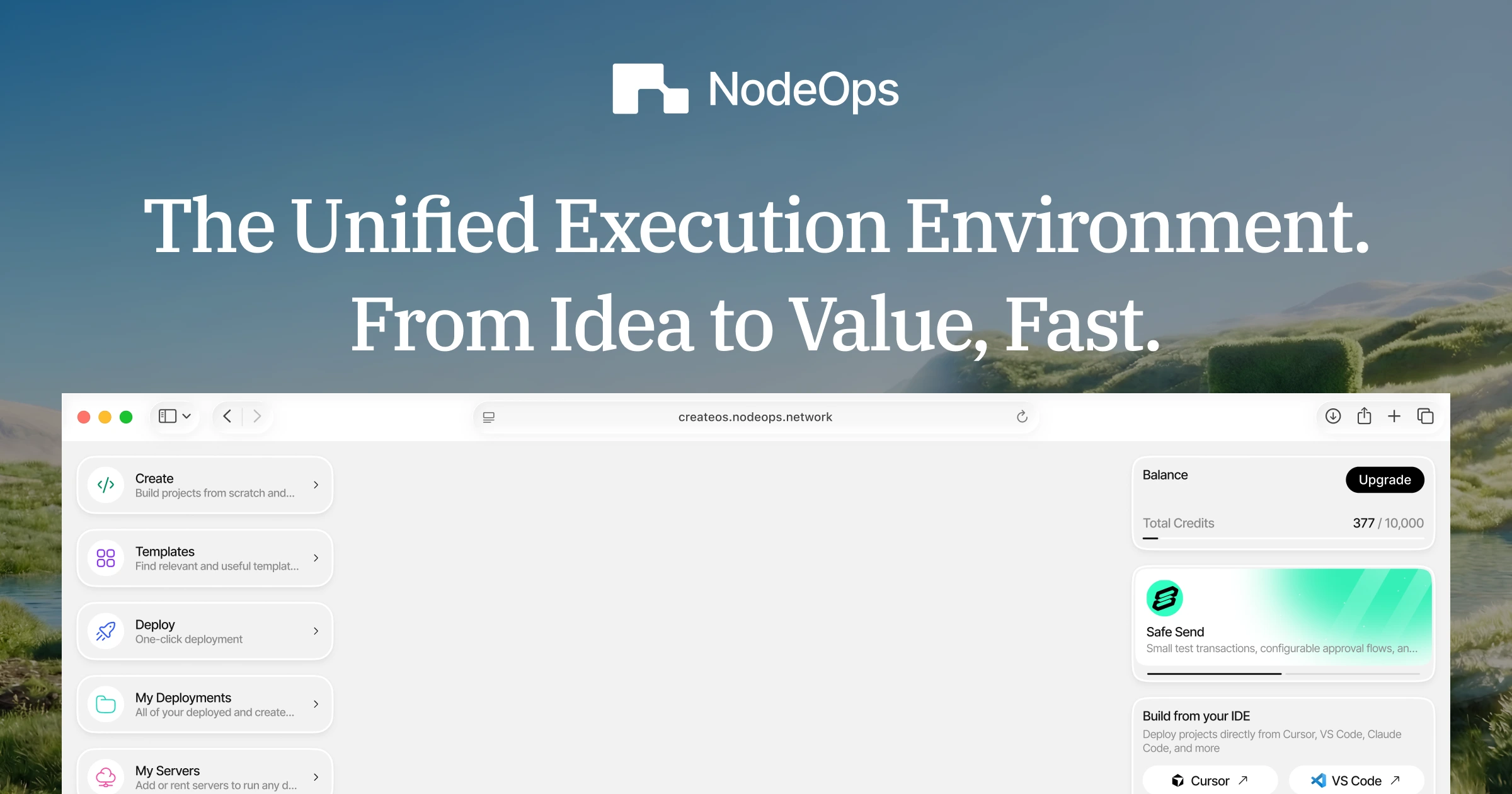
CreateOS is a unified execution environment and AI deployment platform built by NodeOps that covers the entire application lifecycle from ideation to monetization. It replaces 15+ fragmented tools—code editors, CI/CD pipelines, hosting dashboards, domain managers, database consoles—with a single workspace. Designed for vibe coders, indie hackers, and full-stack developers, it supports 14 runtimes including Next.js, React, Python, Go, and Rust, with three deployment methods: GitHub push-to-deploy, Docker containers, and file upload. The AI-assisted builder generates working apps from plain English prompts, integrating with Cursor, VS Code, and Claude Code via MCP. Core value: eliminate DevOps complexity and ship production apps in under 10 minutes.
Modern developers face significant friction: managing 15+ separate tools for coding, testing, deployment, databases, domains, monitoring, and scaling. This tool sprawl leads to context switching, misconfigurations, and delays. CreateOS eliminates this pain by providing a single workspace where every step—from code to production URL—is handled automatically. For AI-first developers, the deployment gap between generated code and live app is a major bottleneck; the average time from AI prompt to production is 7.8 hours in traditional setups. CreateOS reduces this to 12 minutes via MCP integration, making it possible to iterate rapidly and ship features without hiring DevOps engineers.
One-click deployment is the core delivery mechanism of CreateOS. When you connect a GitHub repository, the platform automatically detects your framework, runs the optimal build pipeline, and deploys with zero-downtime rollouts. Every deployment includes automatic SSL certificates via Let's Encrypt, global CDN distribution, load balancing, health checks, and a free .nodeops.app subdomain. Branch previews allow testing changes before merging to production, and automatic rollbacks occur on build failure. This feature alone replaces the need for separate CI/CD pipelines, hosting dashboards, and domain managers, enabling developers to focus on code rather than infrastructure.
The AI-assisted app builder lets you describe your application in plain English and have CreateOS generate architecture, write code, configure deployment, provision databases, and go live. It integrates with Cursor, VS Code, and Claude Code via the Model Context Protocol (MCP), enabling AI agents to deploy directly from your editor. The CreateOS Skill, installed with a single npx command, gives AI agents tools to create projects, upload files, set up environments, configure domains, and generate API keys—all without leaving the IDE. Authentication is handled automatically via MCP, so no API keys are needed. This bridges the gap between AI-generated code and production, making vibe coding truly productive.
admin
CreateOS provides one-click provisioning of production-grade databases: PostgreSQL (ACID-compliant with full-text search), MySQL 8.0 with replication, Apache Kafka for event streaming (up to 100 topics on Pro), and Valkey (Redis-compatible in-memory cache). All databases include automatic backups, point-in-time recovery, connection pooling, and monitoring. On the Pro plan, you get up to 100 GB of SQL storage and 2 GB of Valkey cache. Additionally, GPU compute instances from NVIDIA are available on-demand for AI/ML training, inference, rendering, and fine-tuning, with per-second billing and no long-term commitments. These services integrate directly with your deployments, eliminating separate cloud accounts.
The CreateOS workflow is structured in three steps. First, choose your deployment method: connect a GitHub repository for automatic push-to-deploy, upload a Docker image from any registry, drag and drop files for static sites, or start from one of 150+ templates. Second, configure environment variables, select a region, and optionally provision managed databases with a single click—CreateOS auto-detects your framework and applies the optimal build pipeline. Third, hit deploy and your application goes live with automatic SSL, CDN caching, health checks, and zero-downtime rollouts. From there, you can add custom domains (up to 20 on Pro), monitor logs in real time, run security scans, and scale resources—all from one dashboard.
Developers build a wide range of applications on CreateOS. For SaaS products, they can deploy with Stripe billing, team management, and authentication via Clerk or NextAuth, going from prototype to paying customers without DevOps. AI chatbot creators use templates with OpenAI/Anthropic integration, streaming responses, and RAG pipelines, deployable in minutes. E-commerce stores with product catalogs, shopping carts, and Stripe/PayPal checkout are built using marketplace templates. Admin dashboards leverage Recharts for data visualization and real-time updates. API backends with JWT authentication and rate limiting are deployed as Skills, generating revenue via 80% revenue share. The outcome across all cases is production-grade infrastructure without infrastructure management.
CreateOS is built for a diverse audience: vibe coders and AI-first developers who use Cursor or Claude Code; indie hackers launching MVPs on the free tier; startups scaling with Plus ($49/mo) or Pro ($149/mo); full-stack developers deploying any stack; hackathon teams needing rapid prototyping; and enterprise teams requiring dedicated infrastructure with 24/7 support. The platform integrates with 25+ tools including Stripe, OpenAI, GitHub, Supabase, and Sentry. Pricing starts at $0/month (free tier) with 1 project and 30 build minutes, scaling to Pro with 20 projects, 2,000 build minutes, and marketplace publisher access. Enterprise plans offer unlimited everything and SLAs. In summary, CreateOS unifies AI-assisted building, deployment, managed infrastructure, and monetization into one execution environment—eliminating tool sprawl and enabling builders to ship faster.
CreateOS is built for vibe coders who develop with AI assistants like Cursor and Claude Code and need a frictionless path to production. It serves indie hackers and solo founders launching MVPs without DevOps overhead, startups and growing teams that want to scale from prototype to production without re-platforming, and full-stack developers deploying any stack with managed databases and custom domains. Hackathon teams benefit from rapid prototyping on the free tier, while enterprise teams require dedicated infrastructure with SLAs and priority support. In short, any builder who wants to eliminate tool sprawl and ship software faster will find CreateOS valuable.