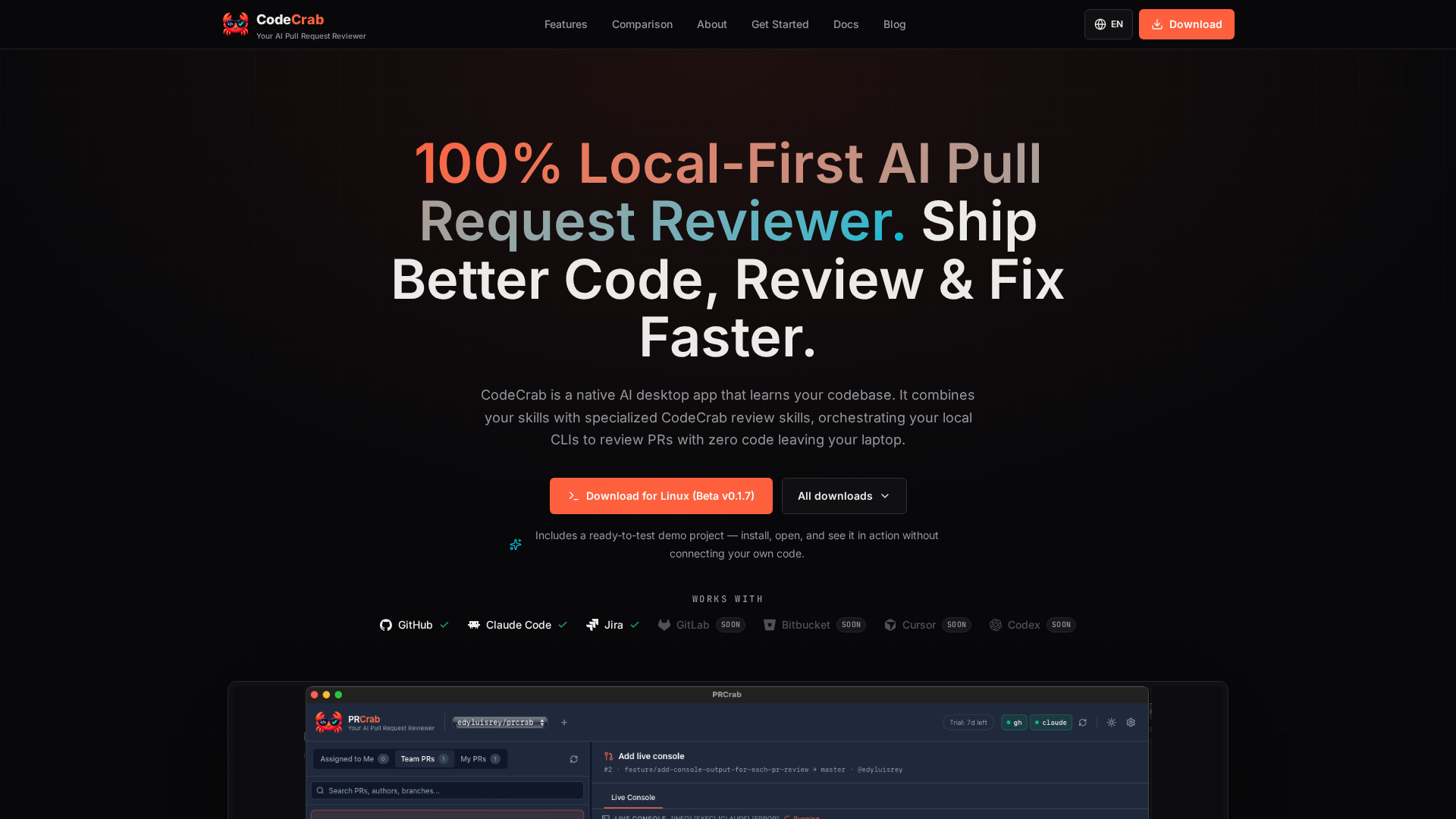
CodeCrab is a native, local-first AI desktop application that reviews pull requests in seconds by orchestrating the CLIs already installed on your machine. It is built for software engineers who review code daily and want to move faster without sending a single line of their source code to a cloud service. The app learns your codebase, combining the skills you already use with specialized CodeCrab review skills, and applies that understanding across three main moments in the development workflow: reviewing a teammate's pull request, responding to feedback on your own pull request, and reviewing local changes before a pull request even exists. Everything runs client-side on your laptop, and the product is currently available as a free public beta for Linux.
The problem CodeCrab addresses is the shift in the engineering bottleneck. As AI toolsets generate code at unprecedented speeds, the author of the product — a software engineer with more than 14 years of experience, including years building systems at Google and Pinterest — observed that the primary constraint moved from writing code to reviewing pull requests efficiently. Deep review is hard: reviewers must hold full repository context in mind, evaluate diffs, and catch logic bugs, risky patterns and regressions before approving. Cloud-based review bots add a second concern: to review your code, they require your source to be uploaded and processed on vendor cloud servers. CodeCrab was built initially as a personal tool to perform deep, Staff-level code reviews fast, without uploading sensitive private code to third-party servers.
When you open a pull request from a colleague, CodeCrab walks through the diff with you and maps AI observations directly onto the changed lines, so you can catch bugs, risky patterns and regressions before hitting "Approve". The review is not limited to the diff itself: CodeCrab reviews against your entire local repository, including types and the test suite, so its observations account for full codebase context rather than isolated changed lines. Because the review is 100% local-first, it can detect logic bugs and regressions without uploading a single line to the cloud. The live review interface shows a file tree, a diff viewer and inline AI observations, and features clear changed-file tracking with inline observation badges for clean multi-file diff inspection and precision navigation.
When a teammate leaves an observation on your own pull request, CodeCrab runs a deep investigation for you. It digs through the code around every comment, connects that code with your project's context, and helps you understand — as precisely as possible — what the observation really means and what the correct solution looks like. The investigation is deep and read-only, covering every reviewer observation on the diff, so nothing changes on your branch while you are still reasoning about the feedback. From there, CodeCrab can propose an assisted fix on your local branch, and that fix is verified against your own test suite before it is applied. The result is a workflow that turns review comments into the right solution rather than a guess.
CodeCrab also reviews your local changes before a pull request exists. While you are still working locally, you can run a read-only review of your in-progress changes; CodeCrab detects errors early, investigates every finding as deeply as needed, and helps you apply the right fix while the context is still fresh. Because this happens before anyone sees the diff, the pull request you eventually open ships cleaner, higher-quality code. The pre-push review keeps the same privacy posture as everything else in the app: your local changes are analyzed locally, so you get early feedback without exposing unfinished work to a cloud service. The product describes this as catching bugs before the pull request even exists.
CodeCrab is designed to plug into your existing workflow rather than replace it. Connect any repository and CodeCrab learns its rules and patterns, building a per-repo review profile that powers specialized review agents and custom skills. That means reviews are tuned to your codebase, and your own local skills can be reused, combined with CodeCrab's skills, and extended as far as you need. The app integrates with GitHub, Claude Code, Jira and GitLab today, with Bitbucket, Cursor and Codex listed as coming soon. Under the hood, CodeCrab orchestrates your local CLIs: it uses your own GitHub CLI login (gh) rather than requiring org-wide OAuth admin permissions, and it works with your local Claude Code and Cursor setups instead of locking you to a vendor's fixed model wrappers. A Live Execution Console displays real-time stdout and stderr, so the execution pipeline is transparent rather than an opaque black box.
Privacy is the product's core promise. CodeCrab uses a 100% on-device architecture with zero-code uploads: your source code never leaves your laptop or passes through external cloud databases, and the product is described as compliance-ready for strict corporate environments where no code may be sent to third-party AI clouds. Control follows from that architecture: CodeCrab is read-only by default and never commits, pushes, or posts public GitHub comments without your explicit permission. When it does propose changes, it runs your native test suite — cargo test, pytest, npm test — before applying them, and it offers 1-click local fixes in the form of verified code patches ready to apply directly to your local branch. The app is a native desktop application with instant, lightweight performance, minimal RAM consumption and instant startup. Economically, it reuses what you already pay for: it connects directly to the tools and subscriptions you already own, such as Claude Code and Cursor, and it gives you full model and cost control so you can choose which AI models to run and control exactly how much you spend on code reviews.
These capabilities map onto concrete moments in a day-to-day engineering workflow. In a typical review cycle, a developer opens a colleague's pull request in CodeCrab, walks the diff with inline AI observations mapped to the changed lines, and reaches an approval decision with full repository context rather than a diff-only view. On the other side of the same workflow, a developer whose pull request has received reviewer comments uses CodeCrab to investigate each observation deeply in read-only mode and then apply an assisted fix on the local branch, verified against the test suite. Between those two moments, the pre-push review covers local, uncommitted work so errors are found before the pull request exists. Teams working in strict corporate environments use the same app because no code is uploaded anywhere. And for anyone evaluating the product, the bundled demo project lets you install, open and see it in action without connecting your own code.
CodeCrab is a native desktop application, currently distributed as a free public beta, with a Linux download available at Beta v0.1.7 (amd64 AppImage) and additional downloads listed on the site. It is the product of an engineer named Edy, who has more than 14 years of experience, including years building systems at Google and Pinterest, and who describes CodeCrab as initially a personal tool that is now being actively refined during public beta based on real engineering workflows. The product integrates with GitHub, Claude Code, Jira and GitLab today, with Bitbucket, Cursor and Codex listed as coming soon. Its stated points of integration include your local Claude Code and Cursor setups, your local custom skills, the GitHub CLI (gh) for authentication, and native test runners such as cargo test, pytest and npm test.
CodeCrab's value proposition is narrow and clear: it brings deep, fast, local AI pull request review to a desktop app that never uploads your code. By orchestrating the local CLIs and subscriptions you already own, mapping observations onto your diffs, investigating reviewer feedback deeply, and verifying fixes against your own tests, it accelerates review without asking you to trade away privacy or control. For engineers and teams who care where their source code ends up, CodeCrab offers the same kind of review acceleration associated with cloud bots, delivered from a 100% client-side architecture.
Publisher
A
admin
Launch Date2026-10-07
Platformdesktop
Pricingfree