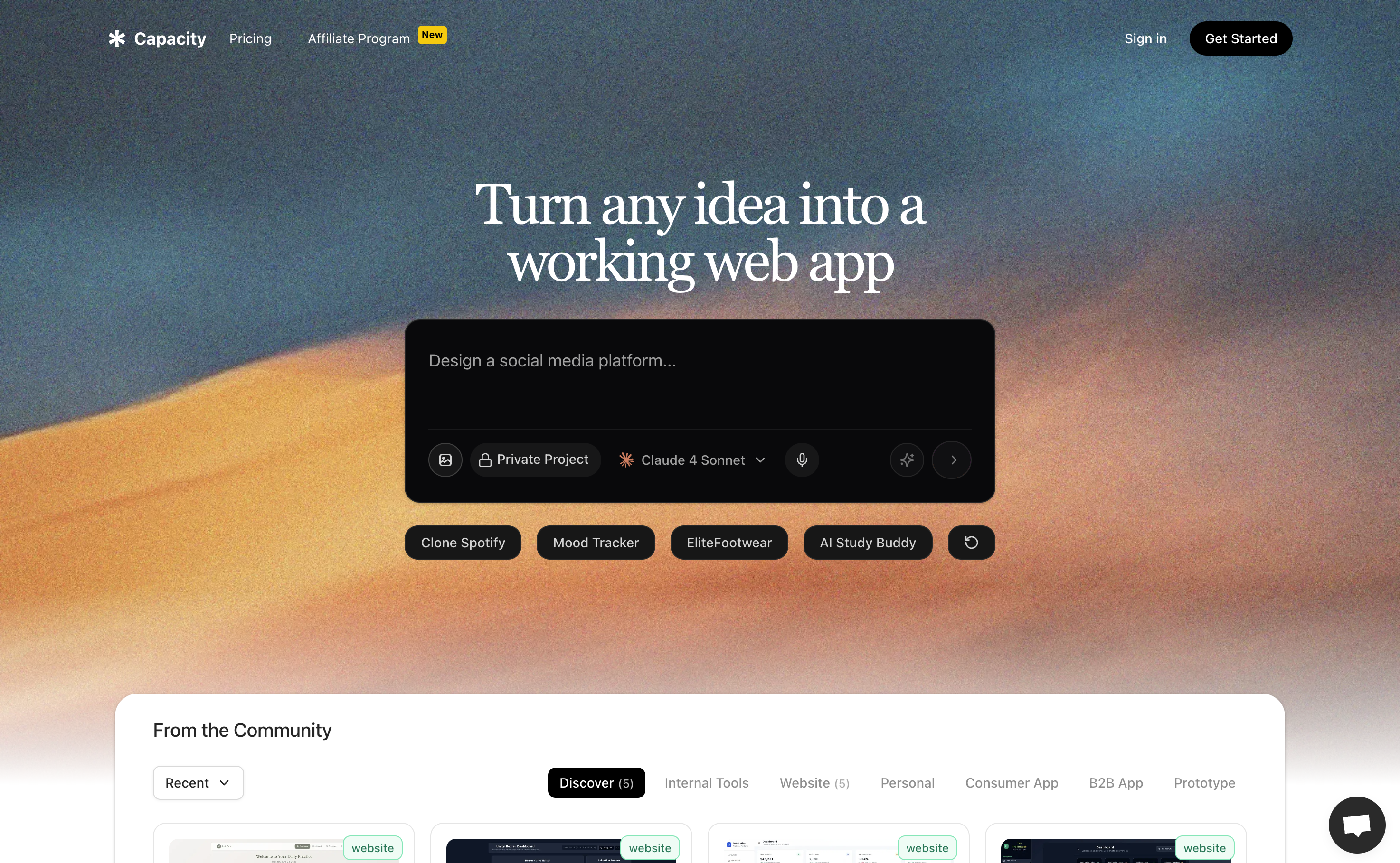
Capacity is an AI-powered platform that builds full-stack web applications using Spec Coding methodology. It generates production-ready React applications with Tailwind CSS, TypeScript, and tRPC/REST APIs that can be deployed instantly to Vercel or AWS.
Capacity is an AI-powered spec coding platform that enables users to build full-stack web and mobile applications through natural language conversations. It belongs to the emerging category of AI-assisted development tools, targeting makers, founders, and non-technical creators who want to ship production-ready apps without writing code. The platform's core value lies in its ability to generate complete React and React Native applications with a real Express backend and SQLite database, all owned by the user. By combining an AI Co-founder assistant with Spec mode for planning, Capacity transforms vague ideas into deployable software in minutes. This approach removes traditional barriers to app development, making it accessible to anyone with a clear vision.
Many entrepreneurs and product builders struggle to turn their ideas into functional software due to the complexity of coding, design, and infrastructure setup. Traditional development requires hiring engineers, managing servers, and dealing with vendor lock-in, which slows down iteration and increases costs. Capacity solves this pain by allowing users to simply describe their vision in plain English, while the AI handles all technical implementation. This matters because it dramatically reduces the time from idea to prototype, enabling faster validation and market entry. Users no longer need to worry about learning frameworks or configuring databases; they can focus on refining their concept and value proposition. The result is a significant reduction in the friction that kills many promising projects before they see the light of day.
The AI Co-founder is the central feature of Capacity, acting as a strategic partner that works alongside users around the clock. This assistant helps clarify requirements, suggests improvements, and generates code in real time. For example, when a user inputs a vague idea, the AI Co-founder asks clarifying questions to refine the scope, then produces a detailed project brief with goals, user flows, and design considerations. This iterative process ensures that the final application aligns with the user's vision without requiring technical expertise. The AI Co-founder also provides ongoing support during development, offering recommendations for features, performance optimization, and even content strategy. By handling the heavy lifting of planning and coding, it enables users to build sophisticated apps they could not create alone.
Spec Mode is a distinctive feature that encourages users to plan before coding. Instead of jumping straight into implementation, Spec Mode guides users through creating a comprehensive specification document that covers project brief, user experience, design components, and technical architecture. This methodology, called "Spec Coding," ensures that every build is grounded in a clear plan, reducing rework and misalignment. The AI Co-founder assists in crafting these specifications, offering templates and examples based on best practices. Once the spec is complete, Capacity uses it to generate code that faithfully implements the planned features. This approach is particularly valuable for complex projects where a structured foundation prevents scope creep and ensures the final product meets all requirements. Spec Mode turns unstructured ideas into actionable roadmaps.
Publisher
A
admin
Launch Date2026-01-08
Platformweb
Pricingfreemium
Tech Stack
#React#Tailwind CSS#TypeScript#tRPC#REST APIs