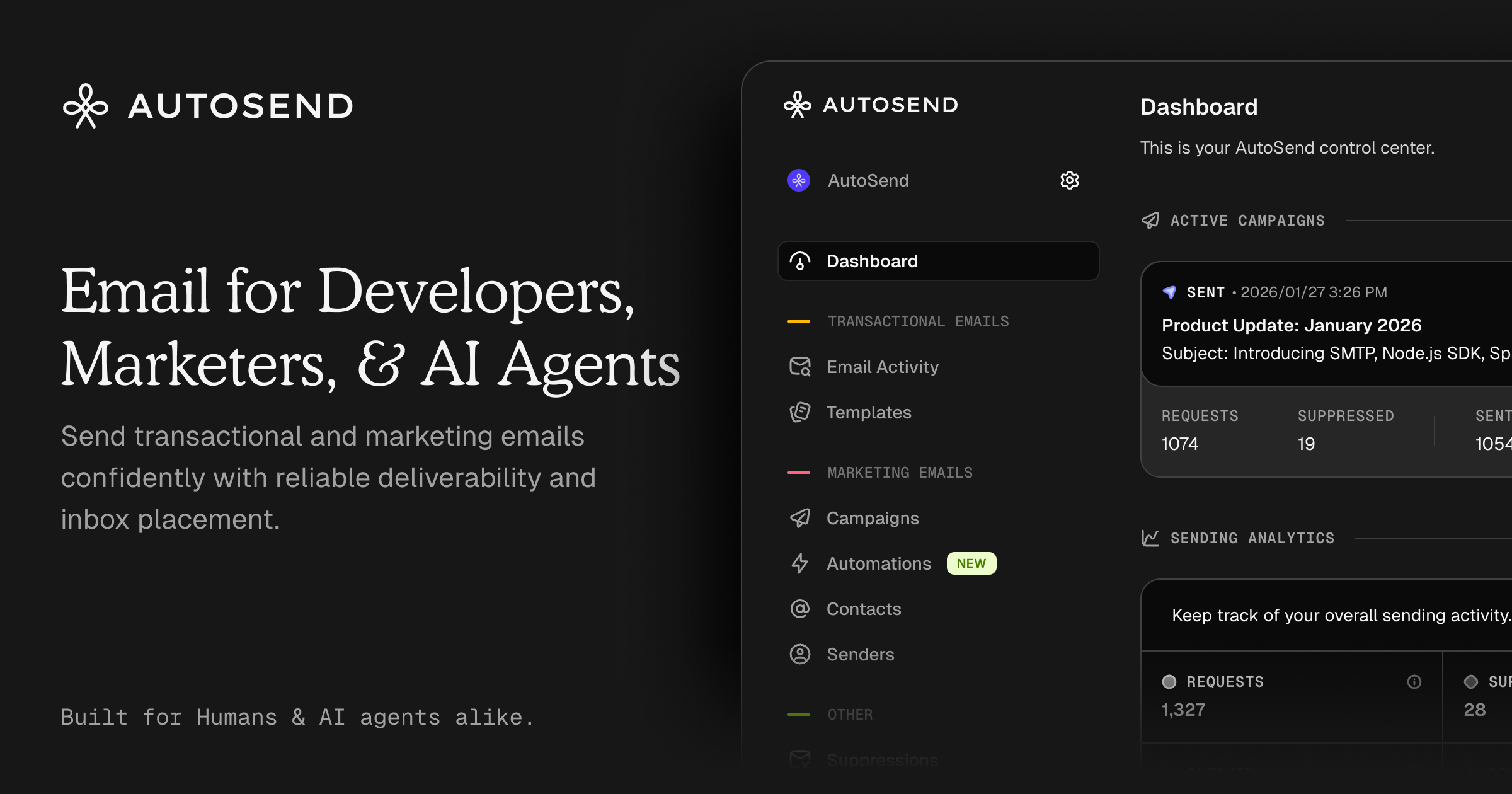
AutoSend is an AI-native email delivery platform that consolidates transactional, marketing, and automation email capabilities into a single, volume-priced service. Designed for teams who ship with AI agents, AutoSend provides an email API for AI agents that integrates natively with LLM workflows, enabling reliable email sending, campaign management, and contact orchestration directly from agentic applications. With a clean REST API, OpenAI-compatible MCP server, and language SDKs, it’s the ideal infrastructure for modern SaaS startups, AI product builders, and marketing teams that demand high deliverability and seamless automation. By charging per email volume instead of per contact, AutoSend eliminates the cost penalties of large user bases, making it a go-to email platform for growth-focused teams.
Traditional email service providers were never designed with AI agents in mind. Developers building agent-driven applications often face complex workarounds to let LLMs send emails, manage lists, or trigger campaigns. AutoSend solves this pain point by offering a Model Context Protocol (MCP) server and a skill.md file that equip AI assistants with full operational knowledge of the email API. This means your ChatGPT, Claude, or custom agent can build email templates, segment audiences, and monitor deliverability without manual coding. Beyond agent compatibility, many legacy platforms charge per stored contact, which becomes prohibitively expensive for apps with large free-tier user bases. AutoSend’s volume-based model removes that barrier, offering predictable costs that scale with actual sending, not database size.
At the core of AutoSend’s transactional offering is the Email API, a lightning-fast REST interface for sending OTPs, password resets, account notifications, and other critical messages. The API supports both pre-saved templates and raw HTML/text payloads, includes built-in unsubscribe group handling for compliance, and returns real-time delivery confirmations. Developers can integrate using AutoSend’s official SDKs for Node.js, Next.js, and other frameworks, or simply plug into existing systems via SMTP without any code changes. Webhooks provide granular event notifications for deliveries, opens, bounces, and failures, enabling automated alerting and analytics. This robust infrastructure delivers 97.36% deliverability and an average inbox placement time of just 1.87 seconds, ensuring that time-sensitive communications reach users promptly.
What truly sets AutoSend apart is its MCP integration for AI agents. The MCP server allows LLMs to call the AutoSend API directly, performing tasks like creating marketing campaigns, managing contact lists, fetching delivery stats, and sending transactional emails on behalf of users. Paired with the skill.md file—a natural language guide that explains AutoSend’s capabilities and best practices—agents can autonomously handle complex email operations. This design makes AutoSend the first email platform purpose-built for the agentic era, enabling scenarios where a user can ask their AI assistant to draft a weekly newsletter, select the target segment, and send it, all through conversational commands. For teams shipping AI-powered products, this eliminates the custom middleware typically required to connect language models to email infrastructure.
admin
For marketing teams, AutoSend offers a full-featured campaigns system that includes a markdown-based Email Builder, Domain Warmup, and Dynamic Segmentation. The Email Builder lets content creators craft beautiful emails without relying on developers, offering instant previews and fast shipping. Domain Warmup gradually builds sender reputation with mailbox providers, protecting deliverability for new domains. Dynamic Segmentation allows marketers to slice audiences based on real-time behavior, contact properties, and engagement signals, ensuring that each message reaches the right people. Combined with the automation engine, users can set up Smart Triggers that launch welcome series, onboarding drips, or re-engagement flows automatically when a user completes a specific action or when a contact property changes.
The platform’s email automation capabilities tie everything together. Using Smart Triggers, you can define automations that fire based on user actions (e.g., sign-up, purchase), changes in contact properties, or custom events sent from your product via the API. Visual Analytics & Insights show opens, clicks, and conversions as they happen, allowing teams to spot what’s working and iterate on campaigns. The workspace supports Multiple Projects: each product, client, or environment gets an isolated project with its own contacts, domains, and API keys, all rolled into a single bill. This architecture suits agencies and multi-product companies that need separation without administrative overhead. Pricing remains volume-based across projects, so you never pay for unused contacts.
Concrete use cases span across industries. A fintech app uses AutoSend’s Email API to send OTPs and transaction alerts with sub-second delivery, maintaining high security and low bounce rates. An e-commerce platform leverages Dynamic Segmentation and Smart Triggers to automate personalized product recommendations and cart-abandonment flows, increasing conversions by targeting users based on browsing behavior. An AI startup deploys the MCP server so its ChatGPT-powered assistant can compose and send follow-up emails to leads, pulling data from the CRM. An agency managing email for multiple clients uses isolated projects to keep lists and domains separate while enjoying a unified billing view, and one customer reported supporting 190,000 users on a $50 plan without compromising deliverability.
AutoSend is built for developers, AI engineers, marketing professionals, and startups that need reliable, scalable email infrastructure. The tech stack supports REST APIs, SDKs in Node.js, Python, Go, Java, PHP, Rust, and C#, plus SMTP for legacy systems. Integrations with popular AI platforms like ChatGPT, Claude, Copilot, Cursor, and Lovable make it the go-to email layer for agent-driven applications. With transparent volume pricing and no per-contact fees, it aligns cost with actual usage. In summary, AutoSend is more than a SendGrid alternative—it’s a forward-looking email platform that delivers exceptional deliverability, rich campaign tools, and deep integration with the AI tools teams already use, all under one roof.
AutoSend targets developers and engineering teams building SaaS products that need a reliable transactional email API, especially those incorporating AI agents into their workflows. AI/ML engineers and prompt engineers who design LLM-driven applications benefit from AutoSend’s native MCP integration and skill.md, enabling agents to send emails without custom middleware. Marketing teams and growth managers seeking an intuitive campaign builder, automation, and segmentation without per-contact fees will find the platform cost-effective. Startups and digital agencies managing multiple client projects appreciate isolated project support and volume-based pricing that scales with usage. The platform is ideal for anyone looking for a SendGrid alternative that combines transactional, marketing, and agentic email capabilities.