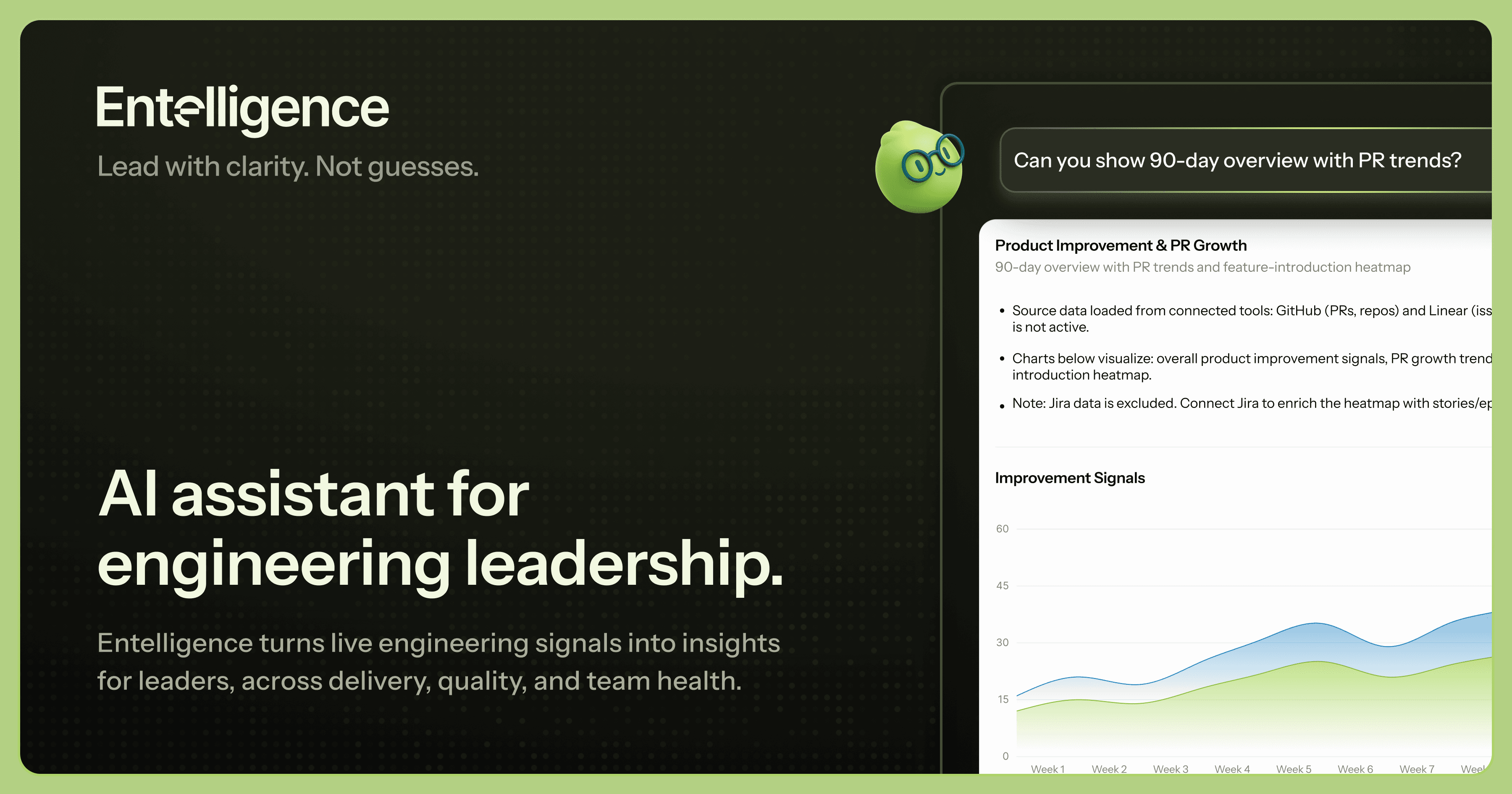
Ask Ellie is an AI chat agent that brings engineering context into Slack. It provides instant answers about code changes, PR status, sprint velocity, production issues, and analytics by pulling data from your actual tools.
Ask Ellie is an AI-powered chat agent from Entelligence AI that lives inside Slack and serves as a direct answer engine for engineering teams. It pulls data from code repositories, release pipelines, incident logs, and product signals to answer natural language questions instantly. The core value is eliminating the need to dig through multiple dashboards or context-switch between tools — instead, users get one clear, contextual answer. This engineering AI assistant is designed for leaders, managers, and developers who need fast, reliable insights without manual data gathering. It connects signals across GitHub, Linear, and other tools to provide a unified view of the engineering workflow.
Engineering leaders often struggle to get quick answers about team velocity, code health, or production stability because information is scattered across different platforms. Ask Ellie solves this by enabling anyone to ask questions directly in Slack and receive composited answers that pull from real-time data. This reduces time spent on manual reporting and context switching, allowing teams to make faster, more confident decisions. The pain point is especially acute during releases or incident response, where every minute counts. Ellie’s ability to surface what changed and why eliminates guesswork and helps teams stay aligned.
The first major feature is "Generates reports on demand." Ellie understands PRs, reviews, commits, and delivery flow from GitHub and Linear. Users can ask questions like "What changed this sprint?" or "What slowed down the last release?" and Ellie will analyze the data to provide a concise report. It works by fetching commit history, pull request statuses, and cycle time metrics, then synthesizing them into a plain-English answer. This is useful because it removes the need to manually compile spreadsheets or log into multiple tools — the answer is delivered instantly in Slack.
The second feature group is "Answers real engineering questions." Instead of presenting raw metrics or dashboards, Ellie gives direct responses with a chart only when it enhances understanding. Users ask questions in Slack like "Which teams have the best vs worst cycle time?" or "What’s our bug backlog trend?" and Ellie returns a natural language answer. The system is integrated with Slack, so it fits naturally into existing workflows. This approach reduces cognitive load because users don’t need to interpret complex dashboards — they get the insight they need, in their preferred channel.
Publisher
A
admin
Launch Date2026-02-02
Platformweb
Pricingfreemium
Domain Authority
Ahrefs DR42/100
Traffic Insights
Month2026-10
Estimated Visits1.5K
MoM Visits Growth+0.0%(+0)
Avg Time on Site-