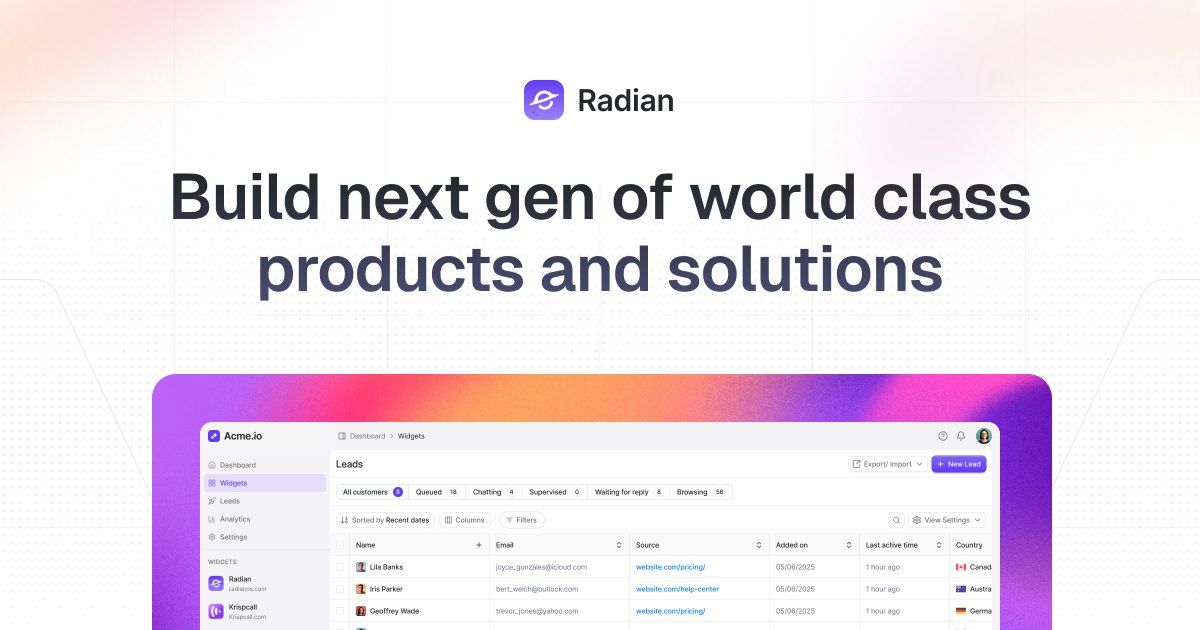
Radian is an open-source UI kit and React development library that keeps design and code in sync. It provides production-ready components and tokens for building consistent interfaces.
Radian OS is an open-source React design system and component library engineered to bridge the gap between design and development for modern web applications. Built on top of React, Radix, and Tailwind CSS, it delivers a comprehensive collection of production-ready UI components, blocks, and design tokens. It is designed for product teams, UI/UX designers, and front-end developers who need to build world-class products with speed, scale, and simplicity. Radian OS provides a unified workflow that ensures pixel-perfect consistency from Figma designs directly into code, eliminating the typical friction of handoff. Its core value lies in enabling teams to go from idea to implementation faster than ever, without sacrificing quality or flexibility.
In typical development cycles, design specifications often get lost in translation, leading to inconsistent user interfaces, wasted time on rework, and frustration between designers and developers. The pain point is amplified when teams juggle multiple tools and maintain separate sources of truth for styles and components. Radian OS addresses this by offering a single, cohesive system where design variables and code components stay perfectly synchronized. This eliminates the tedious back-and-forth of recreating designs manually and reduces errors, so teams can focus on innovation instead of alignment. For startups and enterprises alike, the ability to ship polished, responsive interfaces quickly is a critical competitive advantage that Radian delivers.
Radian OS provides an extensive library of high-quality base components, including buttons, inputs, checkboxes, dialogs, dropdowns, tabs, tables, and over a dozen others, each crafted with meticulous attention to detail and adherence to accessibility best practices. These components are composable and fully customizable, allowing developers to import only what they need via a tree-shakable architecture. Using Radian’s CLI command npx radianui@latest init --next, or simply copying and pasting code snippets, developers can instantly integrate these solid, reusable building blocks into their projects. The components are type-safe, eliminating common code errors, and are designed to seamlessly adapt to any project of any size. This accelerates development while maintaining a uniform, professional look across the entire application.
One of Radian OS’s standout capabilities is its Seamless Design to Code Sync with Figma. By leveraging a Figma variable system and auto layout, changes made in design files are easily replicable in code, guaranteeing pixel-perfect consistency. The integrated workflow allows designers to create all user flows using reusable blocks directly within Figma, and then developers can pull those blocks from the Radian Blocks directory into their codebase. This eliminates manual translation errors and speeds up the iteration cycle. Teams can modify screens to match updated requirements, and those modifications propagate naturally, ensuring that the final product always mirrors the approved design. It fundamentally streamlines the design-to-development pipeline, making collaboration truly efficient.
Publisher
A
admin
Launch Date2026-02-05
Platformweb
Pricingfree
Tech Stack
#React#Tailwind CSS#TypeScript#Radix#Next.js
Domain Authority
Ahrefs DR0/100