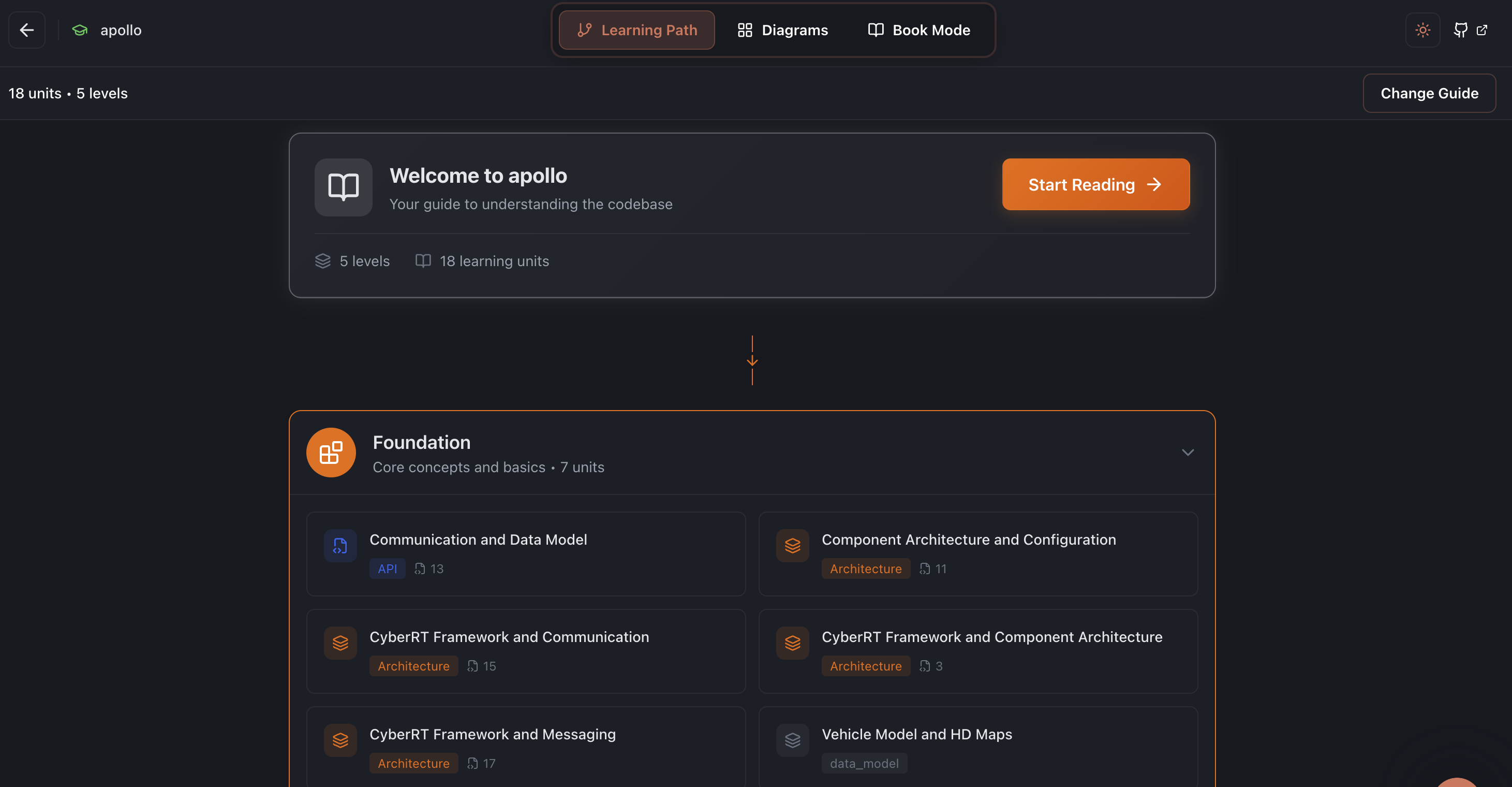
OS Ninja is an AI-powered platform that transforms complex open source codebases into interactive, AI learning paths designed for developers and engineers who want to explore and understand the architecture of popular repositories. By leveraging advanced codebase analysis, it creates structured tutorials that adapt to individual learning preferences, making open source accessible and comprehensible. The core value lies in turning what was once a daunting task into a guided journey, addressing the need for up-to-date, code-aware education in a fast-moving ecosystem where traditional wikis quickly become obsolete. Users can dive into any project from AI frameworks to distributed systems and immediately receive a personalized curriculum tailored to their learning style.
Traditional wikis and static documentation have struggled to keep pace with the rapid evolution of open source codebases. Developers often waste hours navigating scattered resources, outdated README files, and incomplete guides just to understand a single repository. OS Ninja solves this pain point by performing deep, automated research on the entire codebase, distilling it into coherent learning paths that stay current. This matters because time spent searching for documentation is time taken away from actual development and contribution. By replacing the manual, fragmented learning process with an AI-driven approach, engineers can quickly gain a holistic understanding of the code, its patterns, and its architecture, enabling faster onboarding, more confident contributions, and deeper mastery of the technology they rely on.
The first major feature group is 'Discover & Request,' which allows users to search for any open source project by name or keyword. If a desired repository is not yet in the library, users can submit a request, prompting the system to analyze and add it. This ensures comprehensive coverage of millions of open source projects and eliminates the friction of hunting for quality learning material. The benefit is immediate: developers no longer waste time curating their own study resources. Instead, they simply request the repo, and within hours, a structured learning path is generated. This feature democratizes access to codebase knowledge, making it possible for anyone to dive into even the most complex projects with confidence and clarity.
The second major feature group is 'Deep Research,' which describes the engine's comprehensive analysis of an entire codebase to generate structured learning paths. The site states this high-fidelity research can take up to 24 hours, reflecting the thoroughness of the process. During this time, the engine examines file structures, dependencies, function relationships, and architectural patterns to create a logical progression of learning units. The output is a detailed, chapter-based breakdown of the repository, including explanations of key components and their interactions. This is useful because it saves developers days or weeks of manual reverse-engineering, providing a canonical path through the code that even experts can use to quickly grasp unfamiliar areas.
admin
The third feature group is 'Your Learning Style,' which offers three pedagogical approaches: Socratic questioning, the Feynman technique, and traditional book format. Socratic questioning engages users through probing questions that stimulate critical thinking, ideal for those who learn by asking 'why.' The Feynman technique simplifies complex concepts by teaching them in plain language, perfect for building deep understanding. The book format presents the material as structured chapters, suitable for linear, reference-style learning. By allowing users to choose their preferred method, OS Ninja adapts to how individual brains best process technical information. This personalization increases retention and reduces cognitive load, making the learning experience more effective and enjoyable.
OS Ninja operates through a clear, three-step workflow: Discover & Request, Deep Research, and Learning Style customization. First, the user searches for or requests a repository. Once the request is submitted, the platform's engine begins its comprehensive analysis, which may take up to 24 hours for high-fidelity results. After analysis completes, the system generates a structured learning path composed of multiple units or chapters. The user then selects their preferred learning style, and the content is presented accordingly. This approach blends AI automation with human-centered customization, ensuring that the output is both accurate and pedagogically sound. The entire process is designed to be as effortless as possible, requiring minimal input from the user while delivering a tailored, in-depth educational experience.
Concrete use cases abound across many domains. A developer encountering the async runtime internals of Rust can search for 'tokio' and receive 142 learning units presented in the Feynman mode, breaking down the concurrency model step by step. A student exploring blockchain can request the Solidity repository and receive a Socratic tutorial that questions each contract pattern. An engineer preparing to contribute to a game engine like Godot can request a deep research path covering rendering pipelines and scripting APIs. Outcomes include faster onboarding to new codebases, reduced time-to-contribution, and the ability to compare architectural decisions across different implementations. Users come away with not just knowledge, but a mental model of the code that persists long after the tutorial ends.
Target users include software developers, open source contributors, engineering students, technical leads, and AI engineers who need to quickly comprehend unfamiliar repositories. The platform integrates with coding agents via an MCP server, allowing automated tools to query learning paths and repo summaries directly. While pricing or plan details are not mentioned on the page, the service is supported by XHawk and offers a free newsletter for AI-native development trends. OS Ninja is currently web-based, accessible from any browser, and provides curated collections for major categories like AI, Data, Robotics, and Distributed Systems. The primary takeaway is that OS Ninja eliminates the friction of understanding open source by delivering personalized, AI-driven learning paths that scale across the entire open source universe.
Software developers, open source contributors, engineering students, technical leads, and AI engineers who need to quickly understand unfamiliar repositories. The platform serves anyone who wants to go beyond reading documentation and truly grasp a codebase's architecture, patterns, and design decisions. It is especially valuable for those contributing to large projects like Kubernetes, React, or LLVM, as well as learners looking to master specific domains such as distributed systems, machine learning, or game development.