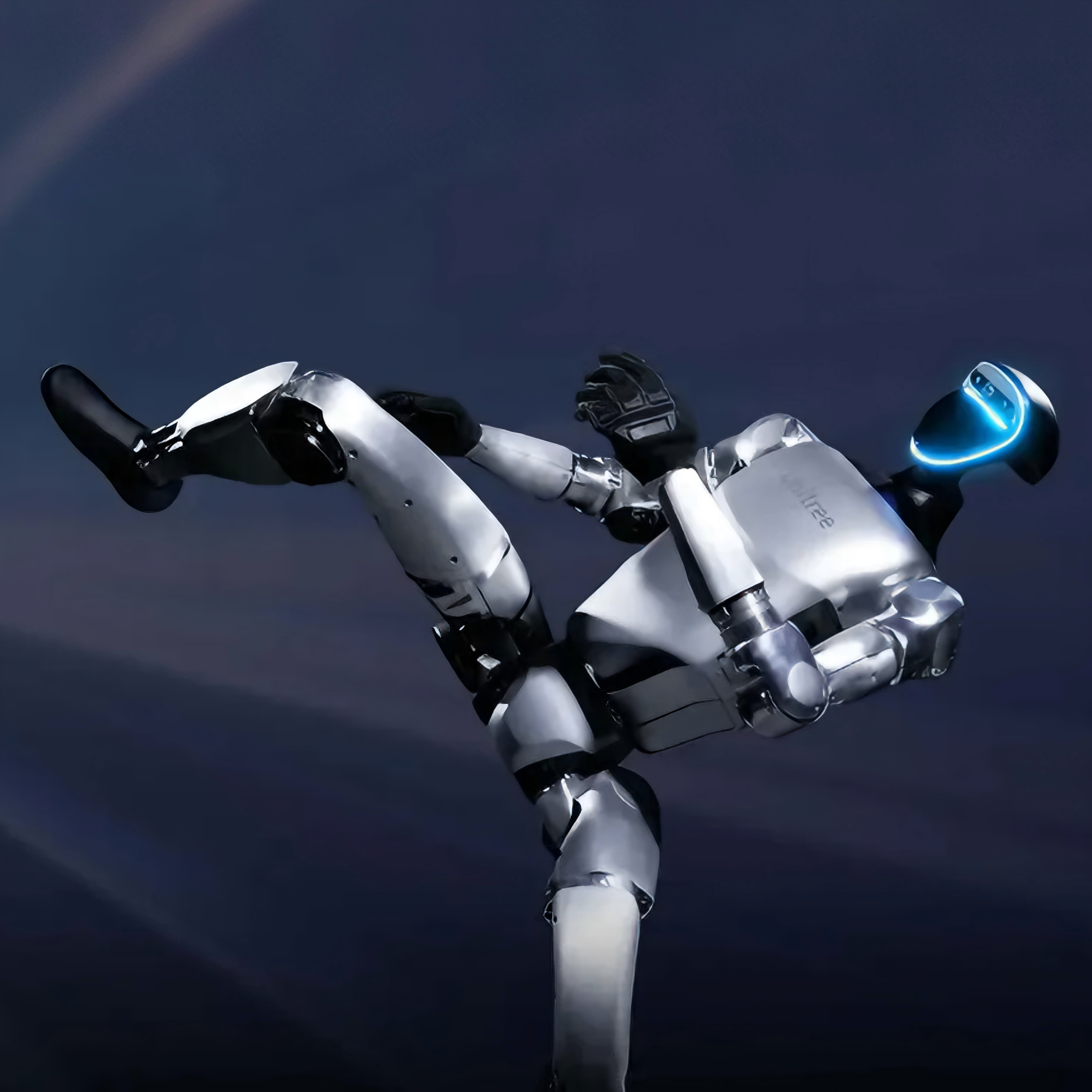
OmniXtreme is an open-source control framework that breaks the generality barrier in high-dynamic humanoid control. Developed as a research project presented at RSS 2026, it targets robotics researchers and engineers who need a unified approach to whole-body control across an extreme range of behaviors. The core value lies in its ability to handle diverse, high-dynamic motions—from backflips and handstands to breakdancing sequences—within a single learned policy. By unifying control, it simplifies the development pipeline and opens new possibilities for agile humanoid robots in research and real-world applications.
Traditional humanoid control systems typically address a narrow set of motions with specialized policies, leading to a fundamental generality problem. When robots need to perform a sequence that includes both low-speed precise movements and high-dynamic explosive actions like backflips or webster flips, separate controllers must be designed, trained, and switched. This approach is inefficient, time-consuming, and limits the robot's ability to adapt to unexpected scenarios. OmniXtreme directly solves this pain point by providing a unified framework that learns from multiple motion tracking experts simultaneously. Instead of retraining for each new behavior, the system aggregates diverse motion priors into a single base policy, reducing development overhead and enabling smooth transitions between radically different behaviors.
The pre-training phase of OmniXtreme employs a DAgger-based Flow Matching algorithm to aggregate diverse motion priors from different tracking experts. DAgger (Dataset Aggregation) iteratively improves the policy by collecting corrective examples from expert demonstrations. Flow Matching, a powerful generative modeling technique, learns the distribution of expert motions in a continuous-time framework. By combining these approaches, the system effectively combines multiple sources of motion data, such as demonstrations from different skills or even different robots. This allows the base policy to learn a rich repertoire of behaviors ranging from static poses to explosive jumps and spins. The benefit is a single policy that captures the essence of many extreme motions without requiring separate training runs or hand-crafted transition logic.
After pre-training, OmniXtreme freezes the base policy and optimizes a lightweight residual policy during post-training. This residual policy is trained under stringent motor constraints, such as joint limits, torque limits, and communication delays, ensuring learned behaviors are physically feasible on the real robot. Extensive domain randomization is applied during this stage to bridge the sim-to-real gap—parameters like friction, mass, and actuator noise are varied to make the policy robust to real-world uncertainties. Additionally, power-safety regularization explicitly penalizes excessive negative joint power, preventing unsafe energy absorption and transient braking loads during high-dynamic motions. This combination of residual learning and regularization ensures the final policy generalizes across behaviors while operating safely within hardware constraints.
admin
OmniXtreme's deployment pipeline is designed for real-time execution entirely onboard the humanoid robot, eliminating reliance on external computation. The inference speed enables closed-loop control at rates required for high-dynamic maneuvers, such as consecutive back handsprings or butterfly kicks. A key innovation is the power-safety regularization, which explicitly penalizes excessive negative joint power to prevent destructive energy absorption during extreme motions like landings or rapid direction changes. Motor characteristic modeling, studied in the ablation experiments, further refines control by accounting for the real motor's nonlinearities. Together, these features allow OmniXtreme to push robots to hyperhuman performance without sacrificing hardware longevity.
The overall workflow of OmniXtreme follows a two-stage training paradigm: pre-training a unified base policy via imitation learning, followed by post-training with reinforcement learning-inspired optimization for sim-to-real transfer. During pre-training, the DAgger-based Flow Matching method aggregates motion priors from multiple experts, effectively building a generalist policy that knows how to perform hundreds of different extreme behaviors. Then, in post-training, the base policy is frozen and a residual policy is optimized under realistic motor constraints and domain randomization. This separation of concerns allows the system to first learn diverse motion patterns, then adapt them to a specific robot platform. Deployment is fully onboard, meaning all computations run on the robot's embedded computer, enabling real-time control without network latency.
Concrete use cases demonstrated in the behavior gallery include a humanoid robot performing a breakdancing sequence with rapid-fire back handsprings, transitioning through hand-to-headstands, and executing webster flips consecutively. Another scenario shows the robot alternating pistol squats, demonstrating dynamic balance and strength. In attack combos, the robot delivers spinkicks and butterfly kicks with precision. These behaviors are executed by a single unified policy without switching between controllers. The outcome is a robot that can fluidly move from crawling to flipping to handstand walking, showcasing unprecedented versatility. Such capabilities are crucial for applications in entertainment, rescue, and exploration where robots must adapt to unstructured environments. The supplementary demos also include a 'Knocked out' scenario, indicating the policy can handle unexpected disturbances and falls.
OmniXtreme is primarily targeted at robotics researchers, especially those working on humanoid control and reinforcement learning. The open-source code is available on GitHub, and the project is detailed in an arXiv paper. While the specific tech stack is not explicitly mentioned, the implementation likely uses standard deep learning frameworks such as PyTorch for policy learning. The project is a collaboration between research institutions and Unitree Robotics, suggesting compatibility with Unitree humanoid platforms. Pricing is free and open-source. As a research framework, it accelerates the development of agile humanoid robots by providing a ready-to-use control baseline. In summary, OmniXtreme breaks the generality barrier in high-dynamic humanoid control, enabling a wide range of extreme behaviors from a single policy, and sets a new standard for versatility and robustness in legged locomotion.
Robotics researchers, AI scientists, PhD students in embodied AI, humanoid robot developers, reinforcement learning engineers, roboticists focused on locomotion control, and engineers at robotics companies like Unitree interested in pushing the limits of humanoid agility. Also open-source contributors and academic labs working on sim-to-real transfer, whole-body control, and high-dynamic manipulation.