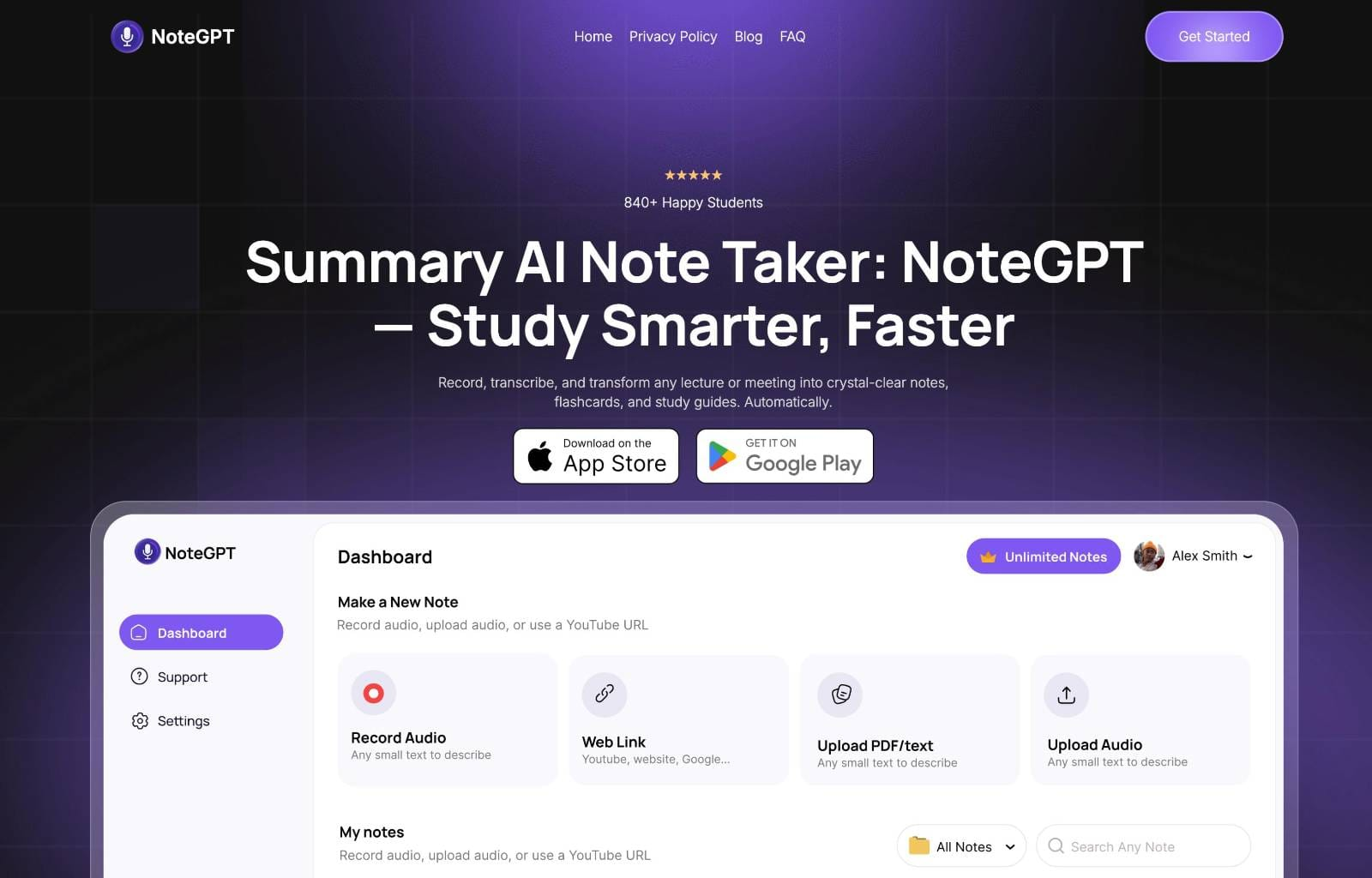
NoteGPT is an AI-powered note-taking application designed to help students, professionals, and learners automatically transform spoken content into structured, usable study materials. This tool serves as a comprehensive learning hub, capturing lectures, meetings, videos, and documents to generate accurate transcripts, concise summaries, and interactive study aids like flashcards and quizzes. Its core value lies in automating the tedious process of manual note-taking, allowing users to focus entirely on comprehension and engagement with the material rather than frantic transcription. By leveraging advanced artificial intelligence, NoteGPT acts as a personal assistant that never misses a detail, converting any audio or text source into an organized knowledge base that enhances learning efficiency and retention for academic and professional success.
The primary problem NoteGPT solves is the overwhelming challenge of keeping up with fast-paced lectures, complex meetings, or dense educational content while trying to manually document every key point. Students often struggle with professors who speak rapidly, international learners face barriers with non-native languages, and professionals juggling work and study lack time to review lengthy recordings. This leads to fragmented notes, missed information, and significant post-session time spent deciphering and rewriting content, which hampers understanding and exam preparation. NoteGPT directly addresses this pain by providing lightning-fast, accurate transcription that eliminates the scramble to write everything down, ensuring users capture complete information without distraction. The consequence is reduced cognitive load, improved focus during live sessions, and reclaimed hours previously lost to manual note organization, translating into better grades and more effective learning outcomes.
One of NoteGPT's major feature groups is its Record & Transcribe capability, which allows users to capture live audio from lectures or meetings with professional-grade accuracy. The system uses AI to deliver instant transcription, handling accents, technical terminology, and multiple speakers effectively, outperforming traditional note-taking methods. This works by simply hitting a record button within the app during a session, after which the audio is processed into a clean, editable text transcript. The utility lies in its reliability and speed, freeing users from the anxiety of missing information and providing a verbatim reference that can be reviewed, searched, and annotated later. This foundational feature ensures that every word is captured, forming the basis for all subsequent AI-powered enhancements like summaries and study tools, making it indispensable for environments where precision and completeness are critical.
admin
A second major feature group is the AI-Powered Summaries, which condense lengthy transcripts, videos, PDFs, or webpages into key points within seconds. This functionality analyzes the full content to extract central themes, crucial arguments, and essential facts, presenting them in a concise, readable format. Users can input material by uploading files, pasting URLs from platforms like YouTube, or using existing transcripts from recordings. The benefit is dramatic time savings, turning hours of review into minutes, and it enhances comprehension by highlighting what truly matters without the noise of redundant or peripheral information. For students, this means efficient exam preparation; for professionals, it enables quick briefing on meeting outcomes. The summaries are generated using sophisticated natural language processing, ensuring they are contextually accurate and tailored to the source material's specific educational or professional intent.
NoteGPT's third significant capability is its Smart Study Tools, which automatically generate interactive learning aids like flashcards and quizzes from the transcribed notes and summaries. This feature transforms passive transcripts into active recall exercises, reinforcing memory and understanding. The system identifies key concepts, definitions, and questions from the content to create structured study sets that users can employ for self-testing. Additionally, the platform supports Global Learning with transcription and study support for over 100 languages, allowing non-native speakers to learn in their preferred language or translate sections as needed. Integration extends to various content sources: users can transcribe audio files, YouTube videos, PDFs, and websites, making NoteGPT a versatile hub for all learning materials. This multi-format compatibility ensures that whether the source is a live lecture, an online tutorial, or a research paper, the tool can process it into unified, manageable study resources.
The overall workflow of NoteGPT follows a streamlined four-step methodology: record or upload, transcribe, generate, and review. Users first capture live audio via the app or upload existing audio files, video links, or PDF documents. The system then processes this input using AI to produce an accurate, editable transcript almost instantly. Next, leveraging the transcript, the AI creates tailored outputs such as summaries, flashcards, and quizzes, which are designed to highlight and test comprehension of key material. Finally, users review these materials within the app, export them as PDFs or text files for sharing, or use them for offline study. This end-to-end approach automates the entire note-taking and study preparation pipeline, reducing manual effort from hours to moments. The methodology emphasizes accessibility and flexibility, supporting both real-time recording and asynchronous processing of diverse media formats to accommodate different learning schedules and environments.
Concrete use cases demonstrate NoteGPT's practical impact: a university student recording a fast-paced biology lecture can focus on understanding concepts while the app transcribes every word, later generating flashcards that help secure an A- on exams. An international business student in Copenhagen uses it to transcribe English lectures, overcoming language barriers by reading transcripts at their own pace, leading to improved grades from barely passing to high marks. A working professional taking night classes records lectures on their phone and returns home to find transcripts and summaries already prepared, saving 3-4 hours of note-rewriting time. Content creators employ it to generate subtitles from videos, while language learners utilize multi-language support for transcription and translation. In each scenario, the outcome is enhanced comprehension, significant time savings, reduced stress, and measurable academic or professional improvement through organized, AI-enhanced study materials.
NoteGPT primarily targets students at universities, professionals managing meetings and continuing education, content creators needing subtitles, and language learners across the globe. It is trusted by students at leading institutions like MIT, UCLA, Purdue, and Monash. The platform is available on iOS and Android devices via app stores and through a web application, requiring an internet connection for core AI features but allowing offline access to saved notes. While specific pricing details are not enumerated, a free trial provides full access to unlimited transcription, AI summaries, flashcard generation, and multi-language support without a credit card. The tech stack employs enterprise-grade encryption to ensure data privacy, with user recordings and transcripts kept secure and never shared. In summary, NoteGPT delivers an all-in-one solution that transforms how individuals capture and internalize information, making learning and note-taking smarter, faster, and more effective across diverse contexts and needs.
NoteGPT is designed for university students at institutions like MIT, UCLA, and Purdue who need to keep up with lectures; professionals who require accurate meeting transcriptions and continuing education support; content creators producing subtitles for videos; and international or language learners who benefit from multi-language transcription and translation capabilities. It specifically serves individuals juggling academic and work commitments, such as MBA students working full-time, and Erasmus or international students overcoming language barriers in foreign educational systems.