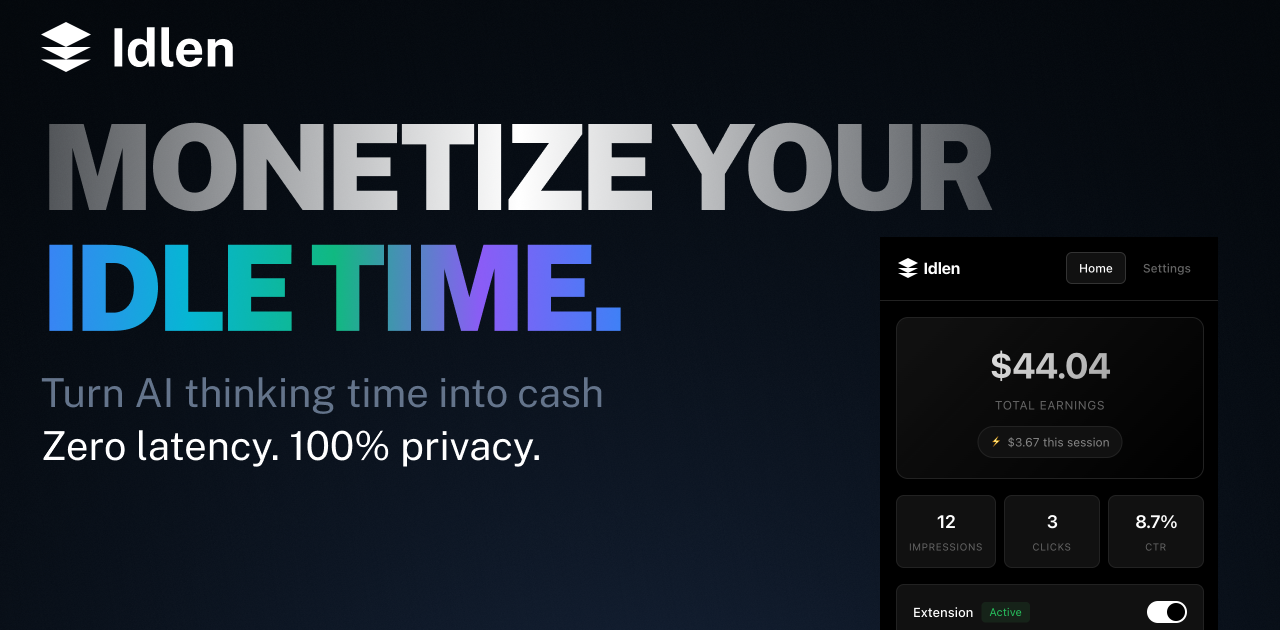
Idlen is an advertising network built around the idle time that appears while AI models are thinking. Its promise is short and direct: AI thinks, you earn. The product puts native developer-tool ads in three places — the IDE, the browser, and the chat app you shipped. Developers install the Idlen extension for VS Code, Cursor, or Chrome and see a native ad during the moments their AI assistant is processing a request, keeping 70% of the revenue. Advertisers use the same network to reach developers inside the tools they already use every day, targeted by the stack they actually work with, including React, Python, and AWS. AI app builders add three lines of code with npm i @idlen/chat-sdk to monetize their own chat products, and ads remain optional there: no key, no ads.
Developers spend a large part of their day waiting on AI. A prompt is sent, the model thinks, and the editor sits idle for a few seconds at a time. Idlen takes that observation literally: the wait is an ad slot. Instead of treating AI processing time as dead time, the network fills it with a native, relevant sponsor message — the demo shows a sponsored slot carrying Neon, described as serverless Postgres for modern apps. The reasoning behind the product is that the waiting is unavoidable: developers are already using Claude, ChatGPT, Cursor, and other AI tools, and they change nothing about their workflow. Idlen simply adds an ad during processing and pays the developer a share. At the same time, developer-tool companies struggle to reach this audience precisely, and AI app builders who ship chat products have usage but often no monetization. Idlen answers all three sides with one network and three doors.
The earning side of Idlen is built for individual developers first. The extension is described as earning €20-100 per month passively, without lifting a finger, and earnings go directly to the developer's account. Payouts are flexible: Stripe, PayPal, or a 10% bonus taken as credits. Idlen also supports teams through a shared earnings pool, so an entire group can collect the income generated by its members. An earnings calculator on the site lets developers model the result using their coding hours per day and a target subscription — ChatGPT Plus, Claude Pro, or v0 Premium — showing, for example, that four hours per day yields 150% coverage, making ChatGPT Plus free with surplus pocket money. The site notes these figures are based on average developer activity and ad inventory fill rates. Onboarding is presented as taking under two minutes.
Privacy is treated as a core feature rather than a footnote. Idlen states plainly that your code stays on your machine, and the privacy process is spelled out in three steps. First, no code access: the extension never reads, stores, or transmits your source code. Second, local analysis only: package.json is analyzed on your machine to determine ad relevance, and nothing leaves the device. Third, the ad request itself is anonymous — the illustrative code shows dependencies read locally, keywords matched from those dependencies, and then an anonymous fetch for an ad. The company also describes the extension code as transparent and auditable and available for security review. For developers, that means the monetization does not come at the cost of handing over a codebase or prompts; Idlen states that it does not read your prompts.
Idlen is designed to stay out of the way. Its zero-latency claim rests on timing: ads load during AI processing only, so they occupy time the developer is already waiting rather than adding delay to normal editing. It works everywhere in practice — VS Code, Chrome, and all the AI tools the developer already uses, with support listed for Claude, ChatGPT, V0, Bolt, Lovable, Cursor, Windsurf, and Replit, plus downloads for VS Code, Cursor, Open VSX, Chrome, and Firefox. On the advertising side, the network claims to avoid spam and clickbait, promising only curated developer tools, organized into categories such as Cloud & Hosting for deploying, scaling, and monitoring apps; Databases for modern databases; APIs & Services covering payment, email, and SMS; and Dev Tools for boosting productivity.
The core workflow is deliberately small. Step one: install the extension — add Idlen to VS Code or Chrome in one click, and it works with all your AI tools. Step two: use AI as usual — keep coding with Claude, ChatGPT, Cursor, or any other AI tool, with no workflow changes. Step three: earn passively — relevant dev tool ads appear during wait time and earnings go directly to your account. The site summarizes the whole journey as starting to earn in under 2 minutes. The demo interaction reinforces it: a user sends a message such as "Add proper error handling and improve the loading state," and the assistant thinks for three seconds; during that window a sponsored Idlen slot appears in the chat, and the panel reports earning tokens while you wait. Advertisers enter through a different door: they buy the slot and appear in the IDE and browser, targeted by the stack the developer actually uses. Publishers enter through a third door: they paste a message in the sandbox to preview which ad would serve, then run npm i @idlen/chat-sdk, three lines of code, and keep 70%.
The benefits differ by side but share one shape — value extracted from time that was previously wasted. For developers, the outcome is passive income on top of work they were already doing, with no change to workflow, zero tracking, and no exposure of code or prompts. Reported earnings of €20-100 per month can offset or fully cover an AI subscription, and the calculator turns that into a concrete target: pick your hours and your subscription and see the coverage percentage. Flexible payouts and a team pool make the income usable for individuals and groups alike. For advertisers, the benefit is placement inside the tools where developers spend their day, targeted by real stack signals rather than guesswork, with a welcome offer that doubles the first deposit: pay €200 and get €400 this week. For AI app builders, the benefit is monetization of an existing chat product with a very small integration surface — three lines — while keeping 70% and retaining the option to show no ads at all.
A few concrete workflows illustrate where Idlen is used. A developer using Cursor or VS Code spends a few seconds waiting for code generation; the Idlen extension fills that moment with a native, stack-relevant sponsor message and credits the earnings. A developer working in the browser with ChatGPT or Claude gets the same treatment through the Chrome or Firefox extension. An advertising team that sells a serverless database or a hosting platform buys slots and appears while developers are actively coding, matched against the technologies visible in that project. An AI app builder who shipped a chat product installs @idlen/chat-sdk, previews a message in the sandbox to see which ad would serve, and switches on monetization without managing keys. A team adopts the extension together and pools its earnings through the shared team pool. And a prospective advertiser tests the waters with the €200-to-€400 welcome offer before committing further spend.
Idlen is explicitly built for every side of the ecosystem it touches. The first group is AI users — developers who want passive income while using their favorite AI tools. The second is advertisers selling developer tools who want to appear in the IDE and browser, targeted by the stack developers actually use. The third is AI app builders and publishers who want to monetize an AI product with three lines of code. Integrations and downloads cover VS Code, Cursor, Open VSX, Chrome, and Firefox, with the network listed as working alongside Claude, ChatGPT, V0, Bolt, Lovable, Cursor, Windsurf, and Replit. Installing Idlen is free for developers, who keep 70% of earnings; the paid side of the marketplace is advertising, where the entry offer is €200 matched with €200 for €400 to spend this week. The site also highlights privacy first, zero latency, and cancel anytime as standing commitments.
Idlen's core proposition can be stated in one line: the seconds you spend waiting for AI are already being spent, so the network turns them into income for developers, distribution for developer-tool advertisers, and revenue for AI app builders. One network, three doors — install the extension, buy the slot, or try the sandbox.
Publisher
A
admin
Launch Date2026-09-16
Platformweb
Pricingfree