ClawMetry is an open-source real-time observability dashboard purpose-built for AI agents running on the OpenClaw runtime. It is designed for developers, engineers, and teams who build and deploy AI agents and need instant visibility into what those agents are actually doing. With over 477,000 installs across 126 countries, it supports a wide range of runtimes including OpenClaw, NVIDIA NemoClaw, NanoClaw, PicoClaw, Claude Code, Codex, Cursor, Aider, Goose, and Hermes. The core value proposition is eliminating the black box: instead of hoping agents are working correctly, users gain a live, glanceable view of every sub-agent, tool call, token cost, and session log. ClawMetry runs locally, requires no configuration, and is free under the MIT license, making it accessible to individual developers and large fleets alike.
AI developers face a critical blind spot: agents spawn sub-agents, burn tokens, call tools, and make decisions behind the scenes, but there is no built-in way to see what is happening in real time. Costs can spiral unnoticed when a single agent enters a loop or calls an expensive model repeatedly. Teams often only discover runaway expenses when the monthly invoice arrives. In production, a single misbehaving agent can burn through thousands of dollars in minutes, and without observability, the cause remains invisible until it is too late. ClawMetry solves this by surfacing every detail—token counts, cost per session, sub-agent spawn trees, and tool call logs—so users can catch problems the moment they start, not after the damage is done.
The live flow visualization shows the entire decision path an agent takes, step by step, in real time. When an agent spawns a sub-agent, the spawn tree appears instantly on the dashboard, displaying each sub-agent’s status, tool calls, token usage, and progress. This feature is critical for detecting runaway loops: the dashboard flags an agent that is looping with messages like 'codex looping, 38 tool calls, no progress' and alerts the user before costs blow the budget. Users can stop an errant agent in one tap from the dashboard, their phone, or the optional desk device, giving them immediate control over their AI fleet. The desk device, a $49 hardware companion, provides a dedicated glanceable screen for the entire agent fleet, making it easy to monitor even without opening a browser.
ClawMetry provides granular token cost tracking across every dimension: per agent, per session, per model, and per tool. The dashboard displays tokens in, tokens out, cache hits, response times, and cost per call—all updated as agents run. Teams can see exactly which agent is spending the most, which model is the most expensive, and which tool calls are driving up costs. This level of detail lets users optimize their agent workflows without changing models: for example, a user might discover one agent is using three times more tokens than necessary and adjust its prompt or tool usage accordingly, cutting the AI bill significantly. The cost tracking also helps with budgeting and forecasting, as users can set alerts for when a session exceeds a predefined cost threshold.
admin
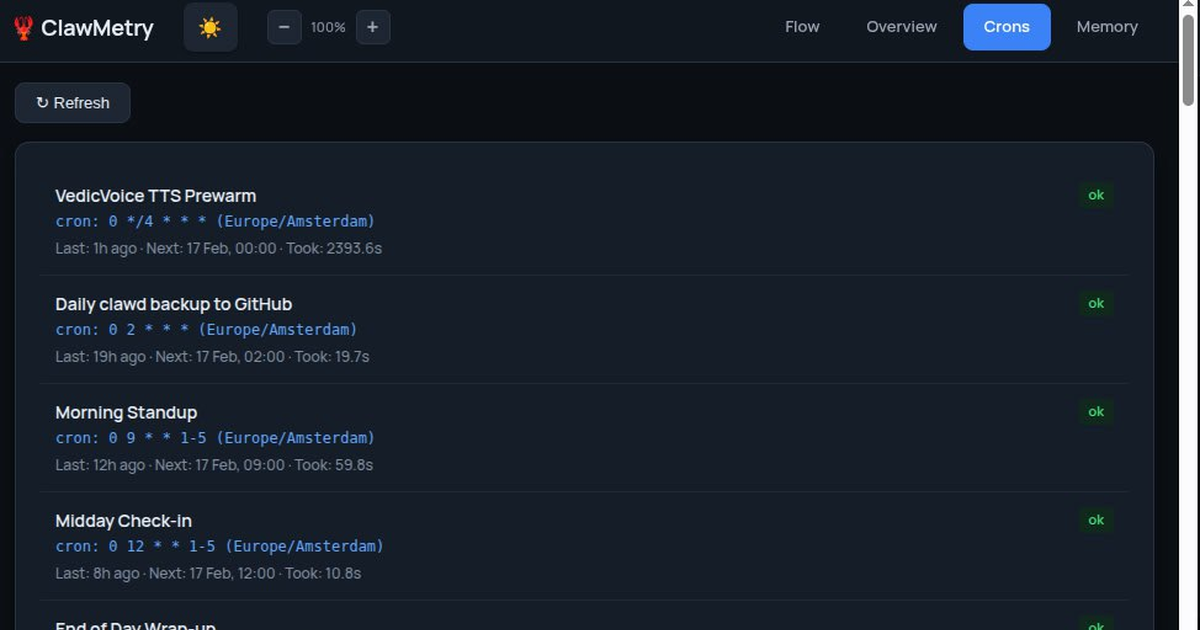
Beyond token costs, ClawMetry monitors cron jobs, memory file changes, and session history. The cron job panel shows job status, history, and any failures, so users know about a failure before their customers do. Memory file changes—such as updates to SOUL.md, MEMORY.md, and AGENTS.md—are tracked and displayed, giving insight into how an agent’s long-term memory evolves over time. Every session is logged with a full timeline of tool calls and cost, enabling teams to audit what an agent did last Tuesday. These features together provide a comprehensive record of agent behavior, essential for debugging, compliance, and performance analysis. Additionally, the platform tracks channel activity and real-time tool call traces, giving a complete picture of agent operations.
ClawMetry installs in under 30 seconds with a single command: pip install clawmetry then clawmetry. It auto-detects the OpenClaw workspace and starts monitoring immediately—no configuration files or setup required. The dashboard runs locally on the user’s machine, ensuring all data stays private and no transcripts leave the network. For users who want remote access, an optional ClawMetry Cloud relay provides end-to-end encrypted syncing of agent conversations and summary data. The tool is OpenTelemetry-native, meaning it can stream traces to Datadog, Grafana, Honeycomb, or any OTLP-compatible collector, ensuring no vendor lock-in. This local-first design combined with optional cloud sync gives users flexibility while maintaining control over their data. The installation also supports macOS, Windows (via WSL), Linux, and even Raspberry Pi.
Developers debugging a stuck agent can open the dashboard and see the exact tool call that failed, the agent’s current channel activity, and the memory state it is operating on, allowing them to diagnose and fix the issue in seconds. A startup running a fleet of OpenClaw agents can set budget alerts and receive pages when any agent crosses a cost threshold, preventing unexpected monthly bills. Teams using NVIDIA NemoClaw integration can enforce enterprise governance policies while monitoring agent behavior in real time. Users have reported that cost tracking alone helped them identify a single agent using three times the necessary tokens, leading to immediate optimization and savings. The desk device provides a physical, glanceable display of agent health for those who prefer a hardware companion, and the companion macOS menubar app offers quick access to the dashboard.
ClawMetry is built for developers, AI engineers, and teams working with OpenClaw and its ecosystem, including NVIDIA NemoClaw, NanoClaw, PicoClaw, Claude Code, Codex, Cursor, Aider, Goose, and more. It runs on Linux, macOS, Windows (via WSL), Raspberry Pi, and ARM devices, requiring Python 3.8+ and an active OpenClaw installation. The core product is free and open-source under the MIT license. For teams with 10+ nodes, ClawMetry offers managed deployment, volume pricing, a 99.9% uptime SLA, and direct founder support. The optional desk device costs $49. In summary, ClawMetry transforms the opaque world of AI agent execution into a transparent, controllable, and cost-aware environment, giving builders the confidence that their agents are working exactly as intended. It has been starred by engineers from OpenAI, Google, PostHog, and others, and achieved #5 on Product Hunt on launch day.
ClawMetry is built for developers, AI engineers, and technical teams who build and deploy AI agents using OpenClaw and its ecosystem, including NVIDIA NemoClaw, NanoClaw, PicoClaw, Claude Code, Codex, Cursor, Aider, Goose, and Hermes. It is also ideal for startups and enterprises managing production agent fleets who need real-time cost visibility, governance, and debugging tools. Compliance and ops teams benefit from the on-device audit trails and local-first privacy model. Individuals who value open-source, local-first software with optional cloud capabilities will find ClawMetry particularly useful.