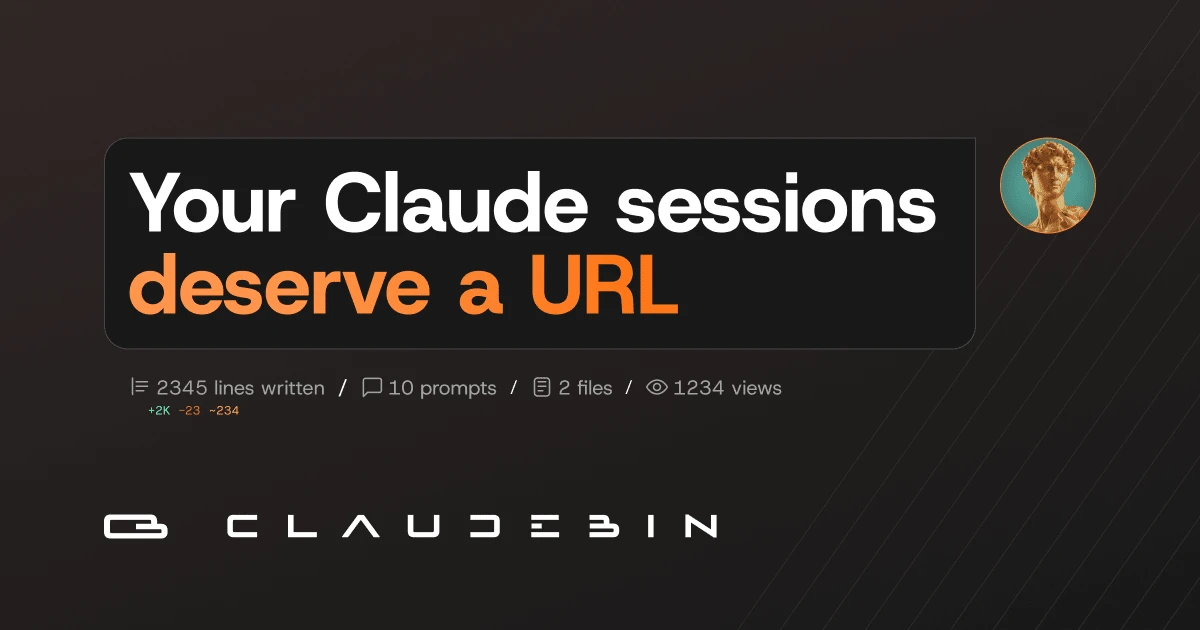
Claudebin is a free and open-source tool that converts ephemeral Claude Code sessions into persistent, shareable, embeddable, and continuable artifacts. It is purpose-built for the growing community of developers who use Claude Code for AI-assisted software development. The product's primary value proposition is giving every session a unique URL, making it possible to revisit, share, or continue interactions long after the original terminal session ends. By capturing not only the message thread but also file operations, bash commands, and web or MCP calls, Claudebin preserves the full context of a coding session. This turns isolated AI conversations into reusable, collaborative resources that teams can reference, discuss, and build upon.
The core problem Claudebin solves is the ephemeral nature of Claude Code sessions. Without it, a developer's conversation with Claude is lost once the terminal closes—no history, no way to share insights, and no mechanism to continue work from a previous point. This becomes especially problematic in team environments where multiple developers need to understand or iterate on AI-generated code. Important decisions, debugging steps, and architecture discussions vanish into the ether. Claudebin addresses this by providing a permanent URL that captures every aspect of the session. Users can bookmark, share, or embed these artifacts, ensuring that valuable AI interactions remain accessible and actionable. This transforms one-off coding assistance into a durable knowledge base that enhances productivity and collaboration.
The first major feature group is comprehensive session capture. Claudebin records the full message thread between the user and Claude Code, including all prompts and responses. It also logs file operations—every creation, modification, or deletion—along with the exact bash commands executed during the session. Additionally, it captures web and MCP (Model Context Protocol) calls, providing a complete audit trail of how Claude interacted with external tools and resources. This depth of capture is useful because it allows developers to review the exact steps taken, understand the context behind code changes, and reproduce results reliably. For debugging or educational purposes, having the full command history and tool interactions is invaluable, as it reveals the reasoning behind Claude's outputs. This feature makes each artifact a self-contained record of a problem-solving workflow.
The second major feature group is one-click sharing and embeddability. With a single click, users can generate a public URL for any Claude Code session. This URL can be shared with colleagues, embedded in documentation pages, or posted on collaborative platforms like GitHub issues or project wikis. The embed capability allows developers to include interactive session replays directly in web pages, making it easy to demonstrate AI-assisted development techniques or share complex problem-solving journeys. The integration with the Claude plugin marketplace streamlines installation—a simple command adds Claudebin to the developer's environment. This frictionless sharing transforms Claude sessions from private terminal interactions into team-wide resources that can be referenced, reviewed, and built upon without requiring recipients to have access to the original Claude instance.
admin
Continuability is another key feature explicitly mentioned. Unlike static logs, Claudebin artifacts can be continued—meaning another user can pick up the session from where it left off. This enables collaborative workflows where one developer starts a conversation with Claude, shares the URL, and a colleague continues the interaction, adding new requirements or modifying the trajectory. The feature supports iterative development processes and pair programming across time zones. Additionally, Claudebin is open-source and hosted on GitHub, inviting community contributions and customizations. The project, developed by wunderlabs-dev, encourages transparency and extensibility. Featured threads on the Claudebin website showcase handpicked conversations that demonstrate the tool's capabilities across diverse projects, such as building apps, implementing GPU inference, and designing landing pages.
Overall, Claudebin operates as a lightweight plugin that integrates directly into the Claude Code workflow. Installation is achieved via the Claude plugin marketplace: the command "claude plugin marketplace add wunderlabs-dev/claudebin && claude plugin install claudebin@claudebin-marketplace" sets it up in seconds. Once installed, a "Share session" button appears, allowing users to capture and save the current session with one click. The tool then generates a unique URL pointing to a hosted artifact on claudebin.com. This artifact is automatically updated as the session progresses, ensuring that the shared link always reflects the latest state. Users can browse featured threads on the platform to see examples of how others have used the tool, and they can manage their own shared sessions. The entire workflow is designed for minimal friction—capture, share, and continue.
Concrete use cases range from individual learning to team collaboration. For instance, a developer building a blockchain stats web app can capture a 86-message session with 5 file operations and share it with a teammate who needs to understand the thought process behind the architecture. An educator might share a 51-message session on building a Next.js bookstore app to demonstrate best practices. A team debugging GPU inference can preserve a 155-message thread as a reference. The outcomes include faster onboarding, fewer misunderstandings, and the ability to revisit decisions weeks later. Teams save time by not repeating the same prompt engineering and debugging steps, as shared artifacts serve as a living documentation of AI-assisted work. This turns ephemeral chats into a reusable knowledge repository.
The primary target users are developers already using Claude Code for AI-assisted programming—from solo developers to enterprise teams. It is especially valuable for those who rely on Claude for complex tasks like code generation, refactoring, debugging, and architectural planning. The tool is open-source and free, lowering the barrier to adoption. It runs on any platform where Claude Code is available, likely Linux, macOS, or Windows via terminal. The tech stack behind Claudebin includes Next.js (as implied by the website's image path), and it is hosted on claudebin.com. The project is actively developed on GitHub under wunderlabs-dev. In summary, Claudebin addresses a critical gap in the Claude Code ecosystem by making sessions persistent, shareable, and collaborative, thereby enhancing productivity and knowledge sharing among AI-augmented developers.
Claudebin is designed for developers who use Claude Code for AI-assisted programming, including solo developers, engineering teams, open-source contributors, technical educators, and anyone who wants to persist, share, and collaborate on Claude Code sessions. It benefits teams working on collaborative AI coding projects, educators demonstrating AI-assisted workflows, and professionals documenting AI interactions for future reference.