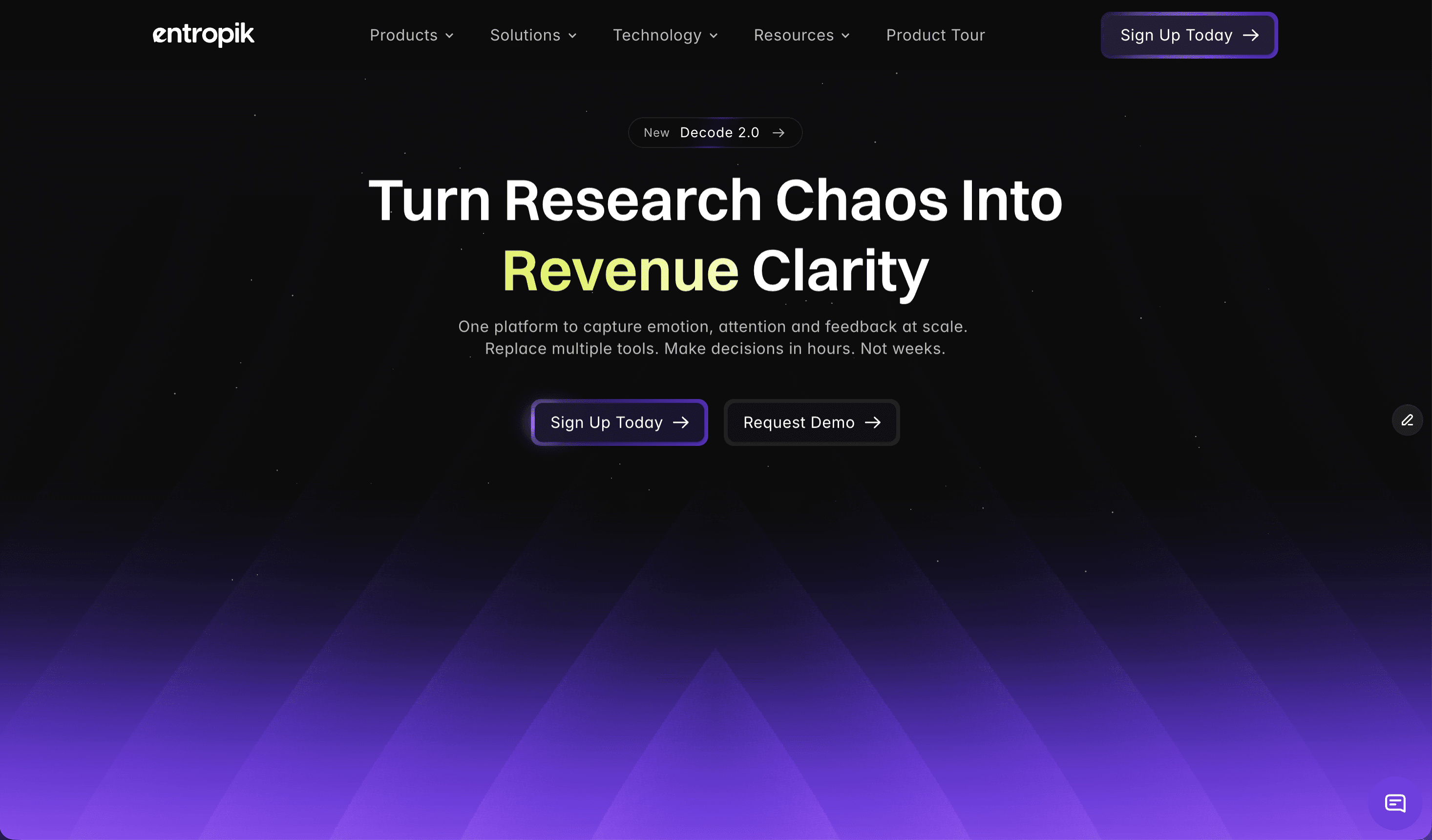
AI Creative Insights by Decode is a predictive creative testing platform built by Entropik, the team behind Decode. It allows teams to upload any ad, banner, out-of-home (OOH) unit, or video creative and predict how people will respond before the media budget goes live. Using Neuro AI, the platform predicts attention, emotion, and conversion impact, helping teams see which creative wins before they commit spend. Its stated promise is direct: predict creative winners before you spend. The platform is aimed at the people who build, test, and approve creative work, including marketing teams, advertising teams, research teams, product teams, and UX/design teams, all of whom need evidence rather than opinion when deciding which asset to launch.
The problem the product addresses is spelled out on the site as a set of broken practices. Creative evaluation today is subjective and inconsistent, slow and difficult to scale, and it leads to inefficient media spend, limited insight depth, and difficulty comparing one creative against another. Decode counters each of those gaps directly: AI-led predictive creative evaluation replaces subjective judgement, instant AI-powered analysis replaces slow manual processes at scale, creatives are optimized before launch instead of after, creative performance scoring adds depth where insight was thin, and benchmarking against category norms makes comparison possible. The argument is that creatives should not be a gamble, and that data should lead the decision.
Predictive Attention AI is the first of the four headline capabilities. It compares creatives and predicts attention, recall, and resonance before launch, so teams can test variations, forecast performance, benchmark against a category, and get second-by-second clarity on how an asset behaves. The purpose is to choose the version that drives maximum impact rather than the version that simply looks best in a review meeting. Because predictions are generated before media goes live, the decision point moves earlier in the process, when changes are still cheap and fast to make.
Emotion Simulation is the second capability and focuses on how people actually feel while watching a creative. The platform visualizes emotional highs and lows second by second and uncovers what triggers engagement or drop-offs at specific moments. Teams can measure emotional response, track emotion flow, check brand safety, and connect emotion to intent. This matters because two creatives can hold attention equally yet produce very different feelings, and those feelings are what shape whether an audience stays engaged, remembers the brand, or acts. By mapping emotion across the timeline of an asset, teams can pinpoint exactly which seconds help or hurt the story.
Visual Hierarchy Heatmaps are the third capability. They show where people look first and what catches or loses attention, allowing teams to optimize layouts, storytelling, and branding with evidence instead of assumptions. The stated outcomes include seeing where people look, ensuring message visibility, removing distractions, and comparing layouts against one another. For designers and creative directors, this turns subjective layout debates into concrete questions about which element earns the first fixation and which elements compete with the message.
Prescriptive AI Suggestions complete the core set. Rather than only reporting scores, the platform provides actionable recommendations that tell teams exactly how to improve performance, explaining what to change, why it matters, and what impact it will drive. Teams can use these suggestions to get improvement recommendations, understand why performance changes, prioritize high impact changes, and build clearer briefs. This converts diagnostic data into a to-do list for the creative team, which is what makes the workflow from insight to revised asset practical.
Synthetic Audience extends evaluation to specific groups of people. Teams build reusable synthetic audiences and apply them across every AI Creative Insights evaluation, then compare predictions persona by persona before spending on media. The page illustrates audience options such as Gen Z Shopper, Urban Professional, Family Buyer, and Value Buyer, each returning a predicted score along with attention, clarity, and CTA focus ratings. Scores are banded as strong fit (75+), moderate fit (55–74), or weak fit (below 55), giving an at-a-glance signal for whether a creative suits a given audience.
Beneath these capabilities sits the intelligence layer. The site names Facial Expression Analysis, Eye Gaze Tracking, and Voice Emotion Analysis as the underlying technologies, describing the ability to capture real behavior and emotion, synthesize answers in minutes, and guide decisions with audit-ready proof. Deeper creative intelligence is organized into three groups. Attention Metrics track where users look first, how long they stay, and the journey their eyes follow, covering first fixation, attention duration, and visual path and retention. Engagement and Comprehension measures emotional impact, message clarity, and how well a creative drives brand recall and purchase intent, through emotion mapping, message clarity assessment, and brand recall and purchase intent measurement. Comparative Intelligence benchmarks performance against competitors, audiences, and past campaigns using industry and competitor benchmarking, channel and demographic comparisons, and historical trends and performance insights.
The workflow is described as running from upload to uplift. Teams drop in assets of any format, let the AI analyze them, make the recommended fixes, and validate results, launching only high performers. Reviewing a creative in the dashboard surfaces metrics such as Attention, Clarity, and Time to Discover, alongside sub-metrics for title and visual elements, so a reviewer can see both an overall verdict and the specific components driving it.
Entropik reports measurable uplift for brands using Decode: 95% predictive attention accuracy, 32% testing cost reduction, 4X faster research timelines, and 40% CTR improvement. The platform is described as being used by more than 150 forward-thinking brands, and the page notes that Entropik helps top companies understand what customers truly feel, do, and expect at scale. Testimonials on the site describe data-driven design decisions, uncovering emotional responses to packaging through facial coding, precise behavioral insight from eye-tracking and AOI metrics, pack design changes made from platform recommendations, and supportive onboarding from the team.
The site names several concrete use cases. AD Testing is positioned as testing ads before they go live to maximize performance with AI. Banner Testing focuses on making every banner ad impossible to ignore. OOH Testing aims to maximize out-of-home advertising impact. Creative Testing is described as transforming creative development with AI-powered testing. AI Creative Recommendations lets AI guide creative excellence by generating improvement guidance for teams. Published success stories include a global fast-food brand that reduced media research timelines by 4X, a global beverage company that used AI moderator-led qualitative research for ready-to-drink beverage experience optimization, and a UK-based financial institution that optimized its digital onboarding experience using Decode by Entropik.
Industries listed for Entropik's solutions include CPG, technology and software, healthcare and pharma, financial services, and retail and e-commerce, with dedicated offerings for research, marketing, product, and UX/design teams. Pricing is not published on this page. Visitors are invited to try AI Creative Insights, request a demo, or sign up today, and a demo request form collects name, business email, contact number, LinkedIn URL, and company on the stated basis that Entropik will store and process personal data under its privacy policy.
The overall takeaway is straightforward: AI Creative Insights by Decode replaces subjective, slow, and hard-to-scale creative judgment with fast, consistent, AI-led prediction of attention, emotion, and conversion impact. By combining predictive attention scoring, second-by-second emotion simulation, visual hierarchy heatmaps, prescriptive suggestions, and persona-level synthetic audiences, it lets teams decide which ad wins before the media budget goes live.
Publisher
A
admin
Launch Date2026-09-22
Platformweb
Pricingfree
Traffic Insights
Month2026-09
Estimated Visits51.2K
MoM Visits GrowthN/A
Avg Time on Site-
MoM Time GrowthN/A
Global Rank#3,953,388
Bounce Rate-
Updated 2026-09-22